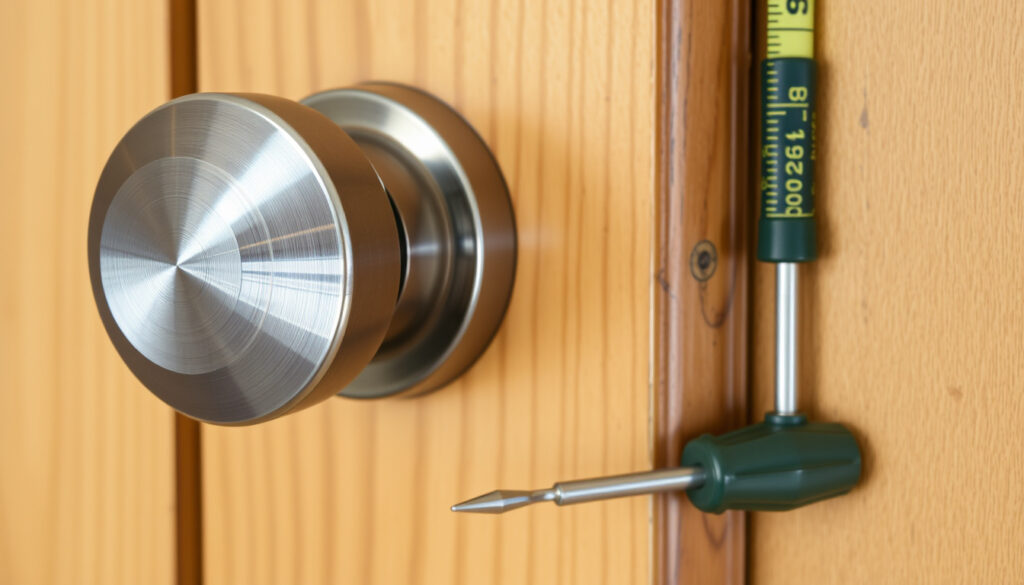
Door Knob: Complete Guide to Spelling, Sizes, and Replacement
Anyone who’s tried to pick up a new door knob at a hardware store already knows: the options are endless, and the measurements matter more than they appear, because behind that simple round shape lie different backsets, bore holes, and regional standards that can make or break your installation. This guide sorts through the noise, giving you the concrete details you need to measure, choose, and fit a door knob with confidence.
Standard bore hole diameter: 2 1/8 inches ·
Standard backset: 2 3/8 inches ·
Typical interior door thickness: 1 3/8 inches ·
Most common residential door knob type: Passage knob
Quick snapshot
- Standard bore hole diameter is 2 1/8 inches (Lowe’s home improvement)
- Standard backsets are 2 3/8 or 2 3/4 inches (Lowe’s home improvement)
- Exact origin of slang term “door knob” for a person unclear (Rocky Mountain Hardware)
- ANSI/BHMA standards have defined door hardware dimensions for decades (Rocky Mountain Hardware)
- Most residential doors use latch backsets around 2 3/8 inches or 2 3/4 inches, though some manufacturers offer adjustable options (wikiHow)
- Whether Irish Part M requirements will eventually mandate a standard door knob type (KCC Group)
- Measure your door’s backset and bore hole before buying a replacement (Rocky Mountain Hardware)
Five key specs define whether a door knob will fit your door—here’s how they stack up across common standards.
| Spec | US Standard | UK / Irish Standard |
|---|---|---|
| Backset | 2 3/8 or 2 3/4 inches | 44 mm or 57 mm (commonly) |
| Bore hole diameter | 2 1/8 inches | 54 mm (approx.) |
| Spindle size | 5/16 inch square | 8 mm square |
| Door thickness | 1 3/8 inches (interior) | 35–45 mm |
| Drive-in latch vs. mortise | Drive-in common | Mortise common |
The implication: if you’re buying hardware for an Irish door, metric dimensions are the norm, and American 2 3/8-inch backset knobs won’t fit without adapters.
Four common door knob types, one pattern: function dictates form, and each type has a specific use case.
| Type | Function | Door Thickness | Backset |
|---|---|---|---|
| Passage | No lock, free-turning | 1 3/8″ | 2 3/8″ or 2 3/4″ |
| Privacy | Lockable from inside (push/turn) | 1 3/8″ | 2 3/8″ or 2 3/4″ |
| Keyed Entry | Key-operated from outside | 1 3/8″–1 3/4″ | 2 3/8″ or 2 3/4″ |
| Dummy | Decorative, no latch | N/A | N/A |
The takeaway: matching the knob type to door function is step one, but thickness and backset are the real compatibility deciders.
What is a door knob called?
Common names for door knobs
- Door knob – the most common term in the US, referring to the round grasping piece.
- Door handle – often used interchangeably in the UK and Ireland, especially for lever-style hardware.
- Doorknob – the single-word spelling accepted by many dictionaries.
- In trade contexts, “door knob” specifically describes the round grasping piece (Rocky Mountain Hardware).
Regional terminology differences
- Americans predominantly say “door knob” or “door handle” for round pieces; “door knob” is more specific.
- British and Irish speakers commonly use “door handle” for both knobs and levers.
- In Australia and New Zealand, “door knob” is standard.
- The slang “door knob” (meaning a foolish person) is understood in English-speaking countries, though its origin is unclear.
Why this matters: if you’re searching for replacement hardware online, using the right term for your region ensures you find compatible products. A US “door knob” might not match a UK “door handle” listing.
Is it door knob or doorknob?
Accepted spellings in dictionaries
- Merriam-Webster lists “doorknob” as the primary entry, with “door knob” as an alternative (Merriam-Webster Dictionary).
- Oxford Dictionary also accepts both forms, though “doorknob” is more common in British English.
- Cambridge Dictionary records “door knob” and “doorknob” as interchangeable.
Usage trends in American vs British English
- Google Ngram data shows “doorknob” (one word) has been more frequent in American English since the 1950s.
- British English uses “door knob” (two words) more often, though “doorknob” is also recognised.
- Both spellings are correct; the choice is largely stylistic. For SEO and clarity, use “door knob” in article text and “doorknob” in dictionary contexts.
The pattern: no single spelling is “wrong,” but using the form common in your target audience (e.g., “door knob” for an Irish audience) helps with search and readability.
Can any door knob fit on any door?
Bore hole and backset standards
- Bore hole diameter is almost always 2 1/8 inches for standard US installations (Lowe’s).
- Backset – the distance from the door edge to the centre of the bore hole – is typically 2 3/8 or 2 3/4 inches in the US (Lowe’s).
- UK and Irish hardware often use metric backsets of 44 mm or 57 mm (Brass-Works UK door hardware specialist).
Door thickness requirements
- Interior doors are typically 1 3/8 inches thick; exterior doors are 1 3/4 inches.
- Latch length must match door thickness – too long and it doesn’t engage, too short and it falls out.
Latch and strike plate compatibility
- Latch faceplates come in round (drive-in) or rectangular (mortise) styles. Most US knobs use drive-in latches; UK/Irish knobs often require mortise faceplates.
- Strike plate size must align with the latch bolt – universal plates exist, but check the backset first.
- The bottom line: door knobs are not universal. Always measure before buying.
The implication: without matching these dimensions, you risk buying hardware that won’t fit your door.
How to tell door knob size?
Measuring backset
- Measure from the edge of the door to the centre of the bore hole or handle point (Lowe’s).
- Common measurements: 2 3/8″ (60 mm), 2 3/4″ (70 mm), 44 mm, 57 mm.
Measuring bore hole diameter
- Use a ruler or callipers across the hole from edge to edge.
- Standard: 2 1/8 inches (54 mm) (Lowe’s).
Determining door thickness
- Measure the edge of the door (not the frame).
- Interior: 1 3/8″. Exterior: 1 3/4″.
- If you live in Ireland, check in metric: typical interior doors are 35–45 mm thick.
The catch: getting these three numbers right is the only way to avoid buying a knob that won’t fit – it’s a 5-minute job that saves hours of returns.
Can I replace a doorknob myself?
Tools needed
- Phillips-head screwdriver
- Tape measure (ruler)
- Optional: pencil, level
Step-by-step replacement
- Remove old knob: Unscrew the screws on the interior plate. Pull the two knob halves apart. Remove the latch assembly from the door edge.
- Measure and confirm: Verify backset and bore hole size match the new knob. If they don’t, you’ll need a different knob or a universal backset adapter.
- Install new latch: Insert the latch into the door edge, making sure the bevel faces the door’s closing direction. Screw the faceplate flush.
- Attach knobs: Insert the spindle through the latch mechanism. Line up the interior and exterior knob halves and screw together. Tighten until snug (not over-tight).
- Adjust strike plate: Close the door and check alignment. If the latch doesn’t catch, file or reposition the strike plate slightly.
Common pitfalls
- Buying a knob with the wrong backset – most online returns are due to this (Suffolk Latch Company).
- Forgetting to check spindle size – US knobs use 5/16″ square; UK handles use 8 mm square (Brass-Works UK door hardware specialist).
- Not tightening screws enough – loose knobs wobble and wear out fast.
A DIY replacement takes about 20 minutes with a screwdriver. Getting the measurements wrong means buying a second knob – or calling a locksmith. Measure twice, buy once.
The catch: even a careful DIYer can miss a spindle-size mismatch. Double-check before you start.
Clarity overview
Confirmed facts
- Standard bore hole diameter: 2 1/8 inches
- Standard backsets: 2 3/8 or 2 3/4 inches (US); 44 mm or 57 mm (UK/Ireland)
- Both “door knob” and “doorknob” are acceptable spellings (Merriam-Webster Dictionary)
What’s unclear
- Exact origin of the slang term “door knob” for a person
- Whether Irish Part M requirements will eventually mandate a standard door knob type (KCC Group)
The standard backset for many UK and Irish-style mortice locks is commonly 44mm or 57mm, not the US imperial pair.
Both ‘door knob’ and ‘doorknob’ are accepted spellings. Merriam-Webster lists ‘doorknob’ as a single word.
The takeaway: on spelling, dictionaries agree both forms are fine. On sizing, the cross-Atlantic gap is real – don’t assume a US knob works on an Irish door without checking the backset and spindle.
Related reading: Compare Health Insurance Ireland · De Facto: Definition, Examples, and Irish Immigration Guide
learn.reeb.com, thekccgroup.com, dkhardware.com, more4doors.com, youtube.com, facebook.com
For a detailed look at spelling variations and fitting styles, check out this comprehensive door knob guide from an Australian perspective.
Frequently asked questions
What is door knob slang for?
In informal slang, “door knob” can refer to a person who is considered simple-minded or foolish. The exact origin is unclear, but it has been used since at least the mid-20th century.
Do door knobs come in standard sizes?
Yes, but there are multiple standards. In the US, backsets are 2 3/8 or 2 3/4 inches. In the UK and Ireland, metric backsets of 44 mm and 57 mm are common. Always measure your existing hardware.
How do you remove a stuck door knob?
If the knob won’t turn, try spraying lubricant into the keyhole or around the spindle. If it’s physically jammed, remove the screws on the interior plate and pull the knob apart. A rubber band around the knob can give you extra grip.
What is the difference between a door knob and a door handle?
A door knob is round and requires a twisting motion; a door handle (lever) is a horizontal bar that you push down. Knobs are more common in older homes; handles are easier to operate and are often required for accessibility (Part M in Ireland).
Can you install a door knob without a latch?
Yes, a dummy door knob has no latch and is purely decorative. It’s used on double doors for the inactive leaf. Functional passage, privacy, and keyed knobs all require a latch mechanism.
What is a privacy door knob?
A privacy door knob has a locking mechanism operated from the inside (push button or turn). It’s used for bathrooms and bedrooms. The lock includes an emergency release on the exterior (often a small hole for a pin or coin).
How to fix a loose door knob?
Tighten the screws on the interior plate. If the knob still wobbles, the latch spindle may be too short or the backplate may be stripped. Replace the knob or add a spacer.
Are door knobs universal across countries?
No. Bore hole diameters, backsets, spindle sizes, and even latch styles differ between US (imperial) and UK/Irish (metric) markets. Always check the measurement system used in your country before ordering online.
For Irish homeowners tackling a replacement, the final check is simple: measure backset and bore hole in millimetres, confirm door thickness, and choose a knob tested to UK/Irish standards. The right fit means no wobble, no returns, and a door that closes just the way it should.
More related posts
 Imane Khelif Gender Test Controversy: Facts & Science
 Debbie Reynolds: Age at Death, Net Worth, Family & Last Words
 Ayatollah Khomeini: Revolution, Women’s Rights, and Legacy
 Ni-Ki ENHYPEN Profile: Age, Real Name, Languages & Facts
 Metallic Taste in Mouth: Causes, When to Worry & How to Fix It
 Gia MAFS 2026: Pregnancy, New Partner, and Job Loss
 Shark Tank: Richest Sharks, Top Products & Biggest Flops
 Wiz Khalifa Biography: Net Worth, Family, and Snoop Dogg Ties
