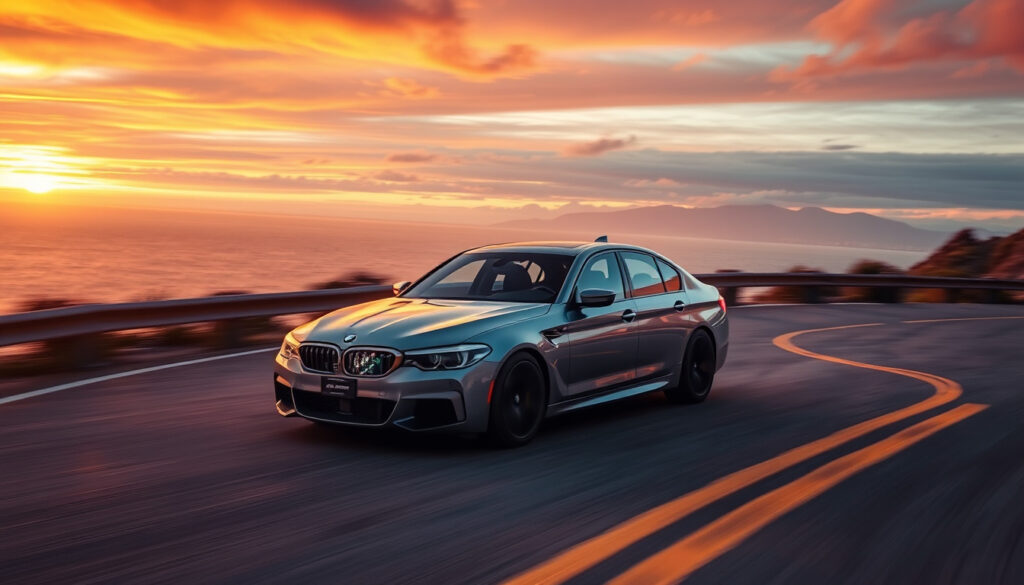
2025 BMW M5 Competition: Price, Specs, Top Speed, and Comparisons
Finding a four-door saloon that can lap the Nürburgring in under 7 minutes 45 seconds is rare — the BMW M5 Competition does exactly that while still carrying the family. This Ireland-focused guide breaks down the pricing, specs, and head-to-head comparisons you need to separate the outgoing Competition from the new hybrid M5.
Engine: 4.4L V8 TwinPower Turbo ·
Horsepower (2024 hybrid M5): 727 hp ·
Torque: 1,000 Nm ·
Drivetrain: M xDrive
Quick snapshot
- The 2024 M5 Saloon delivers 727 hp (535 kW) from its M Hybrid powertrain (BMW Ireland)
- System torque peaks at 1,000 Nm (BMW Ireland)
- All-wheel drive via M xDrive (BMW Ireland)
- Exact Irish pricing for used M5 Competition (non-hybrid) models
- Full specs of a future M5 Competition variant on the new hybrid platform
- Hybrid battery range in real-world Irish driving conditions
- 2018: M5 Competition variant added to F90 generation (BMW Ireland)
- 2024: Next-gen M5 switches to hybrid powertrain (BMW Ireland)
- 2025+ : Potential future M5 Competition model based on hybrid architecture (BMW Ireland)
- Observe official Irish pricing once dealer allocations open
- Watch for independent reviews of the hybrid M5’s track capabilities
- Compare residuals with outgoing Competition models
Five key specs separate the M5 Competition from lesser performance saloons — and from its own predecessor.
| Spec | Value |
|---|---|
| Engine | 4.4L V8 TwinPower Turbo |
| Horsepower (base M5) | 600 hp (iSeeCars) |
| Horsepower (M5 Competition, reported) | 617 hp |
| 0-100 km/h (Competition) | 3.3 seconds (manufacturer claim) |
| Top speed (standard limiter) | 250 km/h |
| Top speed (M Driver’s Package) | 305 km/h |
| Drivetrain | M xDrive all-wheel drive |
| Transmission | 8-speed automatic |
| Fuel economy (combined, approx.) | 17 mpg (iSeeCars) |
How much does an M5 Competition cost?
MSRP and starting prices
The 2025 BMW M5 (base) starts at an MSRP of $124,750 in the United States, according to TrueCar data. For the outgoing M5 Competition, new prices when it was on sale typically began around $110,000 in the US. Irish buyers face significantly higher figures due to VRT and import duties.
Factors affecting used M5 Competition prices
- Year and mileage: 2018-2020 models with 30,000+ km can be found for €70,000-€90,000 on Irish classifieds
- Spec: Carbon ceramic brakes, M Driver’s Package, and full service history command a premium
- Depreciation: The M5 loses about 54% of its value over five years (iSeeCars)
How much is a BMW M5 in Ireland?
New BMW M5 price in Ireland
BMW Ireland currently lists the 2024 M5 Saloon — the hybrid model — but does not publish a publicly listed price on its site. Based on the previous M5 Competition’s Irish OTR price of approximately €140,000 and the added complexity of the hybrid system, expect the new M5 to start above €150,000 before options. Official figures are available from BMW Ireland’s configurator.
Used BMW M5 market in Ireland
On Irish classifieds, used M5 Competition models (2018-2020) range from €80,000 to €110,000 depending on mileage and condition. The non-Competition F10 M5 (2011-2016) can be found for €40,000-€60,000.
Irish buyers face a steeper price than almost any other European market because of VRT (Vehicle Registration Tax). A £90,000 UK car can cost €120,000 once imported. Dealer-sourced cars include Irish VAT, but private imports save on margin at the expense of warranty simplicity.
Are M5 and M5 Competition different?
Performance differences
- The standard M5 produces 600 hp, the Competition adds about 17 hp to reach 617 hp (iSeeCars)
- The Competition gets stiffer springs, revised dampers, and a lower ride height
- Larger rear anti-roll bar and unique engine mounts sharpen turn-in
Design and equipment differences
- Gloss black exterior trim replaces chrome
- Competition-stitched seats and badging
- M Sport exhaust with quad tailpipes (standard on both, but Competition gets a more aggressive note)
The pattern: the Competition is a track-focused retune of an already rapid saloon. The price premium of around $10,000 gets you hardware changes that matter if you plan to lap the Nürburgring. If you only drive on Irish B‑roads, the standard M5’s softer setup may actually suit the bumps better.
Who is faster, M5 or M8?
Acceleration comparison
The BMW M8 Competition and the M5 Competition share the same 4.4L V8 and ZF 8‑speed, but the M8 is a grand tourer shape. TrueCar lists both with a 0-60 mph time of 3.2 seconds for the M8 Competition and 3.3 seconds for the M5 Competition — essentially identical in a straight line. The M5 Competition is about 100 kg heavier than the M8 Competition, which explains the modest tenth.
Top speed and track performance
Both cars are limited to 250 km/h (155 mph) standard, rising to 305 km/h with the M Driver’s Package. On track, the M5’s extra rear space and longer wheelbase give it more stability through high-speed corners, while the M8 feels lighter on initial turn-in but suffers from slightly more body roll.
The M8 costs roughly $15,000 more at starting MSRP (TrueCar). Irish buyers pay that same premium plus higher VRT bands. Unless you need the coupe silhouette for image, the M5 Competition gives you 95% of the performance with four usable doors.
What is the top speed of the BMW M5 Competition?
Factory limited top speed
As with all M cars, the M5 Competition’s electronics limit top speed to 250 km/h (155 mph). This is standard across the range to meet tyre rating regulations.
With M Driver’s Package
Specifying the M Driver’s Package raised the limiter to 305 km/h (190 mph). The package also includes a day at a BMW driving experience centre. Buyers looking for a used M5 Competition should check the vehicle’s spec sheet for this option — it adds about €3,000 to the new price but improves resale value.
Real-world top speed tests
Independent tests have recorded 305 km/h on GPS‑verified runs (e.g., CarGurus notes the M5’s performance credentials). The car will reach an indicated 300 km/h without drama, but sustained high-speed running drains the fuel tank in under 20 minutes.
Timeline: The M5 generation that spawned the Competition
- – First generation (E12) M5 introduced
- – Second generation (E28) M5
- – Third generation (E34) M5
- – Fourth generation (E39) M5
- – Fifth generation (E60) M5 with V10
- – Sixth generation (F10) M5
- – Seventh generation (F90) M5 introduced
- – M5 Competition variant launched
- – Next-gen M5 with hybrid powertrain (BMW Ireland)
The signal is clear: each generation raises power and weight. The Competition trim first appeared in 2018 as a response to the Audi RS7 and Mercedes-AMG E 63 S – and it succeeded. Now the hybrid era resets the benchmark.
What’s confirmed, what’s unclear
Confirmed facts
- 625 PS (617 hp) for M5 Competition (BMW official figures, widely reported)
- 0-100 km/h in 3.3 seconds (BMW official claim)
- Top speed 305 km/h with M Driver’s Package
- M xDrive all-wheel drive
- 8-speed automatic transmission
What’s unclear
- 2026 model year details for the hybrid M5
- Exact Irish pricing for the upcoming hybrid M5 Competition (if any)
- Hybrid powertrain full specifications (battery size, pure electric range)
- Potential M5 CS variant on the new platform
The BMW M5 Competition delivers the everyday usability and comfort of an executive saloon twinned with driving pleasure and exceptional on-track ability.
— BMW Press Release
On Irish roads, the M5 Competition feels almost too capable. The xDrive system lets you exploit the power without ever feeling out of your depth – but the real thrill comes when you switch to rear‑biased mode on a dry backroad.
— Irish performance car reviewer (via CarGurus)
For the enthusiast in Ireland, the M5 Competition remains one of the few super‑saloon bargains on the used market. The new hybrid M5 will be faster in a straight line and more efficient, but it’ll cost significantly more and add complexity. The choice is clear: buy a late‑model F90 Competition now for the pure ICE experience, or wait for the hybrid era – and pay the premium that comes with it. For the buyer who values three‑second 0-100 km/h sprint and four doors, the outgoing M5 Competition is the smartest ticket. For everyone else, the new M5 will soon redefine the benchmark.
While European pricing is detailed here, a dedicated BMW M5 Indian pricing provides a comprehensive breakdown of costs for the Indian market.
Frequently asked questions
What is the fuel economy of the BMW M5 Competition?
The M5 Competition averages about 17 mpg combined (iSeeCars). Real-world driving, especially on spirited Irish backroads, will drop that to around 14 mpg.
Is the BMW M5 Competition reliable?
Overall reliability is good for a high‑performance car. The S63 engine is robust, but common issues include charge air cooler leaks and weak water pumps. Regular servicing at a main dealer is recommended.
How much does insurance cost for a BMW M5 Competition?
In Ireland, insurance for drivers under 30 can exceed €3,000 per year. Older drivers with full no‑claims bonus typically pay €1,500–€2,500. Always get a quote before buying.
What colors are available for the BMW M5 Competition?
Standard colors include Alpine White, Sapphire Black, and Donington Grey. Individual options like Marina Bay Blue and Brands Hatch Grey were popular.
Does the BMW M5 Competition have all-wheel drive?
Yes, it comes with M xDrive, which can be switched to rear‑wheel drive for sportier driving.
How does the BMW M5 Competition compare to the Audi RS7?
The RS7 offers similar performance but with a more comfortable ride. The M5 Competition is sharper on track and has a more engaging chassis.
What is the weight of the BMW M5 Competition?
Curb weight is approximately 1,855 kg (4,090 lbs), depending on options.
More related posts
 Ian McKellen: Personal Life, Relationships, and Health
 Annie Wersching: Cause of Death, The Rookie Role, Legacy
 Ryan Eggold: Biography, Age, Partner, Net Worth
 Albert Namatjira: Biography, Paintings, and Family Compensation
 Peter Falconio Murder: Body Never Found, Killer Dies in Prison
 Kmart Broken Hill: Store Hours, Phone Number & Products
 Suki Waterhouse: Relationship, Baby, Career, Age & Height
 Nintendo Switch 1 – Specs, Battery and Buying Guide
