Bull Arab Dog: Temperament, Care, and Breed Information
Few dog breeds carry their working origins as visibly as the Bull Arab. Built for endurance, loyalty, and the tough job of hunting feral pigs in the Australian outback, this breed was developed in the 1970s by crossing the Bull Terrier, Greyhound, and likely other breeds, according to Wikipedia (online encyclopedia) — understanding its temperament is key to deciding if it’s right for your home.
Average Height: 24–28 inches (61–71 cm) ·
Average Weight: 60–90 lb (27–41 kg) ·
Life Span: 10–12 years ·
Temperament: Loyal, protective, energetic ·
Origin: Australia (1970s)
Quick snapshot
- Developed in Australia in the 1970s (Bow Wow Insurance – Australian pet insurer)
- Used for pig hunting (Lyka Blog – fresh food for dogs)
- Average height and weight ranges well-documented (Dog Breed Info – breed database)
- Not AKC recognized (Wikipedia – online encyclopedia)
- Exact breed composition – Bull Terrier + Greyhound is common, other breeds may have been used (Wikipedia – online encyclopedia)
- Prevalence of specific health issues in the breed (YouTube breed guide)
- Official breed standard from a major kennel club is absent (Wikipedia – online encyclopedia)
- 1970s – Breed developed in Queensland, Australia (Wikipedia – online encyclopedia)
- 1980s–1990s – Gains popularity among Australian hunters (Wikipedia – online encyclopedia)
- 2000s–present – Increasingly kept as family companion globally (Wikipedia – online encyclopedia)
- Breed recognition efforts outside Australia may take years
- Growing demand as guard dog and active family pet
- Veterinary research specific to Bull Arab health remains limited
Here are the key specifications of the Bull Arab.
| Attribute | Details |
|---|---|
| Breed Name | Bull Arab |
| Other Names | Australian Pig Dog, Aussie Pig |
| Origin | Australia (1970s) |
| Purpose | Feral pig hunting |
| Height | 24–28 inches (61–71 cm) |
| Weight | 60–90 lb (27–41 kg) |
| Coat | Short, dense, weather-resistant |
| Color | White with patches, brindle, solid, or tri-color |
| Life Expectancy | 10–12 years |
| Temperament | Loyal, protective, energetic, independent |
What is a Bull Arab dog?
Origin and development
- Developed in Australia in the 1970s – commonly attributed to breeder Mike Hodgens in Queensland (Lyka Blog – fresh dog food guide).
- The most repeated foundation formula: 50% Bull Terrier, 25% Greyhound, 25% German Shorthaired Pointer or English Pointer (Bow Wow Insurance – Australian pet insurer).
- Later bloodlines added Bloodhound and Mastiff for better scenting and stamina (Dog Breed Info – breed reference database).
The Bull Arab’s mix of speed, tenacity, and tracking ability was no accident – it was a tailored solution to Australia’s feral pig problem, built from breeds that already excelled at hunting and endurance.
The pattern: this breed was custom-built for a specific job, not for show.
Physical characteristics
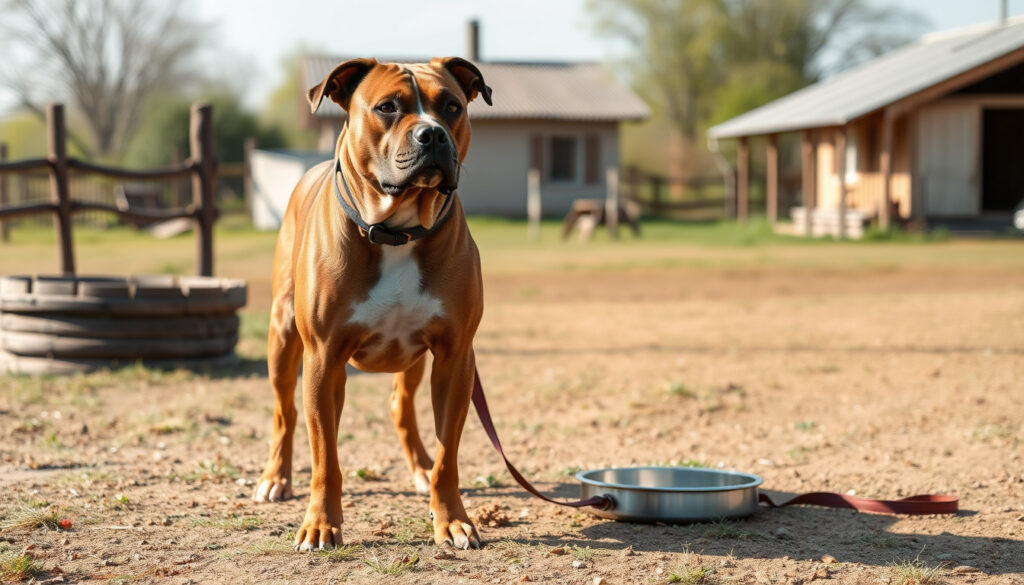
- Large, muscular frame with a strong head and muzzle (Dog Breed Info – breed reference database).
- Coat is short and smooth; some dogs develop a soft undercoat in cold weather.
- Colors include liver, black, red, buckskin, blue, silver, tan, brindle – often white with patches.
- Adult height: 25–27 inches (males), 24–26 inches (females). Weight: 60–90 lb.
Breed purpose
Originally bred to track, flush, and hold feral pigs at bay until the hunter arrived. Its high prey drive and independent thinking are direct reflections of that job. The breed is also known as the Australian Pig Dog or Aussie Pig Dog (Bow Wow Insurance – Australian pet insurer).
The implication: this is a working dog first, companion second. Owners who respect that drive will find a loyal partner; those who ignore it will find a handful.
Is a Bull Arab a good family dog?
Temperament with children
When raised together and properly socialized, Bull Arabs can form strong bonds with children. They are described as “kind, even-tempered, independent, and active” by Dog Breed Info (breed reference database). However, their size and energy mean supervision is essential – a rambunctious dog can accidentally knock over a toddler.
Socialization needs
- Early, ongoing socialization is crucial – introduce to different people, animals, and environments from puppyhood.
- Not recommended for first-time dog owners without experienced guidance (Lyka Blog – fresh dog food guide).
- Without proper socialization, wariness of strangers can become reactivity.
Living environment
Best suited to homes with a securely fenced yard. Apartments can work if exercise needs are met (minimum 60 minutes daily). The breed is adaptable but thrives with space to roam.
A Bull Arab left alone too long or under-exercised will find its own entertainment – often by digging, chewing, or barking. This dog demands a committed owner who values structure.
What this means: for active families with older children and a fenced yard, the Bull Arab can be a wonderful guardian. For sedentary homes, it’s a mismatch.
Is a Bull Arab a pitbull?
Breed lineage comparison
The Bull Arab is a distinct Australian breed, not a Pit Bull. “Pit Bull” generally refers to the American Pit Bull Terrier or American Staffordshire Terrier (Wikipedia – online encyclopedia). The Bull Arab shares some ancestry (Bull Terrier) but was bred for a different purpose – pig hunting – while Pit Bulls were originally bred for bull-baiting and later companionship.
Physical differences
Bull Arabs are larger (up to 28 inches vs. Pit Bull’s 21 inches) and leaner, built for endurance rather than sheer power. Pit Bulls have a broader head and more compact frame.
Temperament contrasts
Both breeds can be loyal and protective, but the Bull Arab’s independence is more pronounced – a holdover from its hunting work. Pit Bulls are often described as more eager to please. Neither breed is inherently aggressive, but both require responsible ownership.
The trade-off: the Bull Arab is less commonly restricted by breed-specific legislation than the Pit Bull, but its size and prey drive can create similar challenges if not managed.
Are Bull Arabs guard dogs?
Natural protective instincts
Highly territorial and protective of home and family. They will alert strangers with a deep bark and can deter intruders simply by their size and presence (Dog Breed Info – breed reference database).
Training for guarding
Not a trained guard dog by default – but their protective instincts can be shaped through obedience and controlled exposure. They do not have the formal guarding drills of breeds like the German Shepherd or Doberman.
Comparison with traditional guard breeds
Bull Arabs are more independent than shepherds, which can make them harder to handle in high-stakes protection roles. However, for home security (alerting and intimidation), they are highly effective.
Why this matters: if you want a dog that will notify you of unusual activity and look imposing, the Bull Arab fits. If you need a dog to execute complex protection commands, look at established guard breeds.
Is a Bull Arab aggressive?
Breed-specific aggression myths
Not inherently aggressive toward humans. Bow Wow Insurance (Australian pet insurer) describes the temperament as “active, independent, even-tempered, and kind.” Aggression in any breed is almost always a product of poor training, lack of socialization, or irresponsible ownership.
Prey drive vs. human aggression
The Bull Arab’s high prey drive can lead to chasing cats, squirrels, or other small animals – this is not human-directed aggression but instinct. Dog-on-dog aggression can occur if not socialized early, especially with same-sex dogs.
Responsible ownership
- Early socialization and consistent, force-free training are non-negotiable.
- Manage the environment: secure fencing, leash walking, and supervised interactions.
- Timid owners should avoid this breed; leadership is key.
A Bull Arab that is not given a job – whether hunting, sports, or structured exercise – may redirect its energy into unwanted behaviors. This is not aggression born of malice but of boredom.
The pattern: with the right owner, the Bull Arab is a stable, loyal dog. Without boundaries, it can become reactive – but that is true of many high-drive breeds.
Comparing the Bull Arab with similar breeds
Three large hunting breeds, one clear pattern: each was designed for game, but their modern roles differ sharply.
| Attribute | Bull Arab | American Pit Bull Terrier | Rhodesian Ridgeback |
|---|---|---|---|
| Origin | Australia (1970s) | USA (19th century) | Southern Africa (19th century) |
| Original purpose | Pig hunting | Bull-baiting, later farm dog | Lion hunting |
| Height (male) | 25–27 in | 18–21 in | 25–27 in |
| Weight (male) | 60–90 lb | 35–60 lb | 75–85 lb |
| Coat | Short, smooth | Short, glossy | Short, sleek |
| Temperament | Independent, loyal, protective | Eager to please, athletic | Dignified, intelligent, protective |
| Recognition | Not AKC recognized | AKC (UKC) | AKC recognized |
| Prey drive | Very high | High | High |
| Good with children | Yes with training | Yes with training | Yes with training |
| Exercise needs | 60+ min/day | 45–60 min/day | 60+ min/day |
The catch: all three breeds share high prey drive and protective instincts, but the Bull Arab flies under the radar of breed restrictions – a potential advantage for renters or owners in areas with BSL.
Bull Arab breed specifications at a glance
Sixteen key specs, one story: a dog built for work, not show.
| Specification | Detail |
|---|---|
| Breed Name | Bull Arab |
| Also Known As | Australian Pig Dog, Aussie Pig Dog |
| Origin | Australia (1970s) |
| Purpose | Feral pig hunting |
| Height (male) | 25–27 inches (63–69 cm) |
| Height (female) | 24–26 inches (61–66 cm) |
| Weight Range | 60–90 lb (27–41 kg) |
| Coat Type | Short, smooth, weather-resistant |
| Colors | White with patches, brindle, solid, tri-color |
| Life Expectancy | 10–15 years (often 12–15 per Bow Wow Insurance – Australian pet insurer) |
| Exercise Requirement | At least 60 minutes daily |
| Grooming | Low – weekly brushing |
| Shedding | Moderate year-round |
| Good with Children | Yes, if properly socialized |
| Dog Aggression | Possible without socialization |
| AKC Recognition | No |
Pros and cons of owning a Bull Arab
Upsides
- Extremely loyal and protective of family
- Low grooming maintenance
- Excellent hunter and tracker
- Adaptable to various climates
- Long lifespan for a large breed (12–15 years)
Downsides
- High prey drive – not safe around small pets without training
- Requires experienced handler
- Can be dog-aggressive if not socialized
- High exercise needs – unsuitable for sedentary homes
- Not AKC recognized, making breed-specific resources scarce
What we know – and what we don’t
Confirmed facts
- Developed in Australia in the 1970s for pig hunting
- Average height and weight ranges of 24–28 in, 60–90 lb
- Not recognized by the AKC or other major kennel clubs
- Short, low-shedding coat with white-and-color patches
What remains unclear
- Exact breed composition – Bull Terrier + Greyhound is most cited, but other breeds including Bloodhound and Mastiff may have been used (Wikipedia – online encyclopedia).
- Prevalence of genetic health issues – no large-scale studies specific to Bull Arabs exist.
- An official breed standard from a recognized kennel club has never been published.
Expert perspectives
“The Bull Arab is a large, muscular, working dog originally bred in Australia for pig hunting. The breed’s exact origins are not well-documented, but it is believed to be a cross of the Bull Terrier, Greyhound, and other breeds.”
– Wikipedia – online encyclopedia
“Bull Arabs are loyal, intelligent, confident, and adaptable dogs that thrive on human companionship. They need firm, consistent training and plenty of exercise to be well-adjusted family pets.”
– Lyka Blog – fresh dog food company
“The Bull Arab is an active, independent, even-tempered, and kind dog. It is best suited to an experienced owner who can provide firm leadership and plenty of exercise.”
– Bow Wow Insurance – Australian pet insurer
Summary
The Bull Arab is not a dog for everyone – but for the right owner, it’s a remarkably capable and devoted partner. Its history as a pig hunter gave it independence, stamina, and a protective edge that can be either a strength or a challenge. For Australian rural owners and active families with fenced yards, the Bull Arab offers a loyal guardian and tireless adventure companion. For urban first-timers or low-energy households, the equation is clear: invest heavily in training and exercise, or look elsewhere.
Related reading: Pet Circle Near Me: Stores, Shipping & Ireland Alternatives · Dine Cat Food Review: Healthy Wet Food Analysis
For a deeper dive into this Australian hunting dog’s traits, refer to our comprehensive Bull Arab breed guide covering history and health.
Frequently asked questions
Do Bull Arabs bark a lot?
They are moderate barkers. They will bark to alert, but not excessively if well-exercised and mentally stimulated. Boredom barking is common if left alone too long.
Are Bull Arabs good with cats?
Due to their high prey drive, Bull Arabs may chase cats unless raised with them and trained from puppyhood. Supervision is required.
How much does a Bull Arab cost?
Prices vary widely based on location and lineage. In Australia, pups from working lines typically range from $500–$1,500 AUD. In the USA, they may be harder to find and cost $800–$2,000 USD.
Do Bull Arabs need a lot of space?
Yes – a securely fenced yard is ideal. Apartment living is possible only with sufficient daily exercise (60+ minutes).
Can Bull Arabs live in apartments?
Possible, but not recommended for most. They need room to move and a job to do. Apartment dwellers must commit to multiple walks and mental enrichment each day.
What is the best diet for a Bull Arab?
A high-quality, protein-rich diet suitable for large, active breeds. Consult a veterinarian for portion sizes. Joint supplements may benefit older or working dogs.
Do Bull Arabs have separation anxiety?
They can, especially if not properly crate-trained or left alone for long hours. They bond strongly with their humans. Crate training, mental toys, and a consistent routine help mitigate this.
More related posts
 Jaryd Dawson: Brother of Jordan Dawson Dies at Age 28
 Annie Potts Biography: Accident, Career & Smoking Rumors
 Tori Spelling: Divorce Finalized, Custody & Debt 2025
 Fred Hollows: Biography, Eye Disease Work, and Legacy
 Shane Crawford: Family Tragedy, Career, and Life Today
 Bluey’s World Brisbane: Worth It? Tickets, Dates and Age Guide
 Minka Kelly Biography: Age, Career & Personal Life
 Aileen Wuornos: Verified Facts, Timeline, and Unanswered Questions
