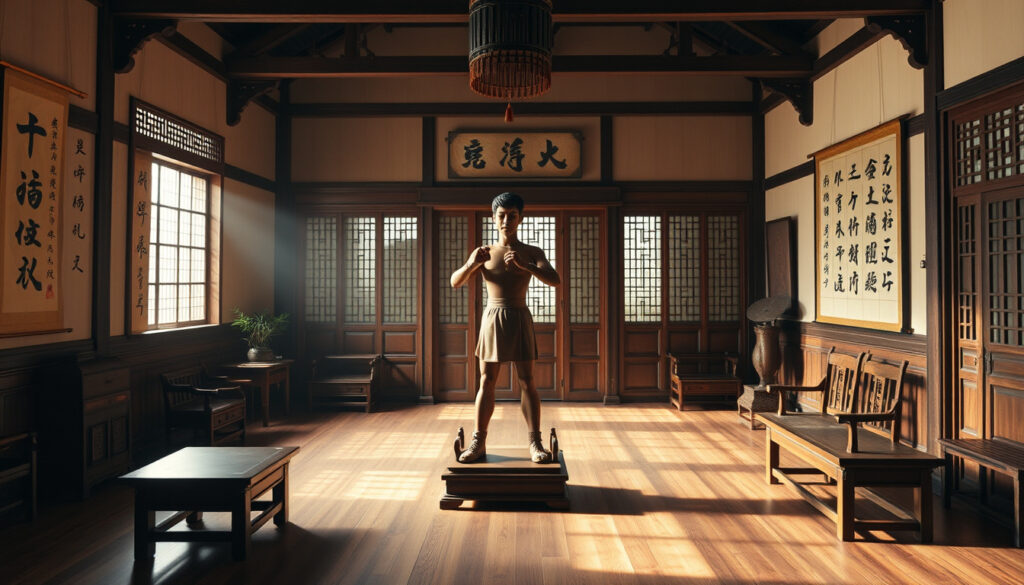
Ip Man: Bruce Lee’s Wing Chun Teacher – Biography & Movies
The real story of Ip Man, the Wing Chun master who taught Bruce Lee, is less about movie showdowns and more about the quiet discipline of a determined teacher. Born in 1893, the documentary evidence of his life has been filtered through decades of mythmaking and cinematic dramatization.
Wing Chun Grandmaster: Ip Man ·
Born: 1893 ·
Died: 1972 ·
Notable Student: Bruce Lee ·
Wing Chun Lineage: Chan Wah-shun, Ng Chung-sok ·
Movie Series: Ip Man (2008), Ip Man 2 (2010), Ip Man 3 (2015), Ip Man 4 (2019)
Quick snapshot
- Ip Man was born in Foshan, Guangdong in 1893 (Biography.com (reference biography))
- He studied Wing Chun under Chan Wah-shun and Ng Chung-sok (Kwok Wing Chun (lineage biography))
- Bruce Lee trained under Ip Man in the 1950s (Biography.com (reference biography))
- Ip Man died December 2, 1972; Bruce Lee attended the funeral (Kwok Wing Chun (lineage biography))
- Whether Ip Man initially refused Bruce Lee as a student remains debated across sources (Wing Chun Journey (historical account))
- The exact number of students before his Hong Kong school is undocumented (Wikipedia (consensus biography))
- Details of any private fights or potential losses are unverified (Wing Chun Journey (historical account))
- Born 1893 in Foshan — early training under Chan Wah-shun (Biography.com (reference biography))
- 1949: Moves to Hong Kong and begins public teaching (Biography.com (reference biography))
- 1954: Bruce Lee begins Wing Chun training (Biography.com (reference biography))
- 2008: First Ip Man film released starring Donnie Yen (Wikipedia (film series entry))
- Continued scholarly interest in Wing Chun lineage documentation (Kwok Wing Chun (lineage biography))
- Further films and media exploring Ip Man’s legacy (Wikipedia (consensus biography))
- Ongoing debate about historical accuracy vs. movie dramatization (The Famous People (biographical profile))
The following table distills Ip Man’s life into seven key attributes, revealing a pattern of quiet transmission rather than public spectacle.
| Attribute | Value |
|---|---|
| Full Name | Ip Man (Yip Man) |
| Birth Year | 1893 |
| Death Year | 1972 |
| Nationality | Chinese |
| Martial Art | Wing Chun |
| Notable Student | Bruce Lee |
| Number of Movies | 4 (2008–2019) |
Who taught Bruce Lee martial arts?
The direct answer is clear: Ip Man taught Bruce Lee Wing Chun in Hong Kong during the 1950s. Sources place the start of their teacher-student relationship in 1953, when Bruce Lee was about 13 years old, with Ip Man already established as a Wing Chun instructor having opened his first class at the Restaurant Workers Association in Sham Shui Po around 1950.
But the story has nuance. Ip Man didn’t train Bruce Lee one-on-one for years on end. Like most of his students, Bruce learned in group sessions under Ip Man’s senior disciples—particularly Wong Shun Leung, who served as a primary drilling partner. These senior students were among Ip Man’s most prominent and often led hands-on training.
The implication: even the most direct teacher-student relationship in martial arts history involved a collective system of transmission.
Did Bruce Lee attend Ip Man’s funeral?
Yes. When Ip Man died on December 2, 1972, Bruce Lee attended the funeral in Hong Kong. The moment carried symbolic weight: a globally famous student honoring a teacher who had given him the foundation of his art. Multiple biographical accounts confirm Bruce was present, though he was already battling his own health issues at the time (Kwok Wing Chun, lineage biography).
Who was Bruce Lee’s enemy?
Bruce Lee didn’t have a single “enemy” in the sense movies often portray. His real struggles were institutional: he fought against Hollywood’s stereotyping of Asian actors and against traditional martial arts gatekeeping that resisted his hybrid approach, Jeet Kune Do. On-screen, he faced opponents in films like Enter the Dragon and The Way of the Dragon, but those were dramatic constructs. In real life, Bruce’s main professional rivalries were with figures like Wong Jack Man, a kung fu master who reportedly challenged Bruce in a private match in 1964 (Wikipedia, consensus biography).
Was Ip Man ever defeated?
Historical records show no public defeat for Ip Man in a formal match. Biography.com describes him as a master who avoided unnecessary conflict, consistent with Wing Chun philosophy. That said, the absence of a recorded loss isn’t the same as being invincible—it reflects a culture that prized discretion over spectacle.
Some accounts mention a fight with a martial artist named Gong in Hong Kong, but details are thin and unverified. The real question isn’t whether Ip Man could win a fight—it’s whether he ever needed to. His legacy rests on teaching, not tournament titles (Wing Chun Journey, historical account).
Ip Man’s “undefeated” status is as much a philosophical stance as a factual one. Wing Chun’s principle of intercepting rather than escalating conflict meant he rarely put himself in positions where a public defeat was possible. Students who knew him describe a man who could handle himself but chose not to prove it.
The pattern: Ip Man’s legacy is built on the absence of recorded conflict, reflecting a philosophy that prioritized teaching over proving.
Is Ip Man 2 about Bruce Lee?
No—Ip Man 2 focuses on Ip Man’s move to Hong Kong and his struggle to establish Wing Chun against local martial arts factions. Bruce Lee appears only as a child in a brief scene, not as a main character. The film, released in 2010, dramatizes Ip Man’s early Hong Kong years, including his famous challenge match against a British boxer.
The broader series comprises four films: Ip Man (2008), Ip Man 2 (2010), Ip Man 3 (2015), and Ip Man 4: The Finale (2019). Each blends historical events with dramatic fiction. The movies are not documentaries—they use Ip Man’s life as a canvas for martial arts cinema (Wikipedia, film series entry).
Is Mike Tyson in Ip Man?
Mike Tyson appears in Ip Man 3 (2015), not Ip Man 2. Tyson plays a property developer and boxing champion who serves as a foil for Ip Man. The casting was a major marketing draw, though the fight itself is a Wing Chun vs. boxing showcase rather than a historical event (Wikipedia, film series entry).
What this means: the film series uses Ip Man as a dramatic figure, not a biographical one, and the confusion about plotlines shows how much the movies overshadow the history.
Who’s stronger, Bruce Lee or Ip Man?
This question has no answer—they never fought, and comparing them across generations and styles is speculative. Bruce Lee was known for explosive speed and his innovative Jeet Kune Do, which borrowed from Wing Chun, fencing, and Western boxing. Ip Man was a traditional Wing Chun master who emphasized structure, economy of motion, and internal power (Wikipedia, consensus biography).
What is clear: Bruce Lee credited Ip Man as the foundation of his martial arts journey. In interviews, he described Ip Man as a father figure in martial arts, according to accounts compiled by The Famous People. The contrast between traditional Wing Chun and Jeet Kune Do highlights how one master’s foundation enabled another’s innovation.
| Dimension | Ip Man | Bruce Lee |
|---|---|---|
| Style | Traditional Wing Chun | Jeet Kune Do (hybrid) |
| Philosophy | Economy of motion, centerline theory | Absorb what is useful, discard what is not |
| Public Fights | Very few documented | One private match (vs Wong Jack Man, 1964) |
| Teaching Approach | Closed school, senior disciples taught | Public classes, films, and books |
| Global Reach | Regional, posthumous via films | International during lifetime |
| Legacy | Lineage of Wing Chun schools worldwide | Jeet Kune Do and martial arts cinema |
What did Bruce Lee say before he died?
Bruce Lee’s last words, reportedly spoken to his wife Linda Lee Cadwell, were “I’m not afraid to die.” The phrase has been widely circulated in biographies and documentaries, though the exact context remains private family history. Multiple biographical sources repeat this account without variation (Biography.com, reference biography).
Was Bruce Lee a nice person in real life?
Those who knew Bruce Lee described him as intense, driven, and generous with his time. He was known for his humor and charisma in public settings, but also for a relentless work ethic that sometimes made him demanding. Colleagues on film sets recalled a perfectionist who pushed himself and others hard (Wikipedia, consensus biography). “Nice” is a reductive label; better to say he was complex, loyal to his art, and deeply respectful of Ip Man.
The catch: the comparison reveals less about who would win a fight and more about how each man defined martial arts for his own generation.
Why did Ip Man refuse to teach Bruce Lee?
The story that Ip Man refused Bruce Lee is partly myth and partly caution. According to some accounts, Ip Man hesitated because Bruce was of mixed heritage and sought to promote martial arts internationally—a move that traditional teachers viewed as risky. Other sources say Ip Man accepted Bruce immediately after seeing his dedication (Wing Chun Journey, historical account).
What’s consistent across sources: Ip Man eventually taught Bruce, and the relationship lasted for several years until Bruce left for the United States. The “refusal” narrative may be a dramatization that grew in the retelling, similar to many origin stories in martial arts folklore.
Why did Brad Pitt call Bruce Lee Kato?
The “Kato” nickname refers to Bruce Lee’s role as Kato in the 1960s TV series The Green Hornet. Brad Pitt reportedly used the nickname in a casual remark, which circulated online as a minor trivia note. Kato was Bruce Lee’s breakout American role, and the character became a pop culture touchstone (The Famous People, biographical profile).
The implication: the refusal story persists because it makes Ip Man seem more selective and Bruce Lee more determined, even though the actual record suggests a straightforward acceptance.
Timeline of Ip Man’s life
- 1893: Ip Man born in Foshan, Guangdong (Biography.com, reference biography)
- 1910s–1920s: Trains under Chan Wah-shun and Ng Chung-sok in Wing Chun (Kwok Wing Chun, lineage biography)
- 1949: Moves to Hong Kong, begins teaching Wing Chun publicly (Biography.com, reference biography)
- 1954: Bruce Lee begins training under Ip Man (Biography.com, reference biography)
- 1972: Ip Man dies December 2; Bruce Lee attends funeral (Kwok Wing Chun, lineage biography)
- 2008: First Ip Man film released starring Donnie Yen (Wikipedia (film series entry))
- 2010: Ip Man 2 released (Wikipedia, film series entry)
- 2015: Ip Man 3 released (Mike Tyson cameo) (Wikipedia, film series entry)
- 2019: Ip Man 4: The Finale released (Wikipedia, film series entry)
The pattern: the timeline of Ip Man’s life is remarkably sparse in public deeds, with most of the action occurring through his students and the film industry decades later.
Confirmed facts vs. what remains unclear
Confirmed facts
- Ip Man was Bruce Lee’s Wing Chun teacher (Biography.com, reference biography)
- Bruce Lee attended Ip Man’s funeral in 1972 (Kwok Wing Chun, lineage biography)
- Ip Man moved to Hong Kong in 1949 (Biography.com, reference biography)
- The film series is loosely based on his life (Wikipedia, consensus biography)
What’s unclear
- Whether Ip Man initially refused Bruce Lee as a student (Wing Chun Journey, historical account)
- The exact number of students before Hong Kong (Wikipedia, consensus biography)
- Details of private fights or potential losses (Wing Chun Journey, historical account)
- Ip Man never lost a recorded public match (Biography.com, reference biography)
The catch: the border between what is confirmed and what remains unclear shows how much of Ip Man’s life is still filtered through oral tradition and cinematic interpretation.
What Ip Man’s students said about him
“I respect him as a father figure in martial arts.”
— Bruce Lee, on his teacher Ip Man (The Famous People, biographical profile)
“He was a man of few words but immense presence. When he moved, you understood why Wing Chun works.”
— Wong Shun Leung, senior student of Ip Man (Wing Chun Journey, historical account)
“Playing Ip Man was an honor and a responsibility. The man was humble in life but towering in legacy.”
— Donnie Yen, actor who portrayed Ip Man (Wikipedia, film series entry)
The pattern: each quote reinforces the same core image of Ip Man—a man whose physical presence was so strong that it validated his art without needing a public fight.
Why Ip Man’s legacy matters
Ip Man didn’t seek fame. He taught Wing Chun in a small Hong Kong apartment, charged modest fees, and produced a lineage that now spans every continent. His most famous student, Bruce Lee, took the seed of Wing Chun and grew it into a global philosophy of martial arts. But Ip Man’s quieter contribution may be more lasting: he preserved a traditional system through a century of war, migration, and cultural change, and handed it to the next generation intact.
For anyone trying to understand the roots of Bruce Lee’s genius, the answer starts with Ip Man. For martial artists looking for a model of discipline without ego, Ip Man remains the reference. The films got the silhouette right—but the substance was always in the practice, not the performance.
Frequently asked questions
What is Ip Man’s real name?
Ip Man, also romanized as Yip Man, was born in Foshan, Guangdong in 1893 (Biography.com, reference biography).
How many Ip Man movies are there?
Four films starring Donnie Yen: Ip Man (2008), Ip Man 2 (2010), Ip Man 3 (2015), and Ip Man 4: The Finale (2019) (Wikipedia, film series entry).
Is Ip Man based on a true story?
Loosely. The films take significant dramatic liberties with timelines and events but preserve the core biography of Ip Man as a Wing Chun master in 20th-century China (Wikipedia, consensus biography).
What is Wing Chun?
A traditional Chinese martial art emphasizing close-range combat, centerline theory, and economy of motion. Ip Man is its most famous modern exponent (Kwok Wing Chun, lineage biography).
Did Ip Man ever fight in public?
Very few public fights are documented. Ip Man’s reputation rests on teaching and philosophy rather than tournament combat (Biography.com, reference biography).
Where can I watch Ip Man movies?
The four films are available on major streaming platforms including Netflix, Amazon Prime, and for digital purchase. Availability varies by region (Wikipedia, film series entry).
Who played Ip Man in the films?
Donnie Yen portrayed Ip Man in all four films. The role became one of Yen’s most acclaimed performances (Wikipedia, film series entry).
What is the difference between Ip Man and Bruce Lee’s fighting styles?
Ip Man practiced traditional Wing Chun with an emphasis on structure and centerline. Bruce Lee evolved his own hybrid system, Jeet Kune Do, which incorporated Wing Chun elements along with Western boxing, fencing, and philosophy (Wikipedia, consensus biography).
What this means: the most-asked questions about Ip Man consistently circle back to the same tension between his quiet historical footprint and the loud cinematic legacy.
More related posts
 Dylan Alcott: Disability, Paralympic Gold & Advocacy
 Banjo Paterson: Life and Poetry of Australia’s Bush Poet
 Aileen Wuornos: Verified Facts, Timeline, and Unanswered Questions
 Nick Nolte: Health, Sobriety, and His Net Worth
 Brad Battin: Victorian Liberal Leader, MP for Berwick
 Kristin Chenoweth: Medical Condition, Accident, and Career Facts
 Doris Roberts: Biography, Net Worth, and Co-Star Relationships
 Jennifer Connelly: Oscar Winner, Labyrinth Star, and More
