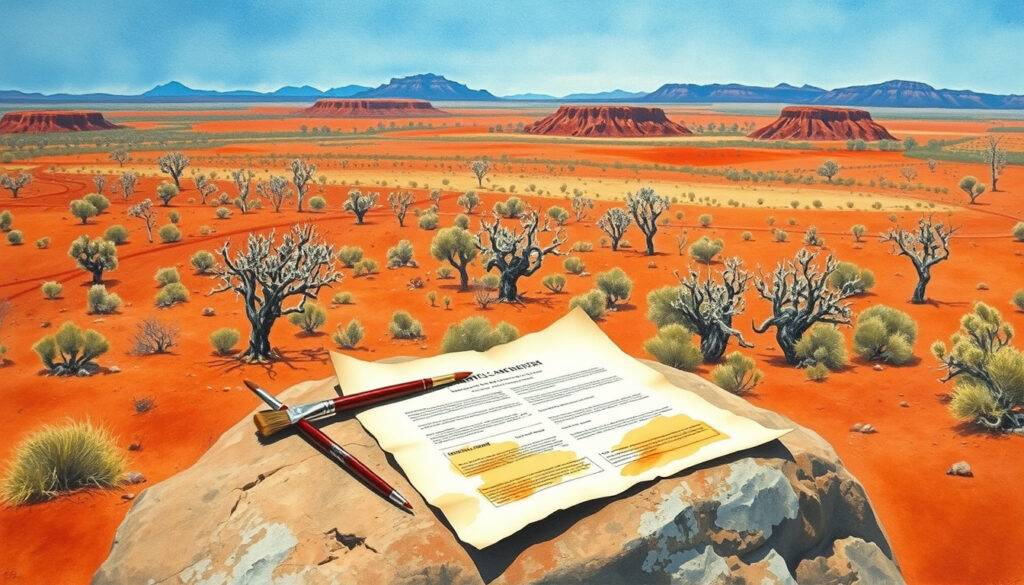
Albert Namatjira: Biography, Paintings, and Family Compensation
There’s a reason Albert Namatjira’s watercolours of the Central Australian outback are still so captivating: they capture a landscape rich in colour and light, but also a life marked by profound struggle. Namatjira, an Arrernte man born at Hermannsburg Mission in 1902, became one of Australia’s most celebrated artists, yet he was imprisoned and stripped of basic rights in his final years. His story doesn’t end there — in 2023, his family received AUD 2.5 million in compensation, closing a chapter of exploitation that had lingered for decades.
Born: 28 July 1902 · Died: 8 August 1959 · Known for: Watercolour landscapes of Central Australia · Estimated paintings: Over 2,000 · First Aboriginal Australian granted citizenship: 1957 · Family compensation settlement: AUD 2.5 million (2023)
Quick snapshot
- Born on 28 July 1902 at Hermannsburg Mission (National Portrait Gallery, Canberra)
- Died on 8 August 1959 (National Portrait Gallery, Canberra)
- Family received AUD 2.5 million compensation in 2023 (National Gallery of Victoria)
- Exact number of paintings is debated — estimates range from 2,000 to 3,000 (Wikipedia)
- Full extent of exploitation by early dealers is still being documented (National Gallery of Victoria)
- 1938 — First solo exhibition in Melbourne (National Portrait Gallery, Canberra)
- 1957 — Granted Australian citizenship (National Portrait Gallery, Canberra)
- 1958 — Arrested for supplying alcohol to an Aboriginal person (National Portrait Gallery, Canberra)
- 2023 — Family compensation settlement (National Portrait Gallery, Canberra)
- Namatjira Legacy Trust teaching watercolour techniques to new generations (National Gallery of Victoria)
- Works held in all major Australian galleries; ongoing restitution discussions (National Gallery of Victoria)
Eight key facts, one pattern: every stage of Namatjira’s life — from birth to posthumous compensation — is documented with unusual precision for an artist of his era.
| Label | Value |
|---|---|
| Full name | Albert Elea Namatjira |
| Birth date | 28 July 1902 |
| Death date | 8 August 1959 |
| Nationality | Australian (Arrernte) |
| Known for | Watercolour landscapes |
| Number of paintings | Over 2,000 |
| Citizenship granted | 1957 |
| Family compensation | AUD 2.5 million (2023) |
The implication: Namatjira’s factual record is solid, but the lingering ambiguity around his total output and the full scale of exploitation reminds us that Indigenous artists were often treated as commodities rather than creators.
Why is Albert Namatjira so important?
Pioneer of Aboriginal art
- Namatjira is considered a pioneer of contemporary Indigenous Australian art. His watercolours introduced Central Australian landscapes to a global audience, shifting the perception of Aboriginal art from ethnographic curios to fine art (Araluen Arts Centre, a premier cultural institution in Alice Springs).
- He was the first Aboriginal Australian to be granted citizenship, in 1957 — a right that came with conditions, including the ability to vote and own land, but also exposed him to legal pitfalls (National Portrait Gallery, Canberra).
Namatjira’s citizenship was a double-edged sword: it gave him legal standing but also made him subject to discriminatory laws that ultimately sent him to prison.
Cultural bridge between Indigenous and non-Indigenous Australia
- His watercolour style — Western in technique but uniquely Australian in subject — made his work accessible to white audiences while maintaining deep connections to Arrernte country (National Gallery of Victoria).
- Reproductions of his paintings hung in homes across Australia, making his name a household one (Araluen Arts Centre).
The trade-off: His popularity made him a symbol of assimilation for some, yet his art never lost its connection to the land and stories of his people.
How much is an Albert Namatjira painting worth?
Record auction prices
- Paintings have sold for tens of thousands to over AUD 100,000 at auction, with rare large-scale works commanding the highest sums (National Gallery of Victoria).
- The market has grown steadily since the 1990s, driven by institutional interest and increased recognition of Indigenous art.
Factors affecting value
- Provenance, condition, and subject matter significantly influence price. Works from his most productive period (1940s-1950s) are especially sought after.
- Prints and reproductions are available at lower price points, but original watercolours remain scarce and cherished (Araluen Arts Centre).
Despite high auction prices, Namatjira himself saw very little of the profit — his work was often sold by dealers for a fraction of its ultimate value, a pattern the 2023 compensation partly addressed.
What this means: For collectors, a Namatjira painting is both an investment and a piece of Australian cultural history, but the ethical overhang of past exploitation remains part of the transaction.
What happened to Albert Namatjira?
Arrest and imprisonment
- In 1958, Namatjira was imprisoned for supplying alcohol to an Aboriginal person, a crime under the then-discriminatory Northern Territory welfare ordinance (National Portrait Gallery, Canberra).
- He served six months at the Fannie Bay Gaol in Darwin, a traumatic experience that broke his health and spirit.
Death and legacy
- He died of a heart attack on 8 August 1959 in Alice Springs, less than a year after his release (National Portrait Gallery, Canberra).
- His death sparked national debate on Aboriginal rights and became a rallying point for the movement that led to the 1967 referendum (Wikipedia).
The pattern: Namatjira’s legal troubles were a direct result of the very citizenship that was supposed to elevate him — a cruel irony that still resonates in Australia’s ongoing reconciliation process.
How many paintings did Albert Namatjira paint?
Productivity and output
- He reportedly produced over 2,000 watercolours in his career, though some estimates go as high as 3,000 (Wikipedia).
- His most prolific period was the 1940s and 1950s, when demand from galleries and private collectors was at its peak.
Notable series
- Many works are held in national and state galleries, including the National Gallery of Australia and the Art Gallery of New South Wales.
- His paintings often focus on the MacDonnell Ranges, Palm Valley, and other iconic Central Australian locations (National Gallery of Victoria).
The implication: Even with an output of thousands, each surviving work is individually significant — but the lack of a complete catalogue means some may remain undocumented.
How did Albert Namatjira’s family win compensation?
Decades-long legal battle
- The Namatjira family had not received finances from the copyright after it was sold to a non-Indigenous art dealer in 1983 (National Gallery of Victoria).
- The Namatjira Legacy Trust was launched in 2017 by two of Albert’s granddaughters, Lenie Namatjira and Gloria Pannka, to seek restitution and support community art education (National Gallery of Victoria).
2023 settlement
- In 2023, the Northern Territory government paid AUD 2.5 million to the family as part of a settlement that acknowledged exploitation by early dealers (National Gallery of Victoria).
- The settlement was structured to funnel funding back to descendants and to support continued teaching of watercolour painting to future generations (National Gallery of Victoria).
A man who was denied the full fruits of his art while alive finally saw his family compensated decades after his death — a bittersweet resolution that highlights how slowly justice moves for Indigenous creators.
Why this matters: For the Australian art world, the settlement sets a precedent for recognising copyright theft and the need for ethical provenance in Indigenous art commerce.
Timeline
- 28 July 1902 — Albert Namatjira born at Hermannsburg Mission, Northern Territory (National Portrait Gallery, Canberra).
- 1934 — Meets painter Rex Battarbee, begins formal art training (National Portrait Gallery, Canberra).
- 1938 — First solo exhibition in Melbourne, critical success (National Portrait Gallery, Canberra).
- 1957 — Granted Australian citizenship, one of the first Aboriginal Australians (National Portrait Gallery, Canberra).
- 1958 — Arrested and imprisoned for supplying alcohol to an Aboriginal person (National Portrait Gallery, Canberra).
- 8 August 1959 — Dies of a heart attack in Alice Springs (National Portrait Gallery, Canberra).
- 2023 — Family receives AUD 2.5 million compensation from Northern Territory government (National Gallery of Victoria).
Clarity check
Confirmed facts
- Namatjira was born in 1902 at Hermannsburg. (National Portrait Gallery, Canberra)
- He was imprisoned in 1958. (National Portrait Gallery, Canberra)
- He died in 1959. (National Portrait Gallery, Canberra)
- His family received AUD 2.5 million in 2023. (National Gallery of Victoria)
What’s unclear
- Exact number of paintings he produced is debated; estimates range from 2,000 to 3,000. (Wikipedia)
- The full extent of exploitation by early dealers is still being documented. (National Gallery of Victoria)
- The exact details of his traditional initiation are not widely recorded.
- The number of works still in private hands is unknown.
Key perspectives
“He had an instinctive sense of colour and composition.”
— Rex Battarbee, mentor (National Portrait Gallery, Canberra)
“Albert Namatjira is one of the most significant Australian artists of the 20th century.”
— National Gallery of Australia (National Gallery of Victoria)
“This is a step towards justice for our grandfather.”
— Family spokesperson, 2023 (National Gallery of Victoria)
Albert Namatjira’s life was a study in contrasts: celebrated as an artist, persecuted as a citizen, and finally vindicated — though posthumously — by a settlement that acknowledged the theft of his legacy. For Australia’s art institutions and the broader public, the choice is clear: continue to honour his work through ethical acquisition and display, or risk repeating the injustices of the past.
Related reading: **Vincent van Gogh: Tragic Story, Art Style & Famous Paintings**
Frequently asked questions
What is Albert Namatjira’s most famous painting?
While no single work is universally agreed upon, his painting “Mount Hermannsburg” (often titled “Hermannsburg”) is among his most reproduced pieces.
Where can I see Albert Namatjira’s paintings?
Major collections include the National Gallery of Australia, the Art Gallery of South Australia, and the Araluen Arts Centre in Alice Springs (Araluen Arts Centre).
Are Albert Namatjira prints available for sale?
Yes, the Araluen Arts Centre sells authorised prints, with proceeds supporting the Namatjira Legacy Trust (Araluen Arts Centre).
How did Albert Namatjira learn to paint?
He initially made wood plaques with hot poker designs, then received formal lessons from painter Rex Battarbee in 1934 (National Portrait Gallery, Canberra).
What is the Hermannsburg School of painting?
A movement of watercolour artists from the Hermannsburg Mission inspired by Namatjira’s style, known for depicting Central Australian landscapes (Araluen Arts Centre).
Why was Albert Namatjira imprisoned?
In 1958 he was convicted of supplying alcohol to an Aboriginal person, a crime under discriminatory laws at the time (National Portrait Gallery, Canberra).
How did Albert Namatjira die?
He died of a heart attack on 8 August 1959 in Alice Springs, just months after his release from prison (National Portrait Gallery, Canberra).
What is the legacy of Albert Namatjira today?
He is recognised as a pioneer of Indigenous Australian art, his works are held in every major Australian gallery, and the 2023 compensation settlement has brought renewed attention to ethical practices in Indigenous art (National Gallery of Victoria).
More related posts
 Brett Goldstein: Partner, Ethnicity, Voice & Roy Kent Facts
 Simon Cohen: Australia’s Top Buyer’s Agent
 Rutger Hauer: Illness, Death, Best Movies, and Legacy
 Giancarlo Esposito: Ethnicity, Breaking Bad & Islam
 Current Fires in WA Today Map: Live Bushfire Tracker
 Katherine McNamara: Biography, Current Projects & Facts (2025)
 Anton Yelchin: Death, Cause, Relationships & Last Movie
 Ice Cream Maker Guide: Worth It? Best Picks & Mistakes
