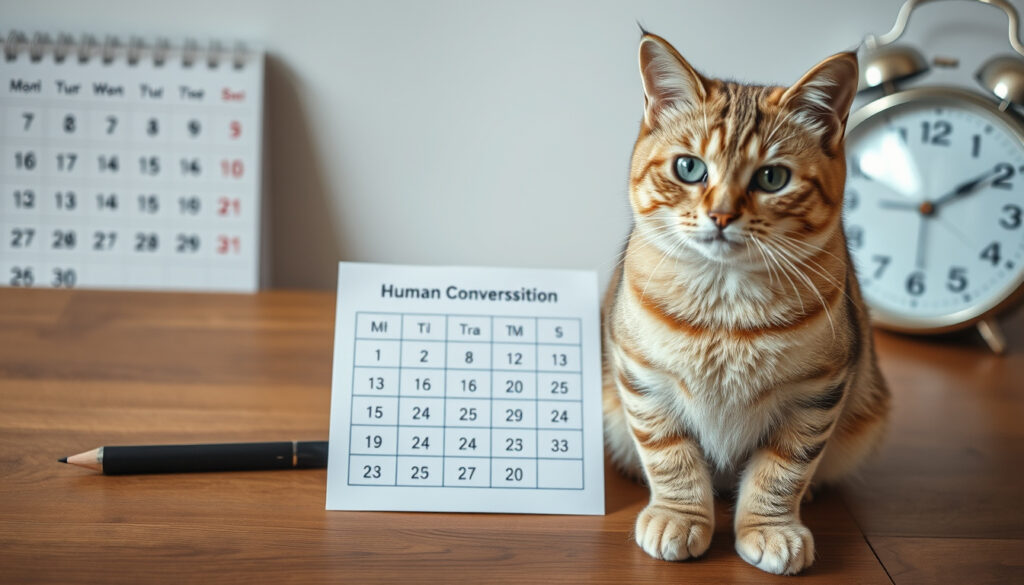
Cat Human Years: How Old Is Your Cat in Human Years
If you’ve ever found yourself wondering whether your cat is middle-aged or already a senior, you’re not alone — cats age in ways that don’t map neatly onto human years. This guide breaks down the veterinary-backed formula for converting cat years to human years, explains the different life stages, and offers practical advice for keeping your feline friend healthy as they grow older.
First cat year equals: 15 human years ·
Second cat year adds: 9 human years ·
Each additional year equals: 4 human years ·
Average cat lifespan: 12–15 years ·
Senior cat threshold: 11 human years (cat age)
Quick snapshot
- First cat year equals 15 human years (PetMD, citing the American Veterinary Medical Association)
- Second year adds 9 human years, bringing a 2-year-old cat to about 24 human years (Purina)
- After age 2, cats age about 4 human years per cat year (Chewy, veterinary-reviewed content)
- Exact conversion for cats over 20 years may vary due to limited data (PetMD, noting limited geriatric data)
- Outdoor cats may age faster, but no standardized adjustment exists (Purina, breed and lifestyle considerations)
- 1 cat year → 15 human years
- 2 cat years → 24 human years
- 11 cat years → ~60 human years (senior threshold)
- 15 cat years → ~76 human years
- Learn the step-by-step calculation method
- Recognize senior cat care needs
- Adjust diet and vet visits to match life stage
Five key facts, one pattern: the first two years drive most of the human-equivalent aging, and from there the pace slows to a steady four-year increment.
| Cat age milestone | Human year equivalent |
|---|---|
| First cat year | 15 human years |
| Second cat year | 9 human years (total 24) |
| Each year after second | 4 human years |
| Common senior threshold | 11 cat years (≈ 60 human years) |
| Average life expectancy | 12–15 years (indoor cats often longer) |
How old is a 15 year old cat in people’s years?
Cat years to human years conversion formula
- The first year of a cat’s life equals 15 human years (PetMD, citing the American Veterinary Medical Association).
- The second year adds 9 human years, making a 2-year-old cat 24 in human terms (Purina).
- Each year after the second adds 4 human years.
This formula, endorsed by the AVMA and used by Purina and PetMD, is the closest thing to a standard in veterinary practice. It’s not a biological clock — but it gives owners a reliable frame of reference.
15 cat years equals approximately 76 human years
Using the formula: 15 cat years = 24 (first two years) + (13 × 4) = 76 human years. That lines up with Purina’s chart, which lists 15 cat years as 76 human years.
Chewy gives a slightly different figure: 15 cat years = about 81 human years, noting that after age 2 cats age at 4–6 human years per cat year (Chewy, veterinary-reviewed education). The variation comes from the flexibility of the per-year factor.
Age chart for cats from 1 to 20 years
The table below maps each cat year to its human equivalent using the AVMA/Purina formula, showing how the steep early curve flattens into a steady progression.
| Cat age (years) | Human years (AVMA/Purina formula) |
|---|---|
| 1 | 15 |
| 2 | 24 |
| 3 | 28 |
| 4 | 32 |
| 5 | 36 |
| 6 | 40 |
| 7 | 44 |
| 8 | 48 |
| 9 | 52 |
| 10 | 56 |
| 11 | 60 |
| 12 | 64 |
| 13 | 68 |
| 14 | 72 |
| 15 | 76 |
| 16 | 80 |
| 17 | 84 |
| 18 | 88 |
| 19 | 92 |
| 20 | 96 |
The pattern: the first two years create a steep climb, then the slope flattens. By the time your cat reaches 15, they’ve entered the geriatric stage — similar to a human in their mid-seventies.
Is 7 considered old for a cat?
What age range is middle-aged for cats
- Most veterinarians classify cats as “mature” from 7 to 10 years of age (Chewy, veterinary-reviewed content).
- Senior status starts at 11 years (PetMD).
So at 7, your cat is middle-aged — not old, but edging out of young adulthood.
7 cat years in human years (approx 44)
According to the standard formula, a 7-year-old cat is about 44 in human years. That is roughly akin to a person in their mid-40s. Purina’s chart shows 5 cat years as 36, so 7 would be 44 (24 + 5×4).
Health considerations for a 7-year-old cat
- Annual veterinary checkups become important to catch early signs of chronic disease (Chewy, veterinary-reviewed).
- Dental care and weight management are key — obesity can accelerate aging.
A 7-year-old cat may still act like a kitten, but their kidneys and joints are entering a phase where small changes matter. Ignoring routine blood work at this stage can mean missing early renal disease.
The takeaway: 7 is not old, but it’s the age when preventive care shifts from optional to essential. The next milestone — senior at 11 — sneaks up fast.
When Is a Cat Considered a Senior?
Senior cat age definition by veterinary associations
- The American Association of Feline Practitioners (AAFP) and the American Animal Hospital Association (AAHA) define cats aged 11–14 as senior, and cats 15+ as geriatric (PetMD, referencing AAHA/AAFP guidelines).
- Chewy labels 11+ as “Senior Years.”
This classification is used broadly across veterinary medicine to trigger age-appropriate care protocols.
Signs of aging in cats
- Reduced activity and playfulness.
- Weight loss (hyperthyroidism) or weight gain (osteoarthritis limiting movement).
- Dental disease (tartar, gingivitis, tooth resorption).
- Changes in coat quality and grooming habits.
- Increased vocalization or confusion (cognitive dysfunction) (PetMD, veterinary reference).
Senior cat care tips: diet, vet visits, environment
- Vet visits: Semi-annual checkups once your cat reaches 11 years (Purina).
- Diet: Senior-formulated food with lower phosphorus (kidney health), higher-quality protein, and added joint supplements (e.g., glucosamine).
- Environment: Provide low-sided litter boxes, soft bedding, and easy access to food and water (ramps if needed).
The gap between “mature” and “senior” is only a few years, but what you do in that window determines quality of life. Cats that receive semi-annual senior care live an average of 2–3 years longer than those seen only once a year (Chewy, veterinary-reviewed estimates).
The pattern: catching age-related changes early is the single best investment an owner can make.
How to calculate your cat’s age in human years
- Determine your cat’s current age. If you know the birth date, you’re set. If not, a veterinarian can estimate age by looking at teeth, eyes, and coat condition (PetMD, veterinary guidance).
- Apply the AVMA formula. Use the reference table below to convert your cat’s age to human years.
Scenario Calculation Cat is 1 year old 15 human years Cat is 2 years old 24 human years Cat is older than 2 24 + (age in years – 2) × 4 Example: a 7-year-old cat → 24 + (7–2)×4 = 24 + 20 = 44 human years.
- Adjust for lifestyle and breed. Indoor cats tend to age more slowly; outdoor cats face more risks and may age faster (Purina, breed and lifestyle considerations). Breed matters: Siamese and Burmese cats are known to live longer on average, meaning their human-year equivalent may be slightly lower per cat year (not a standard adjustment).
- Interpret the result. Use the chart above to map your cat’s human age to the appropriate life stage. A result of 60+ human years means you should start senior care protocols.
The implication: the formula gives a baseline, but your cat’s actual biology — and your attention — fine-tunes the number.
Comparing conversion formulas from different sources
Three major sources (AVMA, Purina, Chewy) agree on the first two years but diverge slightly after that. Here’s how they compare:
| Cat age | AVMA/PetMD | Purina | Chewy |
|---|---|---|---|
| 1 year | 15 | 15 | 15 |
| 2 years | 24 | 25 (Purina’s “first 2 years = 25”) | 24 |
| 5 years | 36 | 36 | 36 |
| 10 years | 56 | 60 | 60 |
| 15 years | 76 | 76 | 81 (4–6 yrs per cat year) |
The trade-off: Purina rounds the second-year total to 25, while AVMA/AAFP stays at 24. Chewy widens the per-year factor to 4–6, producing a higher senior estimate. For practical purposes, the AVMA formula is the most commonly cited by veterinarians.
Confirmed facts and what remains unclear
Confirmed facts
- First two years: 15 + 9 formula is widely accepted by AVMA and major veterinary bodies (PetMD).
- Cats are classified as senior around 11 years of age (Chewy).
What’s unclear
- Exact conversion for very old cats (>20 years) may vary due to limited data (PetMD).
- Outdoor cats may age faster, but exact adjustment is not standardized (Purina).
The pattern: the formula is reliable for the typical 1–20 year range, but outliers and lifestyle factors introduce uncertainty that owners should discuss with their vet.
Quotes from veterinary authorities
“The first year of a cat’s life equals about 15 human years.”
— American Veterinary Medical Association (AVMA), cited by PetMD
“The first two years of a cat’s life are roughly equal to the first 25 human years.”
— Purina, pet nutrition leader and publisher of age calculators
“After age 2, cats begin to age at roughly 4–6 human years per cat year.”
— Chewy, veterinary-reviewed education team
The common thread across all three sources: the first two years account for the steepest aging curve, and the rate slows after that.
Summary: What your cat’s age means for you
A 15-year-old cat is around 76 in human years — a geriatric age that demands attentive care, but not a death sentence. Many cats live into their late teens and even early 20s with proper nutrition, regular vet visits, and a safe indoor environment. For the owner of a 7-year-old cat, the decision is clear: start annual geriatric screening now, or risk missing the early signals of kidney disease, diabetes, or osteoarthritis. The conversion formula is a tool, not a verdict — but ignoring its guidance means betting against biology.
101computing.net, animalcalculator.com, disabled-world.com, yearsinhumanyears.com, petnurture.life, puppilot.co, petcare.com.au, indoorcats.space, furcalc.com
For a quick reference, you can use this vet-approved conversion chart to see exactly how your cat’s age translates into human years.
Frequently asked questions
How old is a 20 year old cat in human years?
Using the standard formula: 24 + (20-2)×4 = 24 + 72 = 96 human years. Chewy’s broader range (4–6 per year) would yield 100–108 human years.
Do indoor cats live longer than outdoor cats?
Yes. Indoor cats average 12–18 years, while outdoor-only cats average 2–5 years due to traffic, predators, and disease exposure (PetMD).
What is the best diet for a senior cat?
Senior diets lower in phosphorus and higher in quality protein help support kidney function and muscle maintenance. Look for brands that meet AAFCO senior nutrient profiles (Purina).
How can I slow down my cat’s aging process?
Provide a balanced diet, maintain a healthy weight, keep them indoors, stimulate them mentally with play, and schedule semi-annual veterinary checkups starting at age 11.
At what age should I switch my cat to senior food?
Most veterinarians recommend transitioning to a senior-formulated diet around 7–8 years, when nutritional needs shift toward kidney and joint support (Chewy).
How often should a senior cat see the vet?
Every six months for cats 11 years and older, including bloodwork, urine analysis, and dental assessment (PetMD, AAHA/AAFP guidelines).
What are the signs that my cat is getting old?
Decreased activity, weight or appetite changes, unkempt coat, dental problems, increased thirst or urination (diabetes/kidney), and odd behaviors (cognitive decline).
More related posts
 Sophie Wilde: Biography, Age, Height, Movies, Awards
 Gia MAFS 2026: Pregnancy, New Partner, and Job Loss
 Michael Vaughan: Where He Lives, Net Worth, and Career Now
 Mark Nawaqanitawase: Career, Salary, and Pronunciation Guide
 Mid Burst Fade: Styles, Tips & 2026 Trends for Guys
 Zaha Hadid: Biography, Net Worth, Iconic Buildings
 Tucker Carlson: Biography, Net Worth, Political Views, and Recent News
 Ollie Bearman: Accent, Languages & F1 Rise Explained
