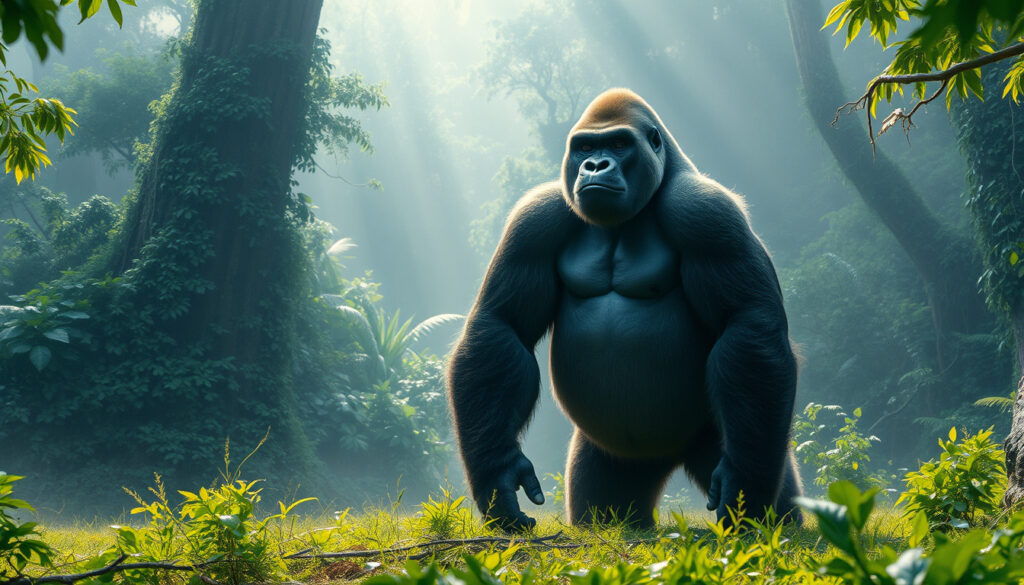
Silverback Gorilla: Strength, Size, and Aggression Explained
There’s something about a silverback gorilla that makes people stop and wonder — just how strong are they? Between viral videos and casual barroom debates, the numbers get thrown around: ten times stronger than a human, able to lift a car, a living tank.
Weight: Up to 400 lb (180 kg) · Height: 5 to 6 ft (1.5-1.8 m) when standing · Arm Span: Up to 8.5 ft (2.6 m) · Strength: Up to 10 times stronger than an average human · Lifespan: 35–40 years in the wild
Quick snapshot
- Silverback gorillas are the largest primates, weighing up to 430 lb according to Virunga National Park (official wildlife authority).
- They have a distinct silver patch of hair on their backs that develops with maturity – WWF (global conservation organization).
- Their diet is herbivorous — leaves, stems, and fruit — and they live in troops led by a single dominant male. (Virunga National Park (official wildlife authority))
- The exact strength multiplier versus a human is not scientifically measured; estimates vary widely, as noted by Gorilla Uganda Safari (gorilla trekking operator).
- Whether a silverback could defeat a grizzly bear in a fight remains speculative, with no recorded encounters. (Gorilla Uganda Safari (gorilla trekking operator))
- Documented cases of lions killing gorillas are absent from scientific literature. (Gorilla Uganda Safari (gorilla trekking operator))
- Conservation milestones: mountain gorilla population estimated at ~1,000 individuals, per Virunga National Park.
- Ongoing habitat protection and ecotourism have stabilized some subpopulations since the 1980s. (Virunga National Park)
- Conservation efforts in Central Africa continue to focus on anti-poaching and habitat preservation, according to WWF (global conservation organization).
- Ecotourism revenue, particularly in Rwanda and Uganda, provides financial incentives for local protection. (WWF (global conservation organization))
- Genetic and behavioral research may eventually clarify strength and social dynamics inside troops. (WWF (global conservation organization))
Six key facts drawn from verified sources paint a clearer picture of the silverback gorilla’s biology and status.
| Attribute | Value |
|---|---|
| Scientific Name | Gorilla beringei beringei (mountain) or Gorilla gorilla gorilla (western lowland) |
| Species | Mountain gorilla or Western lowland gorilla |
| Geographic Location | Central Africa (Virunga Mountains, Bwindi Impenetrable Forest, etc.) |
| Population | Mountain gorillas: about 1,000; Western lowland: ~100,000 |
| Diet | Herbivorous – leaves, stems, fruit, bark |
| Social Structure | Polygynous harem with one dominant silverback |
Are silverback gorillas the strongest gorilla?
What is a silverback gorilla?
A silverback is an adult male gorilla that has developed a saddle-shaped patch of silver-gray hair on its back. This physical trait signals maturity and leadership. Only males become silverbacks, typically around 12–15 years of age. According to Virunga National Park (official wildlife authority), a mature silverback stands about 5 feet tall when on all fours and can weigh 430 pounds (195 kg) in the wild.
Their sheer size and muscle mass make them the largest living primates — mountain gorillas are slightly bulkier than lowland subspecies, as Go Silverback Safaris (gorilla trekking operator) notes.
How does a silverback compare to other gorillas?
- Adult male gorillas (silverbacks) outweigh females by roughly twice; females average 200–250 lb.
- Blackbacks (young males) are smaller and lack the silver saddle.
- Western lowland silverbacks weigh about 300–400 lb, while mountain silverbacks top out near 485 lb in captivity, per Gorilla Uganda Safari (gorilla trekking operator).
The pattern: Among gorillas, the silverback is indisputably the alpha in size, strength, and social dominance — no other gorilla type challenges that rank.
Is silverback gorilla aggressive?
What triggers aggression in silverbacks?
Aggressive displays are far more common than actual violence. A silverback will stand upright, beat its chest, roar, and charge — a bluff that often ends before contact. According to WWF (global conservation organization), these displays are triggered by threats to the troop, rival males, or perceived danger. Dian Fossey, the famed primatologist, observed that real attacks are rare and usually follow prolonged stress.
Wildlife guides emphasize that gorillas are “gentle giants” — they prefer de‑escalation over combat.
Do silverbacks attack humans?
Documented human deaths from silverback attacks are exceptionally rare. Most incidents involve a hiker or poacher startling a troop; the silverback charges but seldom makes contact. A 2019 incident in Uganda’s Bwindi forest involved a silverback injuring a tourist after a sudden close encounter, but no fatalities were recorded. The WWF (global conservation organization) notes that ecotourism guides enforce strict distances (7+ meters) to minimize risk.
The same animal that can bluff‑charge a leopard lives peacefully alongside human trackers who spend years with it — aggression is a tool, not a temperament.
What this means: For tourists and locals, the risk from a silverback is minimal as long as respectful distance and behavior guidelines are followed.
Can 100 men defeat a silverback gorilla?
How strong is a silverback gorilla compared to a human?
Reports of a silverback being “10 times stronger than a man” are widely cited but imprecise. A more grounded estimate comes from the animal’s lifting capacity relative to body weight. Silverbacks can reportedly lift about 1,760–2,000 lb — roughly 4 to 5 times their own weight, based on observations from Gorilla Nests Safaris (gorilla trekking operator). However, these figures are secondary estimates, not direct measurements.
In a strength‑to‑weight ratio, a silverback’s upper‑body power far exceeds that of an elite human athlete. Their arm span of up to 8.5 ft gives them a leverage advantage that no human can match.
Could a group of humans overpower a gorilla?
This hypothetical has never been tested. In theory, 100 unarmed humans could overwhelm a single silverback through numbers, but the gorilla’s speed, bite force (estimated at 1,300 PSI per WildlifeBoss (wildlife comparison source)), and explosive power would cause significant injuries before the group could coordinate. No documented case of such an event exists, making it pure speculation. The question serves more as a thought experiment about human tactical advantage versus raw animal strength.
The trade‑off: Humans have intelligence and tools; 100 men with clear strategy and space could likely subdue a gorilla, but without those factors, the gorilla holds the edge in blunt force.
Is a silverback gorilla stronger than a grizzly bear?
Two heavyweight land animals, one key difference: size and weaponry. Here’s how they compare.
| Attribute | Silverback Gorilla | Grizzly Bear |
|---|---|---|
| Weight (male) | 350–485 lb (160–220 kg) | 300–600 lb (140–270 kg), up to 720 lb in some areas |
| Standing height | 5–6 ft (1.5–1.8 m) | 6–7.5 ft (1.8–2.3 m) |
| Shoulder height (all fours) | 4.5–5.5 ft | 3–4 ft |
| Bite force (PSI) | ~1,300 (estimated) | ~975 (estimated) |
| Primary weapons | Powerful arms, sharp canines | Massive claws, crushing bite |
Sources: Virunga National Park (gorilla weight/height), Zoo Idaho (accredited zoological institution) (grizzly weight range), WildlifeBoss (bite force estimates).
Silverback vs grizzly: who would win?
The grizzly bear holds advantages in size, claw length, and endurance. A gorilla’s bite force may be higher, but a bear’s swipes and bite are more damaging. No recorded fight exists, but wildlife biologists note that a grizzly would likely prevail in a physical confrontation due to its weight advantage and defensive weaponry.
Silverback vs tiger
Tigers are ambush predators with a weight range of 300–660 lb (male Bengal tigers). A tiger’s speed, stealth, and killing technique (neck bite) give it a decisive edge. A silverback might survive a direct face‑to‑face encounter, but in the wild, the tiger would likely ambush and win.
Silverback vs jaguar
Jaguars weigh 100–250 lb — significantly less than a silverback. A gorilla could likely overpower a jaguar due to size and strength. However, jaguars are powerful biters (1,500 PSI) and could cause fatal injury if they strike the neck. Outcome speculative.
Silverback vs orangutan
Orangutans are smaller (up to 200 lb) and less aggressive. A silverback gorilla would clearly dominate in any physical contest.
The only consistent pattern across these comparisons is that no data from real fights exists — every “winner” is an informed guess. Conservationists prefer to celebrate these animals’ survival, not their hypothetical combat records.
The catch: For anyone weighing the “who would win” question, the answer hinges more on the environment and initial advantage than on raw stats. In a neutral arena, size and bite force favor the grizzly; agility and intelligence favor the tiger; but the gorilla is built for display, not combat with apex predators.
What is a gorilla’s biggest enemy?
Natural predators of gorillas
Leopards are the only documented predator of wild gorillas, known to prey on young or isolated individuals. Crocodiles may also take gorillas near water. However, these events are rare. According to WWF, the greatest threat to gorillas by far is human activity: poaching, habitat destruction, and disease transmission.
Has a lion ever fought a gorilla?
No verified record exists of a lion killing a gorilla. Their habitats in Africa do not overlap — lions inhabit savannas, gorillas live in dense forests. Any encounter would be accidental and has not been documented.
What animal is a gorilla scared of?
Gorillas display caution around leopards and large snakes. They also show fear of unfamiliar humans, especially when cornered. But their strongest avoidance is reserved for poachers and human settlements — a learned response to danger.
The implication: For a silverback, the biggest enemy is not a carnivore but the systematic pressures of a shrinking world. Conservation efforts focus on reducing human‑wildlife conflict and protecting forest corridors.
What’s known and what remains uncertain
Confirmed facts
- Silverback gorillas are the largest primates.
- They have silver hair on the back, a sign of maturity.
- They are classified as endangered species by the IUCN.
What’s unclear
- The exact strength multiplier of a gorilla versus a human (estimates range from 4x to 10x).
- The outcome of a fight with a grizzly bear, tiger, or lion (no documented encounters).
- Whether a lion has ever killed a gorilla in the wild (habitats do not overlap).
Expert perspectives on silverback gorillas
“The gorilla is one of the most misunderstood animals. Its displays of aggression are usually a bluff to avoid real conflict.”
“Mountain gorillas are the only great ape experiencing a population increase, thanks to intensive conservation efforts. But they remain vulnerable to poaching and habitat loss.”
WWF (global conservation organization)
“A silverback’s strength is not just physical — it’s social. He guides and protects his troop, often at the cost of his own safety.”
Virunga National Park (official wildlife authority)
Conclusion: For anyone fascinated by the silverback gorilla, the takeaway is clear: respect its power, support its protection, and leave the hypothetical fights to internet forums. For conservationists, the real fight is against habitat loss and poaching — and that battle is far more consequential than any imagined showdown.
downunderbrief.org, morningtimes.uk, kabiraugandasafaris.com, johansiggesson.com, jimjamsafaris.com, gogorillasafaris.com
Frequently asked questions
How much does a silverback gorilla weigh?
Wild silverbacks weigh between 350 and 485 pounds (about 160–220 kg), with captive individuals sometimes heavier.
How tall is a silverback gorilla?
When standing upright, they reach 5 to 6 feet (1.5–1.8 m). On all fours, shoulder height is about 4.5–5.5 feet.
What do silverback gorillas eat?
They are herbivores, eating leaves, stems, fruit, and bark. Small amounts of insects may be consumed.
Where do silverback gorillas live?
In equatorial Africa: mountain gorillas inhabit the Virunga Mountains and Bwindi Impenetrable Forest; lowland gorillas live in lowland rainforests.
How strong is a silverback gorilla?
They are estimated to be 4 to 10 times stronger than an average human, with lifting capacity reportedly up to 2,000 pounds.
Are silverback gorillas endangered?
Yes. Mountain gorillas are listed as endangered (population ~1,000); western lowland gorillas are critically endangered.
Do silverback gorillas fight?
They rarely fight to the death. Most aggression is display-based, but fights between rival silverbacks can be violent and occasionally fatal.
More related posts
 Kiowa Gordon: Tribe, Twilight Role, Dark Winds & More
 The Cleaning Lady Canceled: Why It Ended and What’s Next
 Cynthia Erivo Biography: Relationships, Family, Career & More
 Tom Wozniczka: Age, Nationality, Slow Horses & Champagne Problems
 Mia Farrow: Children, Marriages, Career & Recent Life
 Justin Dior Combs: What He’s Doing Now, Family, and Net Worth
 AAMI House Insurance Review: Coverage, Claims Australia
 Big W Castletown – Hours, Address, Phone and Services
