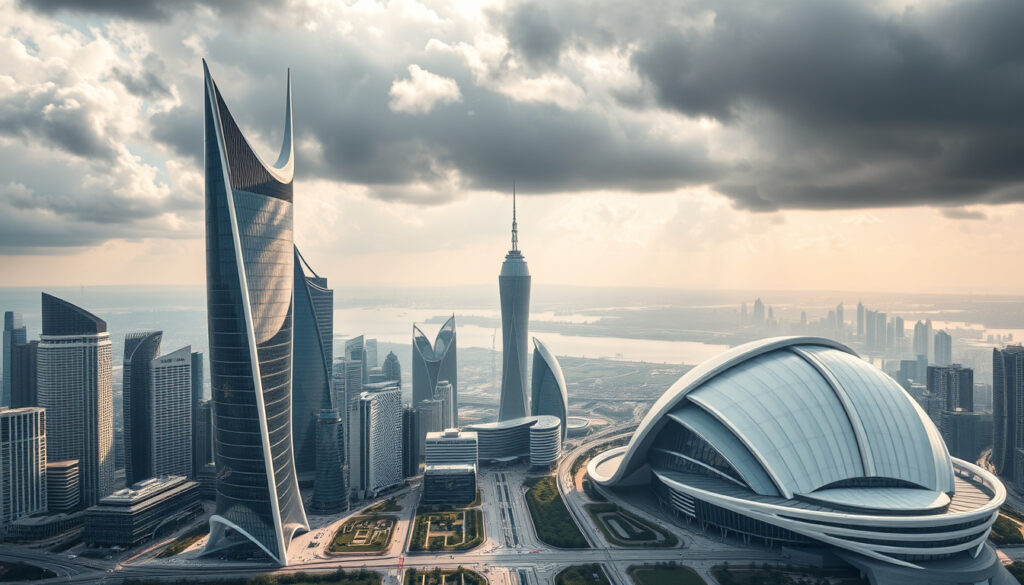
Zaha Hadid: Biography, Net Worth, Iconic Buildings
Most people know Zaha Hadid for buildings that look like they’re in motion — sweeping curves and sharp angles that seem to defy gravity. But in 2004, when she became the first woman to win the Pritzker Architecture Prize, she had completed only four structures. That paradox — immense influence from a relatively small built portfolio — is just one of many reasons her name still draws questions about net worth, relationships, and even whether she’s related to the Hadid models.
Born: 31 October 1950, Baghdad, Iraq (Britannica) ·
Died: 31 March 2016, Miami, Florida, US (Britannica) ·
Awards: Pritzker Prize (2004), Stirling Prize (2010, 2011) (Praemium Imperiale) ·
First woman: First woman to win the Pritzker Architecture Prize (Praemium Imperiale) ·
Estimated net worth at death: ~$82.5 million (estate of £67 million) (The Guardian)
Quick snapshot
- First woman to win the Pritzker Architecture Prize (2004) (Praemium Imperiale)
- Never married and had no children (The Guardian)
- Born 31 October 1950 in Baghdad; died 31 March 2016 in Miami (Britannica)
- Designed London Aquatics Centre, Heydar Aliyev Center, MAXXI Museum (Liverpool John Moores University)
- 2004: First woman to win the Pritzker Architecture Prize (Praemium Imperiale)
- Zaha Hadid Architects continues operations under director Patrik Schumacher
- Her parametric design legacy influences a new generation of architects
The table below compiles the core biographical details that are consistently reported across authoritative sources.
| Label | Value |
|---|---|
| Full name | Zaha Mohammad Hadid |
| Born | 31 October 1950, Baghdad, Iraq (Britannica) |
| Died | 31 March 2016, Miami, Florida, US (Britannica) |
| Nationality | Iraqi-British |
| Occupation | Architect, artist, designer |
| Awards | Pritzker Prize (2004), Stirling Prize (2010, 2011), RIBA Gold Medal (2015) (Zaha Hadid Foundation) |
| Notable projects | London Aquatics Centre, Guangzhou Opera House, Heydar Aliyev Center, MAXXI Museum (Liverpool John Moores University) |
Why is Zaha Hadid so famous?
Zaha Hadid’s fame rests on a combination of radical design and historic firsts. She shattered the glass ceiling of architecture by becoming the first woman to win the Pritzker Prize in 2004 (Praemium Imperiale). Her early completed works — the Vitra Fire Station (1993), the Ski Lift in Innsbruck, the Car Park and Terminus Hoenheim North, and the Contemporary Art Center in Cincinnati — were few but enough to signal a new direction for architecture (Wikipedia).
“Her built work is sparse. Yet each building is a world in itself.”
— Pritzker Prize jury citation, 2004
What are Zaha Hadid’s most iconic projects?
- Heydar Aliyev Center, Baku — fluid, seamless curves that won the Design Museum’s Design of the Year 2014 (Britannica)
- London Aquatics Centre — wave-like roof designed for the 2012 Olympics (Liverpool John Moores University)
- MAXXI Museum, Rome — won the Stirling Prize in 2010 (Zaha Hadid Foundation)
- Guangzhou Opera House — twin boulders by the Pearl River, completed 2010 (Britannica)
- Beijing Daxing International Airport — starfish-shaped terminal (completed posthumously) (Liverpool John Moores University)
What awards did she win?
Beyond the Pritzker, Hadid won the Stirling Prize twice — for MAXXI (2010) and the Evelyn Grace Academy (2011) — and received the RIBA Royal Gold Medal in 2015, the first woman to do so in her own right (Zaha Hadid Foundation). She was appointed CBE in 2002 and made a Dame in 2012 (Zaha Hadid Foundation).
How did she revolutionize architecture?
Hadid’s deconstructivist style rejected right angles in favor of fragmented geometry and fluid lines. She drew inspiration from Russian avant-garde art and from her upbringing in Baghdad, which she described as a city of “mathematical perfection” in Islamic patterns. Her use of parametric design — aided by digital tools — allowed her to turn what seemed impossible into buildable reality. The result: buildings that appear to warp, twist, and flow like natural organisms.
Did Zaha Hadid ever marry?
Zaha Hadid never married and had no children — a choice she often framed as a trade-off for her total devotion to architecture (The Guardian). In interviews, she said her work was her “child.” She did date occasionally but remained fiercely independent. The Straits Times, reporting on her estate, also noted she was “unmarried with no children” (The Straits Times).
Did Zaha Hadid have a husband?
No. Her personal life was intensely private, but multiple confirmations from the probate records and biographical profiles all state she never married.
Did Zaha Hadid have children?
No. She left no direct descendants. Her estate went to her family and a foundation.
Was Zaha Hadid a millionaire?
Yes — a multimillionaire. The probate value of her estate was £67,249,458, equivalent to roughly $82.5 million at the time (ArchDaily). Some earlier estimates of her net worth ranged between $75 million and $120 million, but the official will provided a concrete floor. Her wealth came from architecture commissions, product designs for Cassina and others, teaching positions, and running Zaha Hadid Architects, which employed hundreds.
What was Zaha Hadid’s net worth at death?
£67 million ($82.5 million) according to the probate record (The Guardian). That sum made her one of the wealthiest architects on record, though not the richest.
How did she earn her wealth?
She earned through major architecture commissions (fees typical in the 2–8% of construction cost range), licensing her designs for furniture and homeware, and speaking engagements. Zaha Hadid Architects, at its peak, had projects on every continent.
Are Zaha Hadid and Gigi Hadid related?
No — despite the shared surname, Zaha Hadid is not related to models Gigi Hadid, Bella Hadid, or their brother Anwar Hadid. The name “Hadid” is relatively common in the Arab world, meaning “iron” in Arabic. The model Hadids are of Dutch‑Palestinian descent (father Mohamed Hadid is a Palestinian‑Jordanian real‑estate developer). Zaha Hadid’s family were prominent Iraqi intellectuals: her father was a politician and her mother an artist.
How is Dua Lipa related to Bella Hadid?
Dua Lipa is not related to Bella Hadid by blood, but she is dating Anwar Hadid, Bella’s younger brother, making Dua Lipa a possible future in-law — not part of the family tree.
What is the connection between the Hadid surname?
None beyond coincidence. Zaha’s family roots lie in Mosul, Iraq; the model Hadids descend from a Palestinian family that settled in the US. The similar last name has fueled internet confusion for years.
Who is the richest architect in history?
According to widely cited estimates, British architect Norman Foster is often considered the wealthiest architect, with a net worth exceeding $200 million — roughly double Zaha Hadid’s estate (Wikipedia). Others in the top tier include Richard Rogers (around $150 million), Frank Gehry (around $100 million), and I.M. Pei (around $100 million at his death in 2019). Below is a comparison of their peak estimated net worths.
Six architects, one clear pattern: those who also serve as firm CEOs and license their name globally accumulate the largest fortunes.
| Architect | Estimated net worth at death (or peak) | Key source of wealth |
|---|---|---|
| Norman Foster | >$200 million | Foster + Partners, worldwide commissions (Wikipedia) |
| Zaha Hadid | £67 million (~$82.5M) | Zaha Hadid Architects, design licensing (The Guardian) |
| Richard Rogers | ~$150 million | Rogers Stirk Harbour + Partners (Wikipedia) |
| Frank Gehry | ~$100 million | Gehry Partners, product design (Wikipedia) |
| I.M. Pei | ~$100 million | Pei Cobb Freed & Partners (Wikipedia) |
Career timeline
- 1950: Born in Baghdad, Iraq (Britannica)
- 1972: Studied mathematics at the American University of Beirut (Cassina)
- 1977: Joined the Office for Metropolitan Architecture (OMA) (Wikipedia)
- 1980: Founded Zaha Hadid Architects in London (Zaha Hadid Foundation)
- 1993: Completed first major building: Vitra Fire Station, Germany (Wikipedia)
- 2004: First woman to win the Pritzker Architecture Prize (Praemium Imperiale)
- 2010: Won Stirling Prize for MAXXI Museum (Zaha Hadid Foundation)
- 2012: London Aquatics Centre completed for Olympic Games (Liverpool John Moores University)
- 2016: Died of a heart attack in Miami (Britannica)
What’s confirmed vs. still unclear
Confirmed facts
- Birth and death dates and places
- Pritzker Prize winner (2004)
- Never married and no children
- Major projects: Heydar Aliyev Center, MAXXI, London Aquatics Centre, Guangzhou Opera House
- RIBA Royal Gold Medal 2015
Remains uncertain
- Exact net worth varies from $75M to $120M; official probate £67M
- Some details of her personal relationships remain unconfirmed
In her own words
“I don’t make nice little buildings.”
— Zaha Hadid, interview with The Guardian (2013)
“Her built work is sparse. Yet each building is a world in itself.”
— Pritzker Prize jury citation (2004)
Zaha Hadid’s legacy isn’t just a set of iconic buildings — it’s a proof that radical vision, backed by relentless work, can reshape an entire profession. For the Iraqi‑British woman who refused to be pigeonholed, the choice between personal life and professional greatness was clear: she chose the latter, and the world got MAXXI, the Aquatics Centre, and a standard for what architecture can achieve. For young architects today, the implication is direct: you don’t need a hundred projects to leave a mark — you need a handful that redefine the possible.
While this article covers the basics, a detailed biography provides a more detailed look at her career.
Frequently asked questions
What is Zaha Hadid’s architectural style?
Deconstructivist, characterized by fragmented geometry, fluid curves, and a rejection of right angles. She often used parametric design tools to achieve complex forms.
How did Zaha Hadid die?
She died of a heart attack on 31 March 2016 at a hospital in Miami, Florida, where she was being treated for bronchitis.
What is Zaha Hadid Architects?
The architectural firm she founded in London in 1980. It continues under director Patrik Schumacher and has offices worldwide.
Where can I see Zaha Hadid buildings?
Major examples are in London (Aquatics Centre), Rome (MAXXI), Baku (Heydar Aliyev Center), Guangzhou (Opera House), Cincinnati (Contemporary Arts Center), and Beijing (Daxing International Airport).
Was Zaha Hadid religious?
She identified culturally as Muslim but was not known to be observant. Her designs sometimes drew on Islamic geometric patterns.
Did Zaha Hadid have siblings?
Yes, she had two older brothers: Haithem and Foulath.
What was Zaha Hadid’s education?
She studied mathematics at the American University of Beirut (1972) before earning a degree in architecture from the Architectural Association School of Architecture in London (1977).
More related posts
 Queen Elizabeth II: Biography, Facts, and Myths
 Fred Hollows: Biography, Eye Disease Work, and Legacy
 Discovery Parks Goolwa: Verified Guide to Amenities & Booking
 The Floor Australia – Premiere Host Format Guide
 Chris Williamson: Biography, Podcast, Net Worth, and More
 Best Bar Stools Australia: 2026 Buying Guide & Trends
 Lee Jun-Ho: Biography, Career, Relationships, and Latest News
 Myra Hindley: Moors Murders, Life Sentence, and Facts
