Mario Kart Tokyo: Street Kart Guide, Prices & Booking
If you’ve ever dreamed of zipping through Tokyo’s streets dressed as your favorite video game character, you’re not alone. Street go-kart experiences in the city have become one of the most memorable ways to see Shibuya, Harajuku, and beyond—but there’s more to the booking process than most guides let on. From licensing requirements that catch many international visitors off guard to pricing that varies wildly between operators, the gap between expectation and reality can be wide. This guide lays out exactly what you need to know before you book, backed by operator information, traveler reviews, and official policy.
Booking Advance: 2-3 days · License Required: Japanese or International Driving Permit · Peak Seasons: March-May, September-November · Top Location: Shibuya · Costume Option: Comics, Games, Anime
Quick snapshot
- Voted No.1 Official Tokyo Go-Kart Experience (Street Kart Official Site)
- Maximum speed limited to 60 km/h per Japanese road law (Street Kart Official Site)
- Participants must be 18+ with valid license or IDP (GetYourGuide Listing)
- Exact 2-seater kart availability across all operators
- Specific cancellation and refund policies by operator
- Weather-related rescheduling procedures
- Peak season booking window opens March through May (Tokyo Cheapo Travel Guide)
- Secondary peak runs September through November (Tokyo Cheapo Travel Guide)
- Book 2-3 days ahead for standard availability (Tokyo Cheapo Travel Guide)
- Secure your IDP before arriving in Japan if driving (Tokyo Cheapo Travel Guide)
| Detail | Value |
|---|---|
| Primary Provider | Street Kart Tokyo |
| License Needed | Japanese or IDP (1949 Geneva Convention) |
| Minimum Age | 18 years |
| Advance Booking | 2-3 days standard; 2-3 weeks during peak seasons |
| Key Location | Shibuya Crossing |
| Tour Duration | 1 hour (most operators) |
| Maximum Speed | 60 km/h |
| IDP Cost (US) | ~$20 via AAA |
| IDP Validity | 1 year from entry or issuance |
Is there Mario Kart in Tokyo?
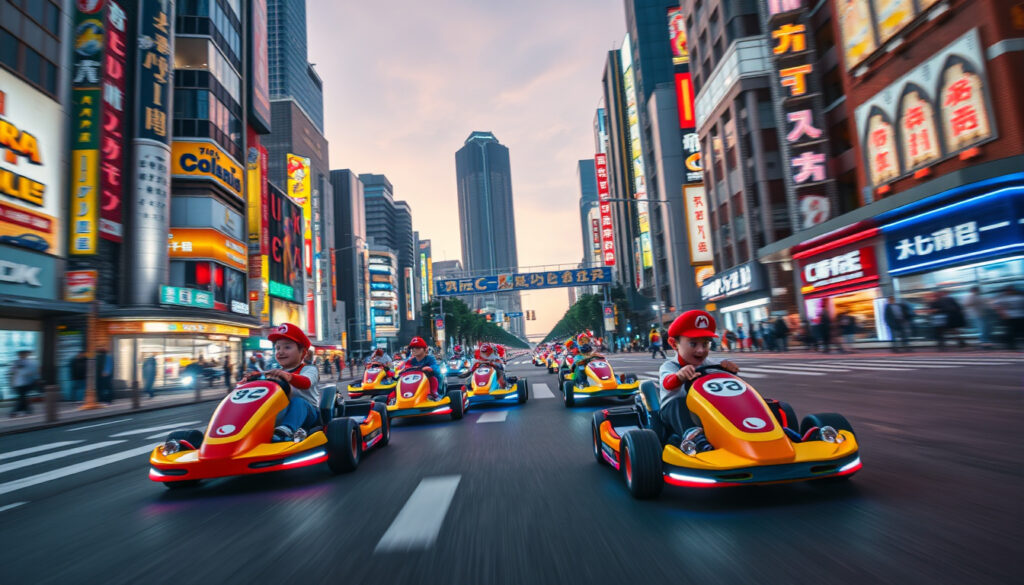
Yes—but not in the way most visitors initially imagine. Tokyo’s street go-kart experiences let you drive custom-fitted go-karts through real city streets while wearing video game, anime, or comic-inspired costumes. The most famous operator, Street Kart Tokyo, holds the distinction of being the voted No.1 official Tokyo go-kart experience.
Three neighborhoods anchor most tour routes: Shibuya (home to the iconic Shibuya Crossing scramble), Harajuku, and Omotesando. Alternative operators run routes through Asakusa, Akihabara, and even past Tokyo Tower. Each location offers a distinct urban backdrop, from neon-lit entertainment districts to historic temple areas.
The important catch: Street Kart is not affiliated with Nintendo or the Mario Kart video game series. Operators explicitly state they do not provide rental of Mario Series costumes. What you get is a street-legal go-kart experience inspired by arcade racing aesthetics, not a branded Nintendo product.
Street Kart Tokyo Overview
- Custom go-karts built for street use with working headlights and signals
- Costume rental included with most tour packages
- Group sizes typically small (4-8 participants)
- Guides lead the pack through city streets
Locations like Shibuya
Shibuya remains the flagship location for street go-karting in Tokyo. The route typically weaves through Shibuya Crossing—one of the world’s busiest pedestrian scrambles—before heading toward Harajuku and Omotesando. JAPANKART offers alternative routes departing from Shinjuku that cover Harajuku, Shibuya, and Kabukicho in a 90-minute tour, while their Kanda store routes extend to Imperial Palace, Roppongi, Tokyo Tower, and Tokyo Station in a 120-minute experience.
Is Mario Kart worth it in Tokyo?
The short answer for most visitors: yes, if you can secure a booking and meet the requirements. Reviews on platforms like TripAdvisor consistently describe the experience as a highlight of Tokyo trips, with the Shibuya Crossing drive receiving particular praise.
Travel blogger Serena’s Lenses captured the appeal in a review: “Honestly I don’t think anything beats driving through Shibuya Crossing, it really is once in a lifetime opportunity.” This sentiment appears repeatedly across travel forums and guide sites.
However, the experience isn’t for everyone. The combination of cost, licensing requirements, and physical demands means some visitors simply cannot participate. Understanding the trade-offs before booking prevents disappointment.
Pros and Cons
Upsides
- Unique way to see central Tokyo neighborhoods
- Costume element adds memorable photo opportunities
- Guided tours mean no navigation stress
- Maximum speed of 60 km/h keeps it manageable
- Group sizes stay small (typically under 10 people)
Downsides
- License requirement excludes many international visitors
- Booking windows shrink during peak travel seasons
- Prices vary significantly between operators (¥8,600-¥16,000)
- No Nintendo affiliation disappoints some fans
- Weather-dependent—rain typically cancels tours
The implication for unlicensed travelers: most go-kart companies offer only single-seater karts with no alternate transportation. If your group includes someone without a license, they cannot join the driving experience.
User Reviews from TripAdvisor and Reddit
Real traveler feedback reveals consistent themes. Positive reviews emphasize the novelty factor and the thrill of driving through iconic locations like Shibuya Crossing. Negative reviews cluster around three issues: booking difficulties during peak seasons, unexpected license requirements, and weather cancellations without clear refund policies.
“Extremely exciting and a must have experience when you visit Tokyo Japan.”
“Honestly I don’t think anything beats driving through Shibuya Crossing, it really is once in a lifetime opportunity.”
How much is Mario Kart in Tokyo Japan?
Prices span a wide range depending on operator, tour duration, and included extras. The cheapest identified option runs ¥8,600 for a one-hour tour; the most expensive tops out at ¥16,000 for 1.5 hours.
Most operators include costume rental in their base price. Add-on options typically cover extended tour durations, premium costume selections, or private group bookings.
Price transparency varies. Some operators list costs clearly on their websites; others require email inquiries or third-party booking platforms to confirm current rates.
| Operator | Location | Duration | Price (JPY) |
|---|---|---|---|
| Akiba Cart | Akihabara | 1 hour | ¥8,600 |
| Monkey Kart Asakusa | Asakusa | 1 hour | ¥10,920 |
| Street Kart Shibuya | Shibuya | 1 hour+ | ¥12,500 |
| Akihabara Tours | Akihabara | 1-2 hours | ¥11,000 |
| Shibuya Tours (costume inclusive) | Shibuya | 1 hour | ¥15,000 |
| Asakusa Tours (costume inclusive) | Asakusa | 1 hour | ¥16,000 |
| Aloha Go-Kart Tokyo Tower | Tower area | 1.5 hours | ¥16,000 |
The spread between ¥8,600 and ¥16,000 reflects differences in location, route duration, and whether costume rental is bundled. Akiba Cart offers the lowest entry point at ¥8,600 for a bare-bones Akihabara route. Adding costume rental typically adds ¥2,500-¥5,000 to most tour packages.
Pricing Details
JAPANKART’s longer tour options (90-120 minutes) command higher total prices but offer more miles through Tokyo. Street Kart Shibuya’s standard ¥12,500 rate covers the core 1-hour route through Shibuya and Harajuku, with options to extend.
2-Seater Options
Information on 2-seater kart availability remains limited across operators. Most companies explicitly state they offer single-seater karts only, which means if your travel companion lacks a valid license, they cannot participate as a driver. Some operators may offer 2-seater arrangements upon special request, but this requires direct inquiry rather than standard booking paths.
The pattern for budget-conscious travelers: peak seasons (March-May, September-November) may require 2-3 weeks advance notice compared to the standard 2-3 day booking window. Prices do not appear to fluctuate seasonally, but availability tightens considerably.
What to know before you book Mario Kart in Tokyo?
The most common reason visitors get turned away at the meeting point: missing documentation. Unlike other tourist activities in Japan, street go-karting requires a valid driver’s license from your home country plus either a Japanese license or an International Driving Permit (IDP) issued under the 1949 Geneva Convention.
IDPs cannot be obtained online once you’re traveling. They must be applied for before departure, typically through your country’s automobile association (such as AAA in the United States, which issues them for approximately $20). The permit must be physically printed—no digital versions are accepted.
Eligibility restrictions extend beyond licensing. Participants must be at least 18 years old. Pregnant women, wheelchair users, people with mobility impairments, and individuals with back problems are prohibited from participating due to safety concerns.
Requirements
- Valid driver’s license (home country) + IDP or Japanese license translation
- Physical passport for identity verification
- Minimum age: 18 years
- No pregnancy, mobility impairments, or back conditions
- Closed-toe shoes required; no high heels or slippers
- No cellphones, alcohol, or drugs during the tour
The implication for citizens of Switzerland, Germany, France, Monaco, Belgium, and Taiwan: they can use their domestic license with an official Japanese translation from JAF, their embassy, or a local organization—bypassing the IDP requirement entirely. Everyone else needs an IDP from their home country.
Booking Process
Standard booking requires 2-3 days advance notice through the operator’s website or a third-party platform like GetYourGuide. During peak seasons, this window extends to 2-3 weeks. Same-day bookings are rarely available.
The typical flow: select date/time and group size, provide license details, pay in advance, receive confirmation email with meeting point details. On the day, arrive 15-20 minutes early with your license, passport, and IDP. Staff will verify documents before assigning karts and costumes.
Cancellation and refund policies vary by operator and are not consistently published. Before booking, confirm the operator’s weather cancellation and rescheduling policy via email.
Step-by-step guide
- Check your license eligibility: Do you hold a valid license from your home country? Can you obtain an IDP before departure?
- Apply for an IDP if needed: Contact your national automobile association (AAA for US citizens; approximately $20 and a few days processing)
- Choose your operator and route: Compare Shibuya, Akihabara, Asakusa, or alternative tour operators based on location and price
- Book 2-3 days ahead (or 2-3 weeks for peak seasons): Use the operator’s website or a verified third-party platform
- Confirm the meeting point and what to bring: License, passport, IDP, closed-toe shoes
- Arrive early on the day: Allow 15-20 minutes for check-in and costume fitting
- Enjoy the tour: Follow the guide, stay within the 60 km/h speed limit, and capture photos at designated stops
The biggest barrier isn’t cost—it’s documentation. Secure your IDP before arriving in Japan, book well ahead of peak seasons, and confirm cancellation policies at booking.
Which is the best Mario Kart tour in Tokyo?
No single operator dominates every category. The “best” choice depends on your priorities: location, budget, tour duration, and included extras.
Street Kart Shibuya holds the distinction of being the voted No.1 official Tokyo go-kart experience, with routes through Shibuya, Harajuku, and Omotesando. JAPANKART offers the longest tours (90-120 minutes) with the broadest route coverage, including Imperial Palace, Tokyo Tower, and Tokyo Station options. Akiba Cart provides the lowest entry price for budget-conscious visitors who prioritize the Akihabara area.
| Factor | Street Kart Shibuya | JAPANKART | Akiba Cart |
|---|---|---|---|
| Starting Price | ¥12,500 | Varies by tour | ¥8,600 |
| Duration Options | 1 hour+ | 90-120 minutes | 1 hour |
| Key Route | Shibuya, Harajuku | Multiple (Kanda, Shinjuku) | Akihabara |
| Reputation | No.1 Official Tokyo Go-Kart | Extended Tokyo tours | Budget option |
| Official Affiliation | Independent (not Nintendo) | Independent | Independent |
For first-time visitors prioritizing the iconic Shibuya Crossing experience, Street Kart Shibuya remains the benchmark. Their consistent routes, established safety record, and status as the most-reviewed operator make them a reliable choice.
Top Providers
JAPANKART suits visitors wanting maximum Tokyo coverage in a single tour. Their Kanda store departing tours through West Tokyo including Imperial Palace, Roppongi, Tokyo Tower, and Tokyo Station offer the most comprehensive urban route identified.
Street Kart vs Others
Comparing operators reveals consistent trade-offs. Budget operators like Akiba Cart offer lower prices but fewer route options and shorter durations. Premium operators include costume rental and extended routes but command higher prices. All operators share the same licensing requirements and age restrictions—there is no “easier” option for unlicensed visitors.
What sets Street Kart Shibuya apart is volume and reputation. As the most-reviewed and most-recognized operator, they have built brand equity that smaller operators haven’t matched. Whether that justifies the premium is a personal calculation based on your priorities.
Confirmed facts
- License requirement from providers
- Booking advance from guides
- Maximum speed limited to 60 km/h
- No Nintendo affiliation
What’s unclear
- Exact 2-seater pricing and availability
- Cancellation policies by operator
- Weather rescheduling procedures
Related reading: JPY to AUD Exchange Rate · Australian Drivers License Changes
japankart.com, streetkart.com, tripadvisor.com, kart.st, yavajapan.com, kart.st
Frequently asked questions
How long does Mario Kart Tokyo take?
Standard tours run 1 hour with most operators. JAPANKART offers 90-minute and 120-minute extended options. Aloha Go-Kart’s Tokyo Tower route runs 1.5 hours.
Is Mario Kart big in Japan?
Street go-karting has become a popular tourist activity in Tokyo since the mid-2010s, though it’s not affiliated with Nintendo. The experience draws visitors seeking novelty ways to see the city.
What are Mario Kart Tokyo requirements?
Participants need a valid driver’s license from their home country plus either a Japanese license with official translation or an International Driving Permit under the 1949 Geneva Convention. Minimum age is 18. Physical passport required for check-in.
Where to buy Mario Kart Tokyo tickets?
Book directly through operator websites or via verified third-party platforms like GetYourGuide. Advance booking of 2-3 days is standard; 2-3 weeks during peak seasons (March-May, September-November).
Mario Kart Tokyo Shibuya details?
Street Kart Shibuya offers 1-hour+ tours through Shibuya Crossing, Harajuku, and Omotesando. Starting price around ¥12,500. Maximum speed limited to 60 km/h per Japanese road law.
Mario Kart Tokyo 2 seater availability?
Most operators offer only single-seater karts. 2-seater availability is not consistently documented—special requests may be possible but require direct inquiry with the operator.
Street Kart Tokyo differences from other operators?
Differences center on location (Shibuya vs Akihabara vs Asakusa), tour duration, and price. All operators require the same licensing documentation and age restrictions. Costume rental inclusion varies by operator.
For visitors who can meet the documentation requirements, Tokyo’s street go-kart experiences deliver something genuinely unique—the thrill of driving through one of the world’s busiest intersections in a custom go-kart, camera-ready costume and all. The practical hurdles (IDP, advance booking, peak-season competition) are real but manageable with planning. Those who skip the prep work, though, often find themselves turned away at the meeting point.
More related posts
 Harley Reid: Salary, Girlfriend, Net Worth, Stats & FAQs (2025)
 Bay of I land Travel Guide: Worth Vi iting? Be t Town
 Words That Rhyme: 150+ Rhyming Words and How to Find Them
 Nick Cannon: Kids, Health, and Son Zen’s Death
 Jessica Sergis: Partner, Salary, Net Worth, and Biography
 Andy Byron: CEO Resigns After Coldplay Kiss Cam Scandal
 Josh Inglis IPL 2026: LSG Debut, Release from PBKS & Career Stats
 Swann Security Camera Review: Is It Worth It? Problems & Lifespan
