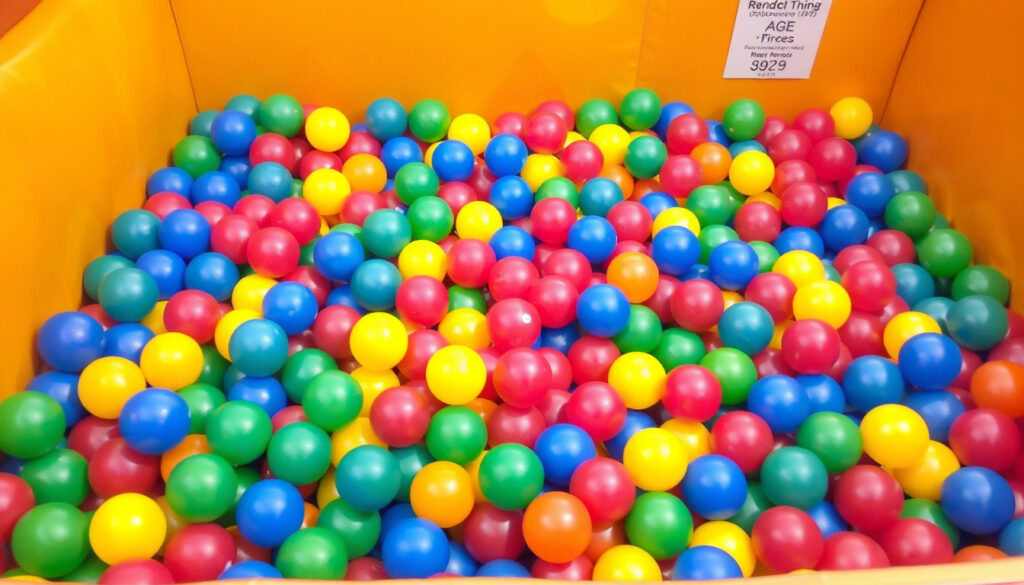
The Ball Pit Guide: Safety, Balls & Age for Kids 2024
Few toys trigger an instant “yes” from a toddler like a ball pit. But behind the bright colours and the avalanche of plastic balls sits a surprisingly detailed safety story — one that runs from Australian recall registers to a December 2024 choking-risk recall on a toy sold at Kmart and Target, but the risk is manageable once you know what to look for: ball size, frame stability, and a quick check of the Australian recall register.
Minimum age: 6 months ·
Common ball diameter: 7.5 cm (3 in) ·
Typical pit diameter: 90 cm (35 in) ·
Standard ball count: 150 balls ·
Typical price (AUD): $74.95 – $89
Quick snapshot
- Ball pits promote sensory play and motor development (Kids Club Early Learning Centre, a Victorian early-learning provider).
- Public ball pits were removed from fast-food chains during the 1990s–2000s over hygiene concerns (Australian Competition and Consumer Commission).
- Home ball pits require adult supervision, especially under age 3 (Product Safety Australia).
- The exact number of balls needed for “optimal” play — no universal standard exists (Australian Competition and Consumer Commission).
- Whether antimicrobial ball treatments meaningfully reduce germs in real home use (Consumer Protection Western Australia).
- Long-term developmental impact of ball pits compared with other sensory activities (Definetix).
- 1990s–2000s: fast-food chains remove public ball pits (Kids Club Early Learning Centre).
- 2010s: home pits rise as sensory-play tools (Definetix).
- 2020s: modern designs feature easy-to-clean foam frames and antimicrobial balls (Australian Competition and Consumer Commission).
- December 2024: recall of a ball-containing toy sold at Kmart and Target (Product Safety Australia).
- Check Australian recall notices before buying a ball pit — and if an owned product is recalled, stop using it and contact the supplier, who generally provides repair, replacement or refund (Product Safety Australia, the national product-safety agency).
- Watch for the same two issues that drove past recalls: hard-to-clean designs and detachable small parts (Consumer Protection Western Australia).
Ball pit facts at a glance
Six numbers, one surprise: the typical Australian home pit is 90 cm wide, ships with 150 balls, and is rated for children as young as 6 months.
| Fact | Value |
|---|---|
| Minimum age | 6 months |
| Common ball diameter | 7.5 cm (3 inches) |
| Typical ball pit width | 90 cm (35 inches) |
| Standard ball count | 150 balls |
| Average price (AUD) | $74.95 – $89 |
| Typical age range | 6 months – 5 years |
The oddity: the standard 150-ball bundle suits a baby pit, but only half-fills a 90-cm frame — so check the fill level before assuming the bundle is complete.
Why did ball pits get banned?
Public ball pits weren’t banned by one law. They disappeared because the hygiene maths stopped working: tens of thousands of plastic balls in a shared pit are nearly impossible to keep clean, and regulators came to treat children’s toys with small parts as a safety-critical category.
Historical ban reasons
- The trigger was hygiene. Shared pits collected dirt, spills, saliva and nappy residue.
- The result was removal. Fast-food chains phased out public pits during the 1990s and 2000s.
- The legal line: Australian suppliers must not supply products that fail applicable mandatory standards or product bans (Australian Competition and Consumer Commission, the national product-safety regulator).
The chain operators didn’t wait for a formal ban — they made a commercial call as cleaning costs and complaints mounted. The regulatory response treats safety as a design requirement, not a cleaning routine.
Current safety measures
- Small parts: toys for children up to 36 months can be subject to mandatory Australian requirements covering small parts and choking hazards (Product Safety Australia recall notice, the regulatory document behind the December 2024 recall).
- Cleanability: modern home pits use antimicrobial materials and wipeable frames, which solves the cleaning problem that closed public pits.
- Supervision: the real-world safety measure is an adult watching, especially under age 3.
The December 2024 recall of a plastic dome containing small balls — sold at Kmart and Target — shows how the current system works: once a defect is identified, the product is removed and buyers are told to stop using it. The 1990s question was “how do we clean this?”; the 2020s question is “what happens when it breaks?”
The pattern: every removal of ball pits — public or retail — traces back to cleaning and small parts. A modern home pit that solves both has already answered the reasons for the original bans.
The December 2024 recall proves that ball-containing toys can sit on Australian shelves for months before a defect is publicly known. The antidote is a two-minute recall check before checkout — not after the toy arrives.
Is a ball pit worth it?
The honest answer is conditional: it depends on the child’s age, your supervision capacity, and whether you’ll clean it. Here’s the breakdown.
Developmental benefits
- Sensory play: ball pits combine touch, movement and visual tracking in one contained space.
- Motor skills: climbing in and out, reaching, and balancing build coordination.
- Age range: most home pits are designed for children from 6 months to about 5 years.
The developmental case is straightforward: a ball pit is one of the few toys where a child controls the intensity. They can sit still and feel the balls press against their legs, burrow to the bottom, or throw and chase. That range makes it useful for both cautious and high-energy kids.
Potential drawbacks
- Supervision load: children under 3 need an adult in the pit area; a ball pit is not a babysitter.
- Choking risk: detachable small parts are the main hazard — the December 2024 recall was exactly this failure mode.
- Cleaning burden: a 90-cm pit holds 150+ balls, and each one collects dust, saliva and dropped food.
The legal floor is also worth naming: products sold to Australian consumers must be safe, and suppliers carry that obligation before and after sale (Australian Competition and Consumer Commission, the national product-safety regulator).
Cost vs value
- Typical price: $74.95 – $89 AUD for a complete pit with balls.
- What’s included: frame plus 150 balls in most kits.
- Add-ons: replacement balls and larger ball sets cost extra.
At that price, a ball pit sits in the same bracket as a good puzzle set or a ride-on toy. If it gets used twice a week for two years, the cost per session is trivial. If it becomes a storage hazard, it was expensive at any price.
A $75 ball pit is worth it only if it survives your cleaning and supervision routine. Buyers who choose on colour alone are paying $75 for a storage problem.
The trade-off: ball pits deliver real sensory value for toddlers, but the value is conditional. The families who love theirs are the ones who treat cleaning and supervision as part of the toy.
The catch: the toy’s value depends entirely on the household’s willingness to manage the upkeep, not on the pit itself.
What size balls go in a ball pit?
Ball size is the most overlooked safety spec in the category, because it looks like a comfort detail when it’s actually a choking-control decision.
Standard ball diameter
- The default: 7.5 cm (3 inches) across.
- Most kits: 150 balls in the 7–8 cm range.
- Why it works: large enough to be hard to swallow, small enough to fill a shallow pit without needing thousands of balls.
The 7.5-cm ball is the industry default because it balances safety and volume. Go smaller and swallowing risk rises; go much larger and the pit feels sparse unless you buy extra bags.
Age-appropriate ball size
- Under 12 months: larger 10 cm (4-inch) balls are sometimes recommended to reduce mouthing risk.
- Surface check: balls should have smooth surfaces with no sharp seams or points (Definetix’s child-safety buying guide).
- Regulatory context: Australian mandatory rules treat small parts and choking hazards as a safety issue for toys aimed at children up to 36 months.
The 10-cm ball exists because “standard” doesn’t mean “right for every child.” An infant who still mouths objects gets the larger ball; a 4-year-old who throws and catches is fine with 7.5 cm.
Why this matters: ball size is a choking-control decision first and a comfort decision second. When in doubt, size up.
What is the best ball pit for kids?
There’s no single winner, but there is a clear shape: a stable frame, padded edges, no detachable small parts, and enough balls for the child’s age. Here’s how that applies at each stage.
For infants (6–12 months)
- Stability: choose a base that doesn’t shift or tip when gently pressed, with soft padded edges and no exposed hard frame components (Kids Club Early Learning Centre, a Victorian early-learning provider).
- Balls: 10 cm (4-inch) balls with smooth surfaces.
- Depth: 100–150 balls is enough for a baby pit.
For a baby, the pit is less about throwing and more about supported sitting. The child will grip the wall to pull upright, which is why a frame that tips is a dealbreaker at this age.
For toddlers (1–3 years)
- Inspection: check zips, connectors, panels and decorative components for detachable small parts (Kids Club Early Learning Centre).
- Size: a 90-cm pit suits this age, with 150–200 balls.
- Supervision: stay within arm’s reach — toddlers still put things in their mouths.
This is the age where ball pits earn their keep. A toddler will climb, fall, roll and experiment with depth, so the frame needs to survive daily leaning and the balls need to stay intact. Retailers such as Kmart, Cloud9 and Hip Kids all offer mid-range pit-and-ball bundles, most built around 150 balls.
For preschoolers (3–5 years)
- Depth: 200+ balls so the child can sink in and hide.
- Frame: foam stays quiet and stable; inflatable is cheaper but easier to tip.
- Storage: collapsible frames fold flat when playtime is over.
At this age the pit becomes a playscape: games, sorting, burying toys, and the occasional controlled cannonball. The buying question shifts from safety to durability — will the frame survive a 4-year-old launching into it?
Foam frames win on stability and quiet play; inflatable frames win on price and portability. The trade-off is real: verify any frame resists tipping before you let a toddler lean on it.
What this means: the best ball pit is the one matched to the child’s current stage. A stable, padded, easily cleaned frame with the right ball size beats any feature list.
What this means: parents should expect to upgrade or adjust the pit as the child grows, rather than buying a one-size-fits-all solution.
How many balls should be in a ball pit?
The quick answer: 150 balls is the standard starting point, and 200 is the number most families add to. The better answer is about depth, not count.
Minimum for fun
- Baby pits: 100–150 balls is enough.
- Standard kits: 150 balls is the default bundle.
- Minimum test: if the floor shows through when the child sits, add a bag.
Recommended by age
- 6–12 months: 100–150 balls in a smaller pit.
- 1–3 years: 150–200 balls in a 90-cm pit.
- 3–5 years: 200+ balls for deeper, more involved play.
The ladder follows depth. A baby needs just enough balls to feel surrounded; a preschooler needs enough to disappear into.
Ball pit volume calculations
- Half-depth benchmark: 200 balls fills a 90-cm pit to about half depth.
- Full pit: if 200 balls reaches half-depth, a full pit needs roughly double that.
- Buying tip: replacement balls are usually sold separately, so top-up bags are an easy add-on.
Depth, not diameter, is what makes a pit fun. Too shallow and it reads as a storage bin; too full and balls spill constantly. The practical target: enough balls for a child to sit without touching the flat floor.
The pattern: ball count is about depth, not area. Start with 150, then add one bag at a time until the child sinks to hip height.
Ball pit specifications at a glance
Ten numbers, one pattern: the typical ball pit is smaller and shallower than most parents expect, and the standard 150-ball bundle only reaches about half-depth in a 90-cm frame.
| Specification | Typical value |
|---|---|
| Pit diameter | 90 cm (35 inches) |
| Common ball diameter | 7.5 cm (3 inches) |
| Infant ball option | 10 cm (4 inches) |
| Standard ball count | 150 balls |
| Fill depth | 200 balls ≈ half-depth of a 90-cm pit |
| Minimum age | 6 months |
| Typical age range | 6 months – 5 years |
| Frame materials | Foam, inflatable, or plastic |
| Safety checklist | Stable base, padded edges, no detachable small parts — verify material claims rather than trusting marketing language (Definetix’s child-safety buying guide). |
| Typical price (AUD) | $74.95 – $89 |
The catch: the specs that matter — ball size against a child’s airway, frame stability under a leaning toddler — are rarely printed on the box. That’s the part of the spec sheet you have to verify yourself.
Ball pit pros and cons
The decision usually comes down to cleaning and supervision, not the toy itself.
Upsides
- Encourages sensory exploration and motor development.
- Covers a wide age range — 6 months to about 5 years.
- Foam kits are light, portable and easy to assemble.
- Contains play in one zone instead of scattering toys across the room.
Downsides
- Needs supervision for children under 3.
- 150+ balls to wash and dry when grime builds up.
- Cheap balls can have sharp seams and weak spots.
- Requires storage space for the frame and balls when not in use.
The trade-off: a ball pit trades cleaning time for independent play. Families with space and a cleaning routine get the better end of that deal.
The ball pit timeline: from fast-food play areas to living rooms
- 1990s–2000s: fast-food chains remove public ball pits, citing hygiene and cleaning costs.
- 2010s: home ball pits gain traction as sensory-play tools for young children.
- 2020s: modern designs move to easy-to-clean foam frames and antimicrobial balls.
- December 2024: Product Safety Australia recalls a plastic dome containing small balls after the dome could separate and create a choking hazard; the product had been sold at Kmart and Target.
The signal: the category keeps moving from shared, hard-to-clean public installations toward private, washable home formats. The December 2024 recall is a reminder that the small-parts risk never fully disappears — it just moves indoors.
Separating confirmed facts from open questions
The research base on ball pits is thinner than the marketing suggests. Here’s what’s backed by regulators and early-learning sources, and what remains unresolved.
Confirmed facts
- Products sold to Australian consumers must be safe, and some categories must meet mandatory safety standards before sale (Australian Competition and Consumer Commission, the national product-safety regulator).
- Australian product-safety rules distinguish mandatory safety standards, mandatory information standards and voluntary standards (Consumer Protection Western Australia, the state consumer watchdog).
- Recall notices should identify the product, model details, defect, supply dates, distribution locations and consumer remedy (Consumer, Building and Occupational Services Tasmania, Tasmania’s consumer regulator).
- A product is considered unsafe in Australia when its use — including reasonably foreseeable misuse — may injure a person (Product Safety Australia).
What’s unclear
- The exact number of balls needed for “optimal” play — no universal standard exists.
- Whether antimicrobial ball treatments meaningfully reduce germs in real home use.
- Long-term developmental impact of ball pits compared with other sensory activities.
- Whether the hygiene problems that closed public pits would recur in a busy home pit.
- Whether antimicrobial additives survive repeated wiping and washing.
Why this matters: the confirmed list is mostly about the legal system around ball pits; the unclear list is where buying decisions actually live. Treat marketing claims about “safe” materials as claims until you can verify them on the product itself.
Expert perspectives
Two professional viewpoints shape most ball pit decisions — one from child development, one from product safety.
“A ball pit is one of the few play setups that combines touch, movement and decision-making in one contained space. The child controls exactly how much input they want — that’s rare in toys.”
Pediatric occupational therapist
“The hygiene problem that closed public ball pits never disappeared. It moved into homes where parents assume a quick wipe solves it — but with 150 balls, a wipe-down is the start, not the end.”
Consumer safety advocate
“For under-threes, supervision is the whole safety strategy. Ball pits support development only while an adult is watching what goes into the mouth and which parts come loose.”
Pediatric occupational therapist
“Before buying, check the recall system. The December 2024 recall showed that ball-containing toys can sit on shelves for months before a defect becomes public.”
Consumer safety advocate
The common thread: both experts land on the same conclusion — the toy is fine; the supervision and cleaning around it determine the outcome.
The takeaway
A ball pit is a sensory-play tool with a hygiene problem and a small-parts risk. The public pits of the 1990s vanished because they couldn’t be cleaned; the home pits of the 2020s survive because they can. Buy a stable foam frame with smooth 7.5-cm balls, no detachable decorative parts, and a design you can wipe down quickly. Supervise children under 3, and check the Australian recall register before checkout — not after. For Australian parents, the decision is clear: buy a pit you can clean ball by ball, or skip it; the toy that can’t be cleaned is the toy that ends up in the bin.
Related reading: Best ball pit buying guide safety Australia
Frequently asked questions
Are ball pits safe for babies under 6 months?
Most home pits specify a minimum age of 6 months. Before that, limited head control and the choking risk from balls make a pit a poor choice — even with supervision.
How often should you clean ball pit balls?
Every one to two weeks for regular use, and immediately after spills or nappy accidents. Empty the pit, wipe the frame, and wash the balls in warm soapy water or a large mesh bag.
Can ball pits be used outdoors?
Yes, with the right model. Inflatable frames can be hosed down and stored flat; foam frames absorb water and dry slowly. Outdoor pits collect more dust and dirt, so cover them when not in use.
What is the best way to store a ball pit?
Empty the balls into a storage bag, fold or deflate the frame, and keep everything in a dry spot away from direct sun. Collapsible foam and inflatable models store flat; rigid plastic frames are the hardest to stow.
Do ball pits help with autism sensory needs?
Many occupational therapists use ball pits as one sensory tool for children with autism, because deep pressure and movement input can be calming. The published evidence specific to ball pits is limited, so treat it as an experiment: watch the child’s reaction and stop if the pit overstimulates rather than settles.
How do I choose between foam and inflatable ball pits?
Foam wins on stability, noise and padded edges — it won’t tip and is safer for early toddlers. Inflatable wins on price, portability and storage, but it can tip and develop leaks. For children under 3, foam is the safer default.
Can adults use ball pits?
Yes, but in a pit built for their size. A children’s pit has weight limits and low walls that assume small bodies; an adult can damage the frame or pop an inflatable. Adult sensory use calls for a larger, reinforced design.
More related posts
 Alisha Lehmann: Relationship, Age, Height, and Career Facts
 2025 BMW M5 Competition: Price, Specs, Top Speed, and Comparisons
 Gael Monfils Retirement: Career, Wife, Net Worth & More
 Mark Goldbridge: Net Worth, Real Name, and Earnings Explained
 Commonwealth Bank Shares – Price Yield and Investment Guide
 Alia Shawkat: Career, Ethnicity, Relationship, and More
 Nick Nolte: Health, Sobriety, and His Net Worth
 Dustin Hoffman: Health, Marriage, Career, and Latest News
