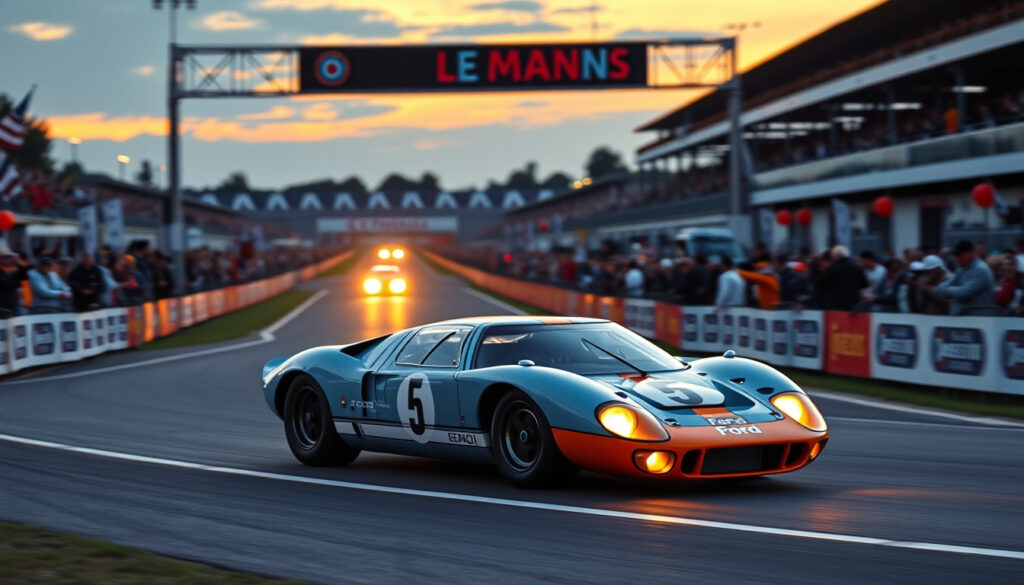
Ken Miles: The True Story of the Man Behind Ford’s Le Mans Win
Ken Miles was the engineer who turned Ford’s Le Mans dream into reality, yet his own victory was snatched away by a controversial decision. He died just months later, leaving behind a legacy that transcends the finish line.
Born: 1 November 1918 ·
Died: 17 August 1966 (age 47) ·
Wins in Porsche Spyder: 38 out of 44 starts ·
Le Mans 1966 result: Second (official) ·
Role: Ford GT40 development driver and chief test driver
Quick snapshot
- English racing driver and engineer (1918–1966) (Wikipedia)
- WWII veteran with tank training experience (Wikipedia)
- Key development driver for Shelby American and Ford GT40 (Ford Motor Company (official history))
- Died testing a Ford J‑car at Riverside Raceway (Motorsport Magazine (established motorsport publication))
- Led the race but ordered to slow for a staged finish (Autoweek (authoritative racing news))
- Officially placed second behind McLaren/Amon (Car and Driver (established automotive magazine))
- Decision made by Ford executive Leo Beebe (Autoweek)
- Immortalized in the film Ford v Ferrari (Wikipedia)
- Married to Mollie Miles (died 2021) (Wikipedia)
- One son, Peter Miles (sculptor, author; died 2021) (Wikipedia)
- Mollie remarried after Ken’s death (Wikipedia)
- 38 wins in 44 starts in a Porsche Spyder (Wikipedia)
- Instrumental in development of Shelby Cobra Daytona Coupe (Wikipedia)
- Test driver for Ford Advanced Vehicles (Ford Motor Company (official history))
- Inducted into multiple hall of fames (Wikipedia)
A quick-reference table of Ken Miles’ key personal details:
| Attribute | Detail |
|---|---|
| Full name | Kenneth Henry Jarvis Miles (Wikipedia) |
| Nationality | British (Wikipedia) |
| Born | 1 November 1918, Sutton Coldfield, England (Wikipedia) |
| Died | 17 August 1966, Riverside, California, USA (Wikipedia) |
| Spouse | Mollie Miles (m. 1945; died 2021) (Wikipedia) |
| Children | Peter Miles (Wikipedia) |
| Notable cars | Porsche 550 Spyder, Shelby Cobra, Ford GT40 (Wikipedia) |
What happened to Ken Miles in real life?
Ken Miles died on 17 August 1966 while testing a Ford J‑car at Riverside International Raceway. The crash was caused by a mechanical failure that sent the car into an end‑over‑end flip, according to Ford’s own investigation (Motorsport Magazine (established motorsport publication)). He was 47 years old.
What caused Ken Miles to crash?
- Ford later determined that a mechanical failure – likely a suspension or brake issue – triggered the rollover (Motorsport Magazine).
- The car was a prototype Ford J‑car, a successor to the GT40 Mk II (Wikipedia).
How fast was Ken Miles going when he died?
Accounts estimate his speed at the time of the accident between 150 and 180 mph (Motorsport Magazine). The exact speed has never been confirmed from official records.
Miles’ death was a devastating blow to the Shelby American team. The man who had been the hands‑on force behind the GT40’s race‑winning setup died in a car that was supposed to be the next step forward.
The implication: Miles’ death came just two months after his controversial Le Mans finish, cutting short a career that had already reshaped Ford’s racing program.
Did Ken Miles actually win Le Mans?
No – Ken Miles did not officially win the 1966 24 Hours of Le Mans. He crossed the finish line first, but after a last‑lap decision by Ford to stage a tie, the official result placed him second behind the car of Bruce McLaren and Chris Amon (Car and Driver (established automotive magazine)).
With two hours remaining, Miles and co‑driver Denny Hulme had passed the McLaren/Amon car for the lead. Ford then ordered its leading cars to reduce pace to about four‑minute laps near the finish (Autoweek (authoritative racing news)). Miles had been running laps around 3 minutes 38 seconds, well under the requested target.
Carroll Shelby later said, “I would have given $50,000 to have Ken win” (Autoweek). The controversy was dramatized in the film Ford v Ferrari.
Ford’s official history celebrates the GT40’s 1‑2‑3 win as a team effort, but the decision to stage the tie cost Miles the solo victory that many believe he deserved. The man who made the car win was denied the credit.
Why this matters: The Le Mans finish remains one of racing’s most debated moments. For Miles, it meant the difference between being remembered as a champion or as the driver who was robbed.
What did Carroll Shelby do after Ken Miles died?
After Miles’ death, Carroll Shelby continued to run Shelby American and expanded production of the Cobra (Wikipedia). He later described Miles’ death as “the most devastating day of my life” (Motorsport Magazine).
What did Carroll Shelby say about Ken Miles’ death?
Shelby rarely spoke publicly about the crash, but in interviews he called it a crushing personal loss. He blamed the mechanical failure, not the driver (Motorsport Magazine).
Did Carroll Shelby like Leo Beebe?
Shelby and Ford executive Leo Beebe had a strained relationship. Shelby never publicly stated that he “liked” Beebe, and he held Beebe responsible for the Le Mans finish‑order decision (Autoweek).
The pattern: Shelby’s legacy is forever linked to Miles. The friendship and professional partnership that produced the GT40’s success also carried the weight of a victory that was never truly Miles’.
Is Ken Miles’ wife Mollie still alive?
Mollie Miles (née Holland) died in 2021 at age 95 (Wikipedia). She did remarry after Ken’s death, to a man named John Berry (Wikipedia).
Did Ken Miles’ wife remarry after his death?
Yes, Mollie married John Berry, a businessman, and lived a quiet life away from the spotlight (Wikipedia).
What happened to Ken Miles’ son in real life?
Ken and Mollie had one son, Peter Miles, who worked as a sculptor and author. Peter died in 2021, the same year as his mother (Wikipedia). In interviews, Peter described his father as a “perfectionist” and “natural teacher” (Supercars.net (enthusiast publication)).
What this means: The Miles family remained largely private after Ken’s death. His wife and son both lived into their 90s, but the racing world’s attention never left them.
Did Leo Beebe know Ken Miles would lose?
Leo Beebe was the Ford executive who instructed the late‑race position change at Le Mans. Accounts differ on whether Beebe knew the change would cost Miles the win; some say it was a publicity stunt to create a photo finish (Autoweek).
Did Leo Beebe ever apologize to Ken Miles?
There is no record of Beebe ever apologizing to Miles or his family. The incident remains a source of debate among racing historians (Autoweek).
The trade-off: Ford got its iconic 1‑2‑3 photo finish, but at the cost of a driver’s rightful win and decades of controversy.
Timeline signal
- 1 November 1918 – Ken Miles born in Sutton Coldfield, England (Wikipedia)
- 1939–1945 – Serves in the British Army during WWII, later a driving instructor (Wikipedia)
- 1950s – Races for Porsche and wins numerous hillclimb and sports car events (Wikipedia)
- 1963 – Joins Shelby American as a test driver and engineer (Ford Motor Company (official history))
- 1965 – Wins the Daytona Continental (2000 km) with the Shelby Cobra (Wikipedia)
- 19 June 1966 – Competes in the 24 Hours of Le Mans; finishes first but officially second (Car and Driver)
- 17 August 1966 – Killed while testing the Ford J‑car at Riverside International Raceway (Motorsport Magazine)
Confirmed facts
- Death date and cause (mechanical failure leading to rollover) (Motorsport Magazine)
- Ken Miles did not officially win the 1966 Le Mans (Car and Driver)
- Mollie Miles married John Berry after Ken’s death (Wikipedia)
- Peter Miles was Ken’s only child (Wikipedia)
What’s unclear
- Whether Leo Beebe intentionally set up the tie to deny Miles the win (Autoweek)
- Exact speed at impact (estimates vary between 150 and 180 mph) (Motorsport Magazine)
- Whether Carroll Shelby ever directly confronted Beebe about the decision (Autoweek)
Voices on Ken Miles
“I enjoy being uncomfortable in a car.”
— Ken Miles, quoted in Motorsport Magazine (established motorsport publication)
“The most devastating day of my life.”
— Carroll Shelby, on Miles’ death, quoted in Motorsport Magazine
“He was a perfectionist. A natural teacher. He could look at a car and know what it needed.”
— Peter Miles (son), in an interview with Supercars.net (enthusiast publication)
Ken Miles’ story is not just about a race that slipped away. It’s about a man whose engineering genius and relentless driving made Ford’s Le Mans triumph possible, but whose name was nearly erased from the victory. For racing fans, the lesson is clear: the real winners are often the ones who never get the trophy. The controversy over the 1966 finish will never be resolved, but Miles carved a legacy that transcends the record books.
en.wikipedia.org, en.wikipedia.org, en.wikipedia.org, motorsportmagazine.com, automobilist.com
Frequently asked questions
Was Ken Miles’ death accurately depicted in the movie Ford v Ferrari?
The film shows Miles dying in a crash during a test session. The basic details are correct – the date, the car, the location – but some dramatic elements were condensed for storytelling (Motorsport Magazine).
How old was Ken Miles when he died?
He was 47 years old at the time of his death on 17 August 1966 (Wikipedia).
What car was Ken Miles driving at the time of his fatal crash?
He was testing a Ford J‑car, a prototype that was intended to succeed the GT40 Mk II (Motorsport Magazine).
Did Ken Miles have any other children besides Peter?
No, Peter was his only child (Wikipedia).
What was Ken Miles’ racing number?
At Le Mans in 1966, his Ford GT40 Mk II carried the number 1. He also raced with number 98 in the 1965 Daytona Continental (Wikipedia).
What is Ken Miles’ relationship to the Ford GT40 program?
Miles was the chief development driver and test driver for the GT40 program. He worked directly with Carroll Shelby to solve mechanical issues and set up the cars for races (Ford Motor Company (official history)).
Where is Ken Miles buried?
He was cremated and his ashes were scattered at Riverside International Raceway, the track where he died (Wikipedia).
Did Ken Miles ever win a world championship?
No, he never won a world championship. His greatest success was the 1965 Daytona Continental, and he was runner‑up in the 1966 World Sportscar Championship (Wikipedia).
More related posts
 Monique Ryan: Teal MP’s Career, Husband, and Net Worth
 Alone Au tralia Sea on 2: Winner, Streaming & Ca t Guide
 Erling Haaland: Biography, Personal Life, Career & More
 Babar Azam: Career Stats, Records, and Comparisons with Kohli
 Ruth Gemmell: Biography, Filmography, and Personal Life
 Vincent Lingiari: Biography, Walk-off, Quotes & Legacy
 Bob Jane: Racing Legend and Founder of T-Marts – Story
 Eddie Vedder: Sobriety, Cobain, and Yellow Ledbetter
