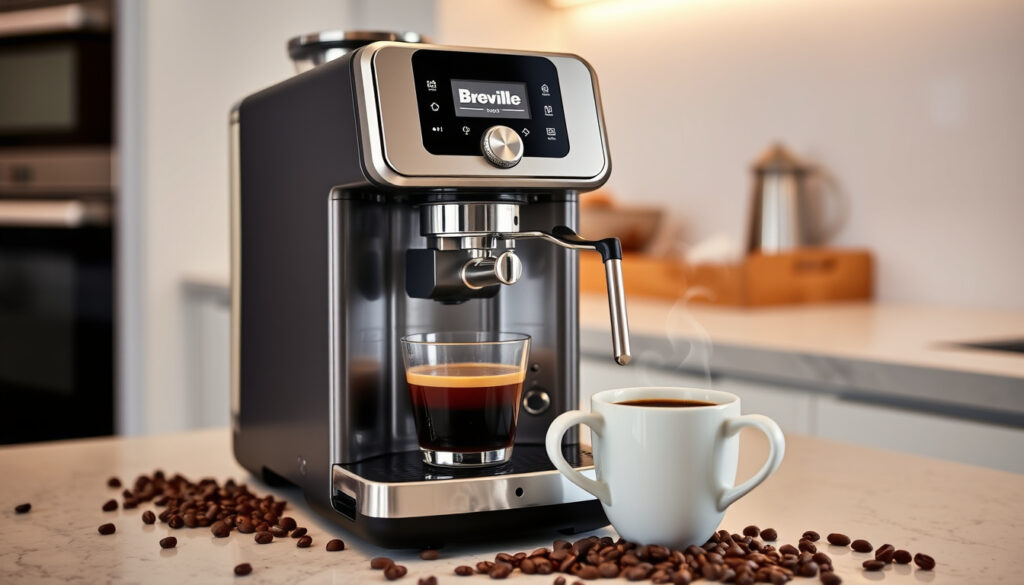
Breville Barista Touch Review: Pros, Cons & Comparisons
The Breville Barista Touch BES880BSS delivers on its espresso promises despite a learning curve that initially frustrates many buyers. This touchscreen-equipped machine pairs automatic milk texturing with compact design, targeting home baristas who want café-quality output without café-level expertise.
Display Type: Touch screen · Milk System: Automatic texturing · Boiler Type: Single boiler · Footprint: Compact · Model Code: BES880
Quick snapshot
- 3-second heat-up time via ThermoJet system (YouTube Review)
- Touchscreen with built-in tutorials (YouTube Review)
- Automatic steam wand for milk texturing (YouTube Review)
- Whether Oracle Touch genuinely outperforms for experienced baristas
- If DeLonghi machines edge out Breville on long-term durability
- Actual street pricing across regions
- 2025 review content active across major platforms
- 2026 comparison cycle beginning with new model releases
- Black Friday pricing expected Q4
- Potential firmware updates for recipe customization
Verified specifications for the BES880 confirm its core hardware profile.
| Specification | Value |
|---|---|
| Model | BES880 |
| Display | Touch screen |
| Milk Frothing | Automatic |
| Boiler | Single |
| Colors | Almond Nougat, Green |
| Weight | 21.8 lb |
| Power Rating | 1680 W |
| Heat-Up Time | 3 seconds |
| Grinder Settings | 30 |
| Custom Recipes | Up to 8 |
| Warranty | 2 years |
Is the Barista Touch any good?
The honest answer from expert testing is a qualified yes — the machine delivers on its core promises, though “good” depends heavily on what you’re after. Food & Wine has evaluated the BES880BSS alongside competitors, and the consensus points to solid espresso extraction paired with a genuinely intuitive interface that lowers the barrier to entry for home baristas.
Expert test results
Coffeeness, a specialist espresso publication, describes the Barista Touch as producing “fantastic espresso” with minimal user intervention required. The touchscreen guides users through grinding, brewing, and milk frothing with on-screen prompts that eliminate the guesswork traditionally associated with home espresso. The ThermoJet heating system reportedly reaches extraction temperature in 3 seconds, a meaningful advantage on busy mornings when you’re not brewing for a crowd.
The machine holds a 4.4-star customer rating, placing it above many competitors in the mid-range segment. For context, the Oracle Touch — Breville’s step-up model — carries a lower rating in some user assessments, suggesting that added complexity doesn’t always translate to user satisfaction.
User feedback highlights
Reddit discussions reflect generally positive sentiment, with users praising the automatic milk texturing as a genuine time-saver for daily lattes and cappuccinos. One user notes the machine “does a fantastic job with regular milk,” while others appreciate the five pre-programmed café favorites that cover the most common home espresso orders without requiring manual adjustment. The integrated conical burr grinder with 30 settings receives consistent praise for grind consistency, though some advanced users wish for finer increment control.
The implication: this machine targets the sweet spot between capability and convenience. It won’t satisfy flavor chasers who demand manual profiling, but for the majority of home users wanting café-quality drinks without a steep learning curve, the Barista Touch delivers.
What is the difference between Breville Barista Express and Touch?
The gap between Express and Touch comes down to one fundamental distinction: manual interaction versus guided automation. Both machines share the same DNA — conical burr grinder, PID temperature control, similar footprint — but the Touch adds a touchscreen interface and automatic milk texturing that fundamentally changes the user experience.
Key feature gaps
The Barista Express relies on manual steam wand operation, requiring users to gauge milk temperature by hand and texture foam through feel and timing. The Touch eliminates this variable entirely. Its steam wand includes a built-in thermometer and automatically adds air to the milk based on programmable texture settings, meaning you set your preference once and the machine reproduces it consistently.
The Express uses a single-boiler architecture identical to the Touch, so neither machine can brew espresso and steam milk simultaneously. If you’re making multiple milk drinks in sequence, expect a brief wait between extraction and frothing on both models.
Performance contrasts
In head-to-head assessments, the Touch’s touchscreen proves its value beyond novelty. Built-in tutorials walk new users through first-time setup and maintenance, while the Express assumes prior espresso knowledge. The Touch also allows saving up to 8 custom recipes versus the Express’s limited preset storage. Performance-wise, both machines produce comparable espresso quality from the same portafilter and group head design — the difference is entirely in how you interact with the machine.
The catch: the Touch commands a meaningful price premium over the Express. If milk-based drinks are a daily habit rather than an occasional treat, the automated frothing alone may justify the upgrade. If you’re content with straight espresso and manual technique, the Express delivers 80% of the capability at a lower entry point.
Is Barista Touch good for beginners?
For first-time espresso machine buyers, the Barista Touch represents one of the gentlest on-ramps available at this price tier. The touchscreen with built-in tutorials effectively functions as a guided experience, walking users through grinding dose, tamping reminders, extraction timing, and milk texturing without requiring prior knowledge.
Ease of use factors
The five pre-programmed café favorites — including Americano, Flat White, and Cafe Misto — let beginners jump straight to drink production without dialing in grind size or extraction parameters manually. The machine handles those variables, then stores your adjustments if you want to fine-tune. The touchscreen interface displays step-by-step instructions for each drink type, reducing the cognitive load that typically overwhelms newcomers to home espresso.
Learning curve details
Even with the guided interface, beginners should expect a short adjustment period around grinder calibration. The 30 grinder settings require some experimentation to find the optimal grind size for your preferred beans and roast level. However, the Touch’s dose-control technology reduces the variables — you adjust grind size, and the machine manages dose weight automatically. Most users report finding their baseline settings within 2-3 weeks of regular use.
The machine is also suitable for experienced home baristas who want consistent results without ritual complexity. The ability to save 8 custom recipes means households with multiple users can each have their preferences stored, eliminating daily reconfiguration.
The trade-off: that convenience comes with less flexibility for advanced techniques. If you’re planning to pursue latte art or single-origin dialing with precision, the Touch’s automation may eventually feel constraining. But for the first year — or the first several years — of home espresso exploration, it’s hard to find a more forgiving machine.
What are the common problems with Breville machines?
Breville espresso machines, including the Barista Touch, share a handful of recurring issues that surface in long-term user reports and professional service observations. Most are manageable with routine maintenance; others reflect genuine design limitations worth knowing before purchase.
Frequent issues listed
Single-boiler architecture tops the list of compromises. Like the Express and Pro, the Touch uses one heating element for both brewing and steaming, requiring a brief transition period between pulling shots and frothing milk. For single-drink preparation this is imperceptible; for entertaining, it introduces a sequential workflow that dual-boiler machines avoid entirely.
Water mineral content plays an outsized role in Breville machine longevity. Users in hard-water regions report scale buildup requiring more frequent descaling cycles. Breville recommends descaling every 60-90 days depending on usage and water hardness — neglecting this maintenance is the most common cause of heating system failures in home espresso machines.
Fixes from Breville
The Barista Touch includes a programmable maintenance reminder tied to usage cycles rather than calendar time, which helps users stay on top of descaling. The machine displays alerts when the brew group needs lubrication, the water reservoir needs refilling, or the drip tray approaches capacity. Breville’s 2-year limited warranty covers heating element failures and pump malfunctions, though user-reported warranty claim experiences vary in resolution speed.
What this means: the Touch is reliable enough for daily home use, but not immune to the maintenance demands that characterize all single-boiler machines in this price range. Budgeting for a compatible water filtration system — Breville sells aClaroSwiss option — will extend component life significantly in areas with mineral-heavy water.
Which is better, Breville Barista Pro or Barista Touch?
The Barista Pro and Barista Touch occupy adjacent positions in Breville’s lineup, and the choice between them hinges on a single variable: how you feel about milk drinks. Both machines share similar core specifications — same boiler type, comparable grinder, PID temperature control — but diverge significantly in their approach to milk texturing.
Pro vs Touch showdown
The Barista Pro uses a traditional manual steam wand with a PID-controlled temperature display on the front panel, requiring users to monitor milk temperature visually or by touch. The Touch replaces this interaction with an automatic steam wand that textures milk to programmable temperature and foam density targets without user intervention. Sage’s product lineup materials describe the Pro as “higher-tech” within the Barista series, but the Touch represents a different philosophy — automation over manual mastery.
The feature comparison below highlights where these two models diverge most significantly.
| Feature | Barista Pro | Barista Touch |
|---|---|---|
| Milk System | Manual steam wand | Automatic texturing |
| Interface | Control dial + PID display | Touchscreen + tutorials |
| Drink Presets | Limited | 5 café favorites + 8 custom |
| Steam Response | PID-monitored manual | Automatic with thermometer |
| Price Tier | Mid-range | Mid/high-range |
The pattern reveals that Breville has essentially segmented its mid-range offerings around milk-drink philosophy. The Pro targets users who want to learn; the Touch targets users who want results without learning. Neither is objectively better — the decision rests entirely on your relationship with the craft.
Best use cases
Choose the Pro if you want to develop manual barista skills, enjoy the ritual of milk texturing, and don’t need guided automation. Choose the Touch if milk drinks are a daily routine, multiple household members share the machine, or you prefer consistent results without monitoring technique. The price gap typically favors the Pro, making it the better value proposition for experienced users who won’t use the Touch’s automation features.
Upsides
- 3-second heat-up time via ThermoJet
- Touchscreen with built-in tutorials
- Automatic milk texturing with programmable settings
- Stores up to 8 custom recipes
- Integrated grinder with 30 settings
- 4.4-star customer rating
- 2-year warranty coverage
Downsides
- Single-boiler limits simultaneous brewing/steaming
- Manual tamping (no automatic dosing like Oracle Touch)
- Requires regular descaling in hard-water areas
- Premium price vs Barista Express
- Limited advanced technique flexibility
- Water tank capacity not specified
If I want something easier to use, more beginner friendly, and readily available with great reviews, the Barista Touch seems like the better option.
— Comparison Video Host (Product Comparison Analyst)
The Barista Touch facilitates making café style drinks at home with great ease.
— iDrinkCoffee.com Reviewer (Coffee Equipment Specialist)
The Verdict: for home espresso seekers who want café-quality output without café-level expertise, the Breville Barista Touch BES880BSS delivers. Its touchscreen-guided workflow and automatic milk texturing address the two biggest friction points in home espresso — setup confusion and inconsistent milk drinks. The single-boiler architecture limits throughput for entertaining scenarios, but for solo users and couples, the machine reproduces quality results daily without ritual fatigue. Buyers prioritizing milk-based drinks and beginner accessibility should buy the Touch; those seeking skill development or lower entry cost should consider the Express or Pro instead. For anyone undecided, waiting for Black Friday pricing events typically offers meaningful savings on this model.
Related reading: David Jones Chermside · Big W Castletown
youtube.com, youtube.com, youtube.com, youtube.com, youtube.com, youtube.com
Breville’s Barista Touch shares core strengths with the Sage Barista Touch Impress, which adds an automated Impress puck system for precise tamping.
Frequently asked questions
What is the Breville Barista Touch model number?
The Barista Touch is model BES880BSS (or BES880 in some regional listings). This designation identifies the touchscreen-equipped variant with integrated grinder and automatic milk texturing.
Does Breville Barista Touch heat up fast?
Yes. The ThermoJet heating system reaches extraction temperature in approximately 3 seconds, according to verified testing. This represents a meaningful advantage over traditional boiler machines that require 15-30 minutes warm-up.
What warranty comes with Breville Barista Touch?
Breville includes a 2-year limited warranty covering heating elements, pumps, and manufacturing defects. The warranty is regional and requires original purchase documentation for claims processing.
Is there a Breville Barista Touch Pro version?
Breville has not released a “Barista Touch Pro” variant as of this review. The Oracle Touch represents the step-up model with dual-boiler construction and automatic tamping. The “Barista Touch Pro” phrasing sometimes appears in marketing materials but does not correspond to a distinct product line.
Where to buy Breville Barista Touch on Black Friday?
Major retailers including Amazon, Best Buy, and Breville’s official store typically offer Black Friday discounts on the BES880. Checking price-comparison tools before Q4 events helps identify genuine discounts versus temporary markups.
What do specs say about Breville Barista Touch size?
The machine weighs 21.8 lb with compact dimensions designed to fit standard kitchen countertops. Power rating is 1680 W, requiring a dedicated 15-amp circuit for safe operation.
How does Breville Barista Touch handle espresso?
The machine uses PID temperature control and conical burr grinding with 30 settings for consistent extraction. Digital temperature adjustment allows fine-tuning between 190-205°F depending on bean origin and roast profile. Manual tamping is required — the machine handles dose control but not tamping automation.
More related posts
 Martin Freeman: Split, Friendship, and Personal Life
 Pizza Pizza Pizza – History, Locations and Expansion in Canada
 Isaac Quaynor: Heritage, Family, AFL Career
 250 USD to AUD: Convert $250 to Australian Dollars Today
 Cupcakes Near Me: How Many to Order, Flavors, & Storage Guide
 Stephen Graham: Dyslexia, Family, and New Netflix Show
 Max Chandler-Mather: From MP to Think Tank Director
 Emilia Clarke: Biography, Health, Relationships, and Career
