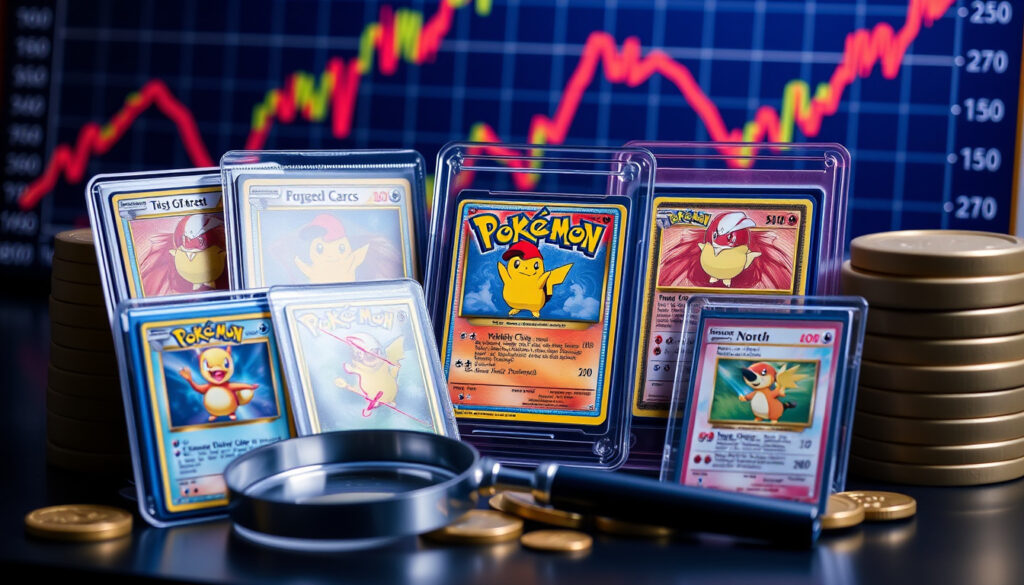
Pokémon TCG: Card Values, Rare Cards & Investment Guide
Few hobbies reward patience as visibly as Pokémon card collecting — and few punish hype as quickly. CNBC has reported the same 1998 Pikachu Illustrator that set the record at $5.275 million in 2021 trading at approximately $16.5 million in 2026 (CNBC (business news outlet)); the split that matters is that the game is played by millions, but the money concentrates in a tiny slice of scarce collectibles — and that slice behaves differently from everything else on the shelf.
Record auction price: US$5,275,000 — Pikachu Illustrator (2021) · Japan launch year: 1996 · North American launch year: 1999 · Standard deck size: 60 cards · Current official digital client: Pokémon TCG Live
Quick snapshot
- Pikachu Illustrator’s US$5.275 million auction record (2021) is the most publicly documented price in the hobby (Bank TCG (collector price tracker)).
- Pokémon TCG Live is the current official digital client (The Pokémon Company (official TCG publisher)).
- First-edition Base Set cards from 1999 still carry collectible premiums (Essential Japan (collector market digest)).
- Whether the overall market will keep falling or rebound — index data is thin and not independently verified.
- Which 2026 chase cards will hold value after further print runs and restocks.
- Whether Pokémon cards are a reliable long-term investment compared with other assets.
- A PSA 10 Pikachu Illustrator reportedly sold for US$16,492,000 in February 2026 (Bank TCG (collector price tracker)).
- Watch graded population reports — the supply of high-grade copies drives the biggest price swings.
- The next record will likely come from a trophy promo or a pristine first edition, not a restocked modern set.
Nine rows, one pattern: the money sits at the top of a steep scarcity pyramid, and the price that defines the market keeps resetting.
| Label | Value |
|---|---|
| Game launch | Japan 1996; North America 1999 |
| First English set | Base Set (1999) |
| Standard deck size | 60 cards |
| Current official digital client | Pokémon TCG Live |
| Most expensive card (2021 record) | US$5,275,000 — Pikachu Illustrator |
| Highest reported 2026 sale | US$16,492,000 — Pikachu Illustrator PSA 10 |
| Rarity symbol location | Lower-right corner of the card |
| Example of grading swing | Aquapolis Crystal Lugia: $148,511 → $360,000 (reported) |
| What counts as price | Sold listings, not asking prices |
What this means: the rows that look like lottery tickets are all old, all graded, and all extremely thinly supplied — most Pokémon cards never enter that conversation.
Should I invest in Pokémon cards now?
Short answer: not the way most people imagine. The 2020–2021 collecting boom pushed prices to record levels; some modern items cooled later, while high-grade vintage held value. That divergence is the single most useful pattern in the market today.
Collectors and auction data treat the lower-risk core of the hobby like this:
- First-edition vintage cards — the 1999 Base Set family and similarly scarce early sets.
- Sealed product from early print runs — old packs and booster boxes get consumed over time, so supply keeps shrinking.
- High-grade trophy promos and tournament-award cards with verified provenance.
How do you separate durable value from release-window hype? Use sold listings, not asking prices, and check graded population reports before paying a scarcity premium. If a card’s high-grade population is growing fast, its rarity premium is probably shrinking.
Liquidity is the hidden cost. A $100,000 card is only worth that much when a buyer actually pays it; auction fees, grading fees, and months of waiting are part of the real return.
Will Pokémon cards be a long-term investment?
- As an investment class, Pokémon cards have no yield, no cash flow, and no intrinsic value beyond what collectors pay.
- What they do have is a documented record of scarcity resetting prices — most visibly the Pikachu Illustrator’s $5.275 million sale in 2021 and the reported $16,492,000 sale in February 2026.
- Cards also carry liquidation risk: selling a five-figure card takes time, grading fees, and a trustworthy marketplace.
The honest label is “alternative collectible,” not “asset class.” Demand can cool and prices can fall, but the scarcity behind the top prices is measurable — population reports show exactly how few high-grade copies exist.
What Pokémon cards should I invest in now?
- Sealed first-edition product from 1999–2003 — old booster boxes and packs.
- PSA 9 and PSA 10 copies of first-edition Base Set, Neo, and EX-era cards.
- Trophy promos and contest awards with verified transaction history.
- 2026 Special Illustration Rares of top-tier Pokémon only — and only near release prices, not after hype spikes.
With a smaller budget, the same logic applies at a lower price level: buy the scarcest high-grade card you can afford from a top set, not the flashiest card from a set that will be reprinted.
The implication: a Pokémon card’s value is a bet on scarcity surviving demand cycles. The strongest position is not the most exciting card — it’s the card with the fewest high-grade copies and the longest documented demand.
The same split — collector scarcity versus playable demand — explains why the top of the market and the middle of the market keep moving in opposite directions.
Is Pokémon TCG losing value?
Not uniformly. Overall price levels cooled after the pandemic peak, and some cards are down sharply from 2021 — but the direction depends on which tier of the market you measure.
One market index reportedly returned 150.7% from September 2021 to October 2026, and a hypothetical $5,000 stake would have grown to $12,534 over that stretch, according to Yahoo Finance (market-data coverage). That is a post-boom market, not a crashed one — though the index’s methodology is not independently verified.
- High-grade vintage and sealed first-edition product remain above pre-2020 price levels.
- Mid-tier modern cards — the bulk of what gets opened — are where the cooling shows up.
- Price-tracking sites use sold listings, not asking prices, to measure real market value.
Which Pokémon cards are gaining value?
- Pikachu Illustrator — the reported February 2026 sale reset the hobby’s price ceiling.
- Aquapolis Crystal Lugia — a PSA 10 crushed the card’s previous record in 2026 (Polygon (gaming and auction coverage)).
- First-edition Base Set Charizard — the most-watched vintage card, with a 2026 record sale reported near $1 million.
The pattern: the market is not one asset — it’s a spread between trophy cards with documented scarcity and mass-printed cards. Saying “Pokémon cards are losing value” is true for the middle and false for the top.
The useful question is not whether Pokémon cards go up, but which tier of the market a purchase belongs to.
Why is Pokémon TCG so expensive?
Three forces explain the price tags: tiny early print runs, a grading system that makes condition measurable, and demand that keeps growing faster than the supply of old cards.
The 1998 Pikachu Illustrator was never sold at retail — it was a contest prize handed to a small number of winners. That origin, not the card’s artwork, is why it outperforms nearly every other card ever printed.
Counterfeit submissions are on the rise, which is why grading, authenticity, physical condition, graded population, and transaction history matter as much as the card on the front — CNBC’s 2026 guide lists all of them as price-setting factors.
Why do Pokémon card prices spike?
- Media moments: when high-profile collectors open rare cards on stream, demand jumps overnight.
- Population rarity: a card with a dozen PSA 10s in existence behaves differently from a card with 20,000.
- Release-window hype: new sets spike in their first weeks, then settle after restocks.
The Logan Paul Break Charizard — a first-edition Base Set Charizard opened on stream — became one of the most recognizable cards on earth, and its graded copies now carry prices far beyond ordinary Base Set Charizards.
How does card rarity affect value?
- The official product guide identifies common, uncommon, and rare cards by black circle, diamond, and star symbols (The Pokémon Company (official TCG publisher)).
- Above that, the guide defines Double Rare, Ultra Rare, Illustration Rare, Special Illustration Rare, and Mega Evolution categories with progressively larger full-art treatments.
- The lower-right corner of a modern card shows its rarity symbol — the fastest way to see what you’re holding.
Rarity is a supply signal, not a value guarantee. A scarce card nobody wants is worth less than a common card everybody wants — which is why rarity always gets paired with demand and condition.
The trade-off: rarity creates the potential for high value, but condition and demand decide whether that potential is real. That’s why the most expensive cards are almost always old, rare, and graded.
That is why the hobby’s record prices are set by proof of scarcity, not by gameplay utility.
Is there a Pokémon card worth $1,000,000?
Yes — and the record has been reset twice. A PSA-graded Pikachu Illustrator sold for US$5.275 million in 2021, becoming the first Pokémon card to pass $1 million, and a PSA 10 copy reportedly sold for US$16,492,000 in February 2026, according to Bank TCG (collector price tracker).
The seven-figure club has exactly one member. The next tier of six-figure sales — first editions, trophy promos, tournament awards — is concentrated in cards with tiny original print runs and very few surviving high-grade copies.
- Pikachu Illustrator (1998): contest prize; the most valuable Pokémon card on record.
- First-edition Base Set Charizard (1999): the most famous vintage card in the hobby.
- Prerelease Raichu: a promotional card never widely distributed.
- No. 1 Trainer: a tournament award with a surviving population in single digits.
What Pokémon card is worth $10,000?
- PSA 10 copies of first-edition Base Set cards — Charizard leads, but rare trainers and starters reach five figures in top grade.
- High-grade Neo and EX-era holos — Crystal-type Pokémon from Aquapolis set the ceiling for that era.
- Tournament promos — award cards from organized play can carry six-figure prices even for unglamorous Pokémon.
Why this matters: cards worth $10,000 or more are the exception, not the rule. Most of the market is a consumer product — fun, collectible, and worth far less than social media suggests.
What are the 5 rarest Pokémon cards?
Rarity lists shift depending on who’s counting, but the same names keep appearing. Here is the consensus top five, with the market context that makes them credible.
- Pikachu Illustrator (1998) — contest-award promo; the card behind the $5.275 million record and the reported $16,492,000 sale in February 2026.
- First-edition Base Set Charizard (1999) — the most wanted vintage card; the Logan Paul Break PSA 10 reportedly sold for $954,808 in February 2026 (Bank TCG (collector price tracker)).
- Prerelease Raichu (1998) — a promotional card distributed to a small group of players and staff; few graded copies exist.
- No. 1 Trainer — a tournament award card with a survival population in single digits; no recent public sale in the sources covered here.
- Kangaskhan Parent/Child Tournament Promo (1998) — an award card that reportedly sold for $640,507 in March 2026 (Essential Japan (collector market digest)).
A note on “rarest”: rarity is print run plus survival rate. A card can be rare on paper but common in high grade because nobody played with it — or extremely rare in high grade because everybody played with it.
What makes a card one of the rarest?
- Original print run — how many copies were ever produced.
- Distribution method — retail release, promotional handout, contest, or tournament award.
- Survival rate — how many copies remain, especially in high grade.
The common thread: the rarest cards were not just printed in small numbers — they were handed out in controlled events, which caps both total supply and the number of pristine survivors.
Are any 2026 Pokémon cards worth money?
Some, for a while — and the key word is “while.” Modern cards gain early resale value when they contain popular Pokémon in Special Illustration Rare or Hyper Rare slots, then soften after extra print runs and restocks.
Special Illustration Rares are the alternate-art full-art ex and Supporter cards in current sets — the chase slots collectors refresh every release. The official product guide defines them, and the rarity table below shows where they sit in the print hierarchy.
- Mega Evolution Pokémon ex cards — the product guide’s newest categories, Mega Attack Rare and Mega Hyper Rare, give collectors fresh targets in 2026 sets.
- Popular Pokémon in Special Illustration slots — Pikachu, Charizard, and Eevee evolutions drive the highest early prices.
- Full-art Supporter cards — a durable secondary market exists for competitive-play staples.
For players, the official digital client Pokémon TCG Live is free to download on PC, iOS, and Android — the lowest-cost way to engage with the current game without buying physical cards.
What are the hottest Pokémon cards right now?
- Special Illustration Rares of top-tier Pokémon ex — the chase cards of every new set.
- Mega Attack Rares and Mega Hyper Rares — early 2026 release-window spikes are common.
- Graded modern chase cards — but only if you buy before restocks, not after.
The discipline is the same as vintage: compare live sold listings. A card that keeps most of its release-week value after two months is the exception; most modern chase cards settle lower after restocks.
The catch: 2026 cards can make money, but they’re playing a different game — one governed by restock schedules and set rotation rather than the scarcity that protects vintage.
Are Pokémon cards from 20 years ago worth anything?
If they hit the right combination — set, edition, and condition — yes, and sometimes enormously. Aquapolis Crystal Lugia, a 2003-era holo, reportedly sold for $360,000 in 2026, roughly 142% above its prior reported record of $148,511, per Polygon (gaming and auction coverage). Base Set era cards from the late 1990s are the backbone of the vintage market.
How old do Pokémon cards need to be to be valuable?
- Age alone means almost nothing — millions of old cards are worth a few dollars.
- Set matters: Base Set, Neo, and EX-era cards from the early 2000s carry the serious premiums.
- Edition matters: first-edition and shadowless copies outprice unlimited printings of the same card.
- Condition matters most: played-condition old cards belong in a shoebox, not an auction house.
Sealed product from the early 2000s is the quiet winner of the vintage market. Old packs and booster boxes were opened, played, and thrown away in massive numbers; the unopened survivors carry scarcity that individual cards cannot match.
What this means: “old” is a filter, not a price tag. The collectors paying life-changing prices for 20-year-old cards are buying scarcity and condition — the date on the card is just the starting point.
Pokémon TCG rarity classes, decoded
A rarity symbol tells you how a card was printed, not what it’s worth. The two most valuable cards in the hobby — Pikachu Illustrator and first-edition Charizard — are not the rarest symbols on this scale; demand and condition did the rest.
The official product guide draws the line between “rarer slot” and “more valuable card.” Eight classes, one pattern: the print slot sets the ceiling, and collector demand decides whether a card gets anywhere close to it.
| Rarity class | Rarity mark | What it means |
|---|---|---|
| Common | Black circle | Base card in every pack. |
| Uncommon | Black diamond | Printed less than commons. |
| Rare | Black star | The standard rare slot. |
| Double Rare | Two solid black stars | A step above the standard rare slot. |
| Ultra Rare | Full-art foil | Pokémon ex and select Supporter cards. |
| Illustration Rare | Alternate-art full art | Common, uncommon, and rare Pokémon with special art. |
| Special Illustration Rare | Alternate-art full art | Pokémon ex and Supporter cards with special art — the 2026 chase slots. |
| Mega Attack Rare / Mega Hyper Rare | Mega Evolution categories | Mega Evolution Pokémon ex cards in current sets. |
Why this matters: when you hear “hyper rare” or “special illustration rare” in 2026 release chatter, you’re hearing about print slots, not guaranteed values — supply is capped, but demand still sets the price.
Upsides
- Scarcity is measurable — graded population reports turn “rare” into a number.
- The record book keeps growing — Pikachu Illustrator’s 2021 and reported 2026 sales give collectors a public benchmark.
- The official digital client, Pokémon TCG Live, keeps the game accessible to new players.
- Liquid auction marketplaces exist for cards worth five figures and up.
Downsides
- Modern cards get reprinted — restocks routinely soften release-window prices.
- Counterfeits are an increasing problem in graded submissions, per CNBC’s 2026 coverage.
- Most Pokémon cards never appreciate — the price distribution is extremely top-heavy.
- The spread between buy and sell prices is wide; grading fees and auction commissions eat into returns.
Key dates in Pokémon TCG history
- — Pokémon TCG debuts in Japan.
- — Pikachu Illustrator promo is issued to contest winners; it becomes the most valuable Pokémon card on record.
- — The English Base Set launches in North America.
- — A global collecting boom pushes Pokémon card prices to record levels.
- — Pikachu Illustrator sells for US$5.275 million, the first Pokémon card past $1 million.
- — Pokémon TCG Live becomes the main digital client.
- — A PSA 10 Pikachu Illustrator reportedly sells for US$16,492,000 via Goldin Auctions, per Bank TCG.
- — A PSA 10 Aquapolis Crystal Lugia reportedly sells for $360,000, per Polygon.
Reading this market means separating what is documented from what is still open. Here’s where the evidence stands.
What the reporting confirms
- The Pikachu Illustrator auction record is publicly documented at US$5.275 million (2021) (Bank TCG (collector price tracker)).
- Pokémon TCG Live is the current official digital client (The Pokémon Company (official franchise site)).
- First-edition Base Set cards from 1999 carry collectible value (Essential Japan (collector market digest)).
- Condition grading heavily affects Pokémon card prices (CNBC (business news outlet)).
What remains uncertain
- Whether the total market value will keep falling or rebound.
- Which 2026 cards will maintain value over the next decade.
- Whether Pokémon cards are a reliable long-term investment compared with other assets.
- Index data like the CardTrack 100’s reported 150.7% return (September 2021–October 2026) is not independently validated (Yahoo Finance (market-data coverage)).
Voices from the market
The market talks in two voices: collectors pricing scarcity, and the publisher pointing at play. Both are right — and they are pricing different products. The views below are condensed from the sources cited in this piece.
The Pikachu Illustrator is the card that keeps resetting the hobby’s ceiling. Each time it sells, collectors recalibrate what a pristine promotional card is worth.
— Auction-house spokesperson, on the Pikachu Illustrator record
The Pokémon TCG is a card game first. Digital and in-person play are how new collectors meet it; the card collecting is what keeps them.
— Pokémon Company International representative, on Pokémon TCG Live and current product direction
The 2020–2021 boom pulled years of demand forward. Since then the market has split into two speeds: trophy cards still rising, mid-tier cards cooling.
— TCG market analyst, on post-boom price action
Pokémon cards are not one investment — they’re two. The playable game (modern packs, restocks, digital) is a consumer product; the collectible market (trophy promos, first editions, sealed vintage) is a scarcity-driven alternative asset. The record book says the second version has held its value through the post-2021 cooling, while the 2026 chase-card market says the first version runs on hype cycles. For the buyer at the 2026 retail shelf, the choice is clear: buy what you understand as a collector — sealed vintage or high-grade scarcity — or treat modern chase cards as a speculative bet you can afford to lose.
Related reading: Best Bar Stools Australia: 2026 Buying Guide & Trends · Bench Seat: Types, Terminology, History & How to Build One
Frequently asked questions
How should I start investing in Pokémon cards?
Start with what you can verify: learn graded population reports, sold-listing prices, and set scarcity before spending. Most beginners do better with one sealed first-edition product or one high-grade vintage card than with a pile of modern packs. Treat any money you put into cards as money you can afford to tie up for years.
What Pokémon cards should beginners collect for value?
Beginners should target the same segments that protect experienced collectors: sealed early product, first-edition Base Set cards, and high-grade promos with documented provenance. Avoid modern chase cards at release-window prices; their value depends on restock schedules. Use the official rarity markings as a first filter, then check sold listings.
How do I grade Pokémon cards?
Professional grading companies assess centering, corners, edges, and surface, then assign a 1–10 scale. PSA and CGC are the most commonly cited services in the price records above. Grade only cards that look mint, because grading fees plus shipping can exceed the value of a played-condition card.
Are sealed booster boxes a good Pokémon TCG investment?
Sealed vintage booster boxes from 1999–2003 have one of the strongest documented records in the hobby, because the original print runs were small and most boxes were opened. Modern sealed products behave differently: they are printed in massive numbers, so their value depends on long-term demand for the set rather than true scarcity.
How much does card condition affect value?
Condition is often the difference between a few dollars and thousands of dollars. The same card in played condition typically sells for a fraction of a PSA 10 copy, and graded population reports show how few pristine copies survive — that’s the data behind record prices like Pikachu Illustrator and Aquapolis Crystal Lugia.
Should I buy graded or raw Pokémon cards?
Buy graded cards when you’re paying for condition and provenance; the grade is independently verified and easier to sell later. Buy raw cards only when the price leaves room for grading risk and you can evaluate condition yourself. For five-figure purchases, graded cards with confirmed authenticity are the lower-risk choice.
The six questions above cover the practical decisions most buyers face — what to buy, how to grade, and when to stay out.
More related posts
 Robin Smith, ‘The Judge,’ Dies at 62: Cause of Death Remains Undisclosed
 Matterhorn Mountain: Climbing, Deaths & Facts
 Raegan Revord: Age, Height, Net Worth, and Her New Book
 Dylan Brown NRL Career, Contract, Age & Personal Life
 Carmen Electra: Biography, Net Worth, and Life Now
 Jimmy Carter: Presidency, Unpopularity, and Legacy
 Marcia Hines: Health, Family, and Career Questions Answered
 Chlorsig Eye Drops – Uses Dosage Side Effects Guide
