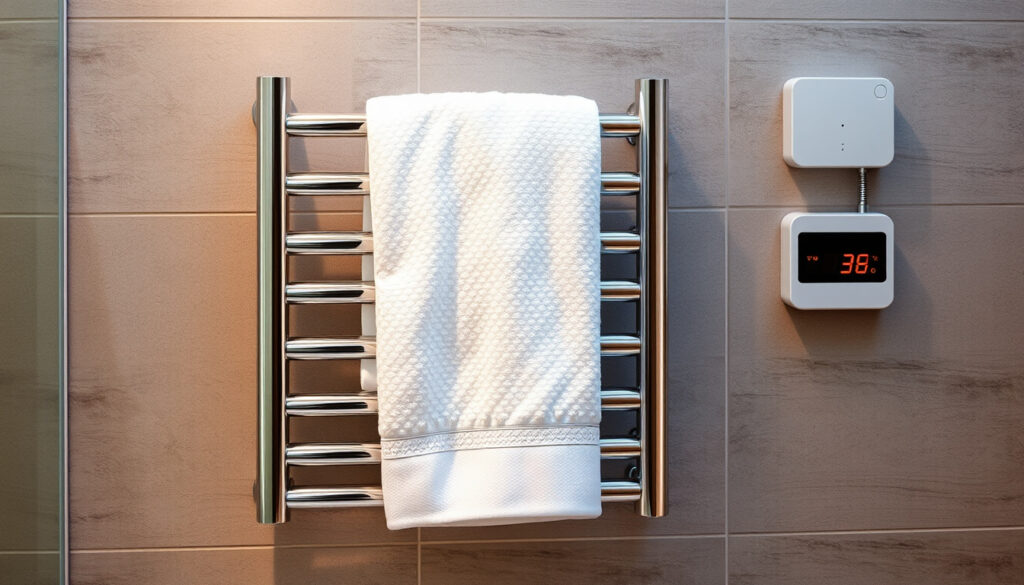
Heated Towel Rail: Worth It? Electricity Use & Installation Guide
Stepping out of a shower into a cold, damp towel is one of those small frustrations that a decent heated towel rail solves instantly. In Irish bathrooms especially, where damp weather and poor ventilation make towels stay clammy for hours, the appeal is obvious. The appeal is obvious, but the real question isn’t whether they work — they do — it’s whether the energy cost, installation hassle, and upfront price actually add up for your situation.
Top Retailers: bestheating.ie, bigbathroomshop.ie · Common Types: Electric, Wall Mounted · Popular Finishes: Chrome, Anthracite, Black · Key Uses: Bathrooms, En Suites · Delivery Info: Free on radiatoroutlet.ie
Quick snapshot
- Electric towel rails use 60W–200W per hour (Tapron.ie Irish retailer guide)
- Professional installation in Ireland costs €150–€300 (Tapron.ie installation guide)
- Safe Electric–registered electrician required for hardwired models (Electric Radiators Direct Ireland)
- Exact annual running costs vary by model, usage patterns, and tariff
- Whether post-2024 regulation updates differ from IS 10101:2020 baseline
- Specific heat output (kW) recommendations for different bathroom sizes
- IS 10101:2020 standard effective 2020; latest installation guides published May 2024
- Low Surface Temperature models now widely marketed for Irish homes
- Regulatory scrutiny likely to tighten as energy-efficiency labelling evolves
- Dual-fuel models expected to gain share as homeowners want year-round flexibility
Key specifications for electric heated towel rails sold in Ireland are summarised below.
| Spec | Detail |
|---|---|
| Primary Function | Warm towels and heat space |
| Common Sizes | 400mm to 750mm wide |
| Warranty Example | 10 years on radiatoroutlet.ie |
| Installation Types | Plumbed or electric |
| Power Consumption | 60W–200W per hour |
| Warm-Up Time | 5–10 minutes initial |
| LST Max Surface Temp | 43°C |
Is it worth getting a heated towel rail?
Heated towel rails solve the towel-drying problem in damp Irish bathrooms — they dry your towels faster than any stand could manage, and they contribute a modest amount of heat to smaller bathrooms. Electric models warm up in 5–10 minutes and reach optimal temperature in 20–30 minutes, so you are not waiting long for that warm towel at 7am. You are adding another electrical appliance to your home, and in Ireland, bathroom electrical work is classified as controlled work — meaning a Safe Electric–registered electrician must handle the installation.
Pros of heated towel rails
- Towels dry in hours rather than a full day in damp Irish weather
- Adds secondary heat output to en suites and smaller bathrooms
- Electric models run independently of central heating, so they work in summer too
- Dual-fuel options let you switch between central heating in winter and electric-only in warmer months
- Stainless steel finishes retain heat longer than chrome, per Tapron.ie Irish retailer guide
Cons and drawbacks
- Professional installation costs €150–€300 on top of the unit price
- Hardwired electric models cannot be DIY-fitted under Irish wiring regulations
- Energy consumption adds to your electricity bill (60W–200W per hour)
- Bathroom placement is restricted by safety zones that limit where appliances can be mounted
- Non-electric hydronic rails reportedly have fewer zone restrictions, per Boards.ie community discussion
The implication: for primary bathrooms where towels pile up daily, a heated rail genuinely improves quality of life. For guest bathrooms used once a week, the installation cost may take years to justify.
Does a heated towel rail use a lot of electricity?
The short answer is no — not compared to most household appliances. Electric towel rails typically consume 60W to 200W per hour, which places them well below a kettle (~2,000W) or a space heater. Tapron.ie Irish retailer guide notes that timers and thermostats can further reduce actual energy use by restricting to when you actually need warm towels. Running a 100W model for 4 hours daily works out to roughly 0.4 kWh — at current Irish electricity rates that is a few cents per day, though exact costs depend on your tariff and usage patterns.
Electricity consumption facts
Four factors drive how much a heated towel rail actually costs to run:
- Wattage: Smaller rails at the lower end (60W–80W) cost less to run than larger designer models reaching 200W.
- Runtime: Models with built-in timers or thermostatic controls use significantly less energy than those left running continuously.
- Insulation quality: Stainless steel reportedly retains heat longer than chrome, meaning the element cycles on less often.
- Tariff: Time-of-use tariffs (common in Ireland) can reduce costs if you schedule heating for off-peak hours.
Factors affecting usage
Where you place the rail matters. Dansani bathroom fixture specialist notes that IP44-approved rails can be positioned 60cm from a shower — close enough that the shower’s heat can supplement warming, potentially reducing rail runtime. Cold corners of larger bathrooms, by contrast, mean the rail works harder to maintain temperature.
For most Irish households, the running cost of a heated towel rail is modest — a few euro per month at typical usage. The bigger cost is the upfront installation if you choose a hardwired model.
Do you leave heated towel rails on all the time?
Most manufacturers and installers advise against leaving a heated towel rail running constantly. Electric Radiators Direct Ireland-based supplier recommends using a timer to restrict operation to peak usage windows — typically morning and evening — rather than a 24-hour cycle. This approach balances towel warmth with energy savings.
Best usage practices
- Use a timer: Program the rail to heat 1–2 hours before typical shower times.
- Thermostatic control: Models with a thermostat cycle on only when temperatures drop below a set threshold.
- Dual-fuel advantage: Tapron.ie Irish retailer guide notes that dual-fuel rails let you run on central heating in winter and switch to electric-only in summer — useful when you only need towel warming.
- Low Surface Temperature (LST) models: These limit surface temperature to 43°C, making them safer for households with children and designed to meet NHS safety standards, per Electric Radiators Direct.
Safety and efficiency tips
- Never leave a rail on continuously without a timer — it wastes energy and accelerates wear on heating elements.
- Ensure the rail is earthed per the ATC official manufacturer manual.
- IPX4-rated models are the minimum for bathroom zones 1 and 2 — check the rating label before purchasing.
- If your model plugs into a standard socket rather than hardwiring, you can simply switch it off when not needed.
The catch: LST models are more expensive upfront but genuinely safer in family bathrooms. Weigh that against how often children actually use the bathroom unsupervised.
Do you need a plumber to fit a heated towel rail?
It depends entirely on the type. Electric Radiators Direct Ireland-based supplier states clearly that all hardwired electric towel rails must be fitted by a qualified electrician — DIY is not permitted under Irish wiring regulations. Plumbed (hydronic) models, which connect to your central heating system, require a plumber. Plug-in electric models, however, can be installed by a competent DIYer with standard socket access.
DIY vs professional installation
A comparison of installation requirements and typical costs across the different heated towel rail types.
| Type | Can DIY? | Professional needed? | Cost range |
|---|---|---|---|
| Plug-in electric | Yes, if socket is nearby | No electrician required | €0–€50 (outlet access) |
| Hardwired electric | No | Safe Electric registered electrician | €150–€300 |
| Hydronic (plumbed) | No | Licensed plumber | Varies; typically €100–€250 labour |
| Dual-fuel | No (requires both trades) | Electrician + plumber | Higher combined cost |
Finding a plumber or electrician in Ireland
- For Safe Electric work, use the Tapron.ie guidance on compliant installation — only registered electricians can issue the compliance certificate required under IS 10101:2020.
- Ask your retailer for installer referrals — many Irish suppliers maintain lists of approved tradespeople.
- Get two quotes minimum; installation typically takes half a day for a straightforward wall-mounted model.
- Confirm the electrician will issue a certificate of compliance — this is mandatory and protects you during home sales or insurance claims.
Skipping a certified electrician for a hardwired installation is not just a regulation issue — it voids product warranties and can affect home insurance coverage. The €150–€300 installation fee is not where you want to cut corners.
What this means: if you are buying a hardwired model, factor €150–€300 for installation into your budget before you commit. Shop for the rail and installer simultaneously — some retailers bundle both.
Where is the best place to put a heated towel rail?
Placement is governed by Irish bathroom safety zones, which classify areas by proximity to water sources. Tapron.ie Irish retailer guide explains that Zone 0 (inside the bathtub or shower enclosure) is completely off-limits for heated towel rails. Zone 1, extending 2.25 meters above the bath or shower tray, requires a minimum IPX4 rating. Zone 2 — 0.6 meters beyond the bath or shower — also mandates IPX4 protection.
Ideal bathroom locations
- Away from direct splash zones: Position the rail outside the 60cm Zone 2 radius from your shower or bathtub water source.
- Near towel storage: Mount it where towels are already stored so you grab a warm one without crossing a cold floor.
- On an interior wall (if possible): Exterior walls in Irish homes lose heat faster, making the rail work harder.
- Adequate clearance: Leave at least 10–15cm between the rail and any adjacent wall or fixture for airflow.
Wall mounting considerations
- Standard mounting height: typically 120–180cm from the floor to the bottom of the rail, depending on model and user height.
- Deluxe Bathrooms Irish retailer guide lists the key installation steps: confirm IP rating, mount brackets securely, connect to a fused spur, and test functions before finalising.
- Ensure wall material can support the rail weight when filled with water — use appropriate fixings for solid walls vs stud walls.
- Hardwired models require the fused spur connection to be accessible (not hidden behind the rail).
Upsides
- Towels dry in hours, not a full day
- Adds supplementary heat to smaller bathrooms
- Electric models run year-round independently of central heating
- Dual-fuel offers flexibility across seasons
- Timers and thermostats keep energy use manageable
- LST models available for family safety
Downsides
- Installation costs €150–€300 for hardwired models
- Bathroom zones limit placement options
- Running costs add incrementally to electricity bill
- Hardwired DIY installation is illegal in Ireland
- IP rating requirements restrict which models suit small bathrooms
- Hydronic models require plumber involvement
Heated Towel Rail Specifications
Five specs to check before buying, listed with the ranges most relevant to Irish buyers.
| Specification | Typical range | What to look for |
|---|---|---|
| Width | 200mm–900mm | 500–600mm most common for standard bathrooms |
| Height | 590mm–1800mm | Match to wall space and towel capacity needs |
| Power (electric) | 60W–200W | Under 100W for small en suites; 150W+ for larger bathrooms |
| Heat output | Measured in kW | Calculate required kW by bathroom size (standard formula applies) |
| IP Rating | IPX4 minimum for zones 1–2 | IP44, IPX4, or IPX7 depending on placement zone |
| Surface temp (LST models) | Max 43°C | Look for LST badge if children use the bathroom |
| Finish options | Chrome, anthracite, black, stainless | Stainless reportedly retains heat longer than chrome |
Why this matters: matching power to bathroom size avoids running an oversized rail at unnecessary cost, or undersizing and finding your towels never fully warm.
Installation Steps
Eight steps from purchase to first use, based on Deluxe Bathrooms Irish retailer guide and the ATC official installation manual.
- Check the IP rating: Confirm the model meets the IPX4 minimum for your intended bathroom zone before purchasing.
- Choose hardwired vs plug-in: Hardwired requires an electrician; plug-in models can connect to a standard socket — know which you are buying.
- Mark bracket positions: Use a spirit level to mark equal-height fixing points; most rails use two or four brackets.
- Drill and plug: Use appropriate wall plugs for your wall type (solid, hollow, or tile). Fix brackets securely.
- Mount the rail: Lift and locate the rail onto the brackets; tighten any locking screws.
- Connect to fused spur (hardwired): This step must be done by a qualified electrician, who will also earth the appliance per I.E.E Regulations.
- Fill hydronic models: If plumbed, fill the system, bleed air, and check for leaks before switching on.
- Test and commission: Run the rail, verify heating function, and confirm the timer/thermostat operates correctly.
Conversion from hydronic to fully electric operation reportedly requires a heating element and blanking plug, per Towel Radiator UK conversion guide. This is a mid-range option but requires technical knowledge — consult a plumber or electrician before attempting.
What the experts say
In Ireland, bathroom electrical work is classified as controlled work. This means that only a Safe Electric–registered electrician can legally carry out the installation.
— Tapron.ie (Ireland retailer guide)
All electric towel rails and bathroom heaters must be hardwired by a qualified electrician.
— Electric Radiators Direct (Ireland-based supplier)
Confirmed vs Unconfirmed
Based on research confidence levels, here is what we can say with certainty versus what requires further verification.
Confirmed
- Electric models use 60W–200W per hour
- Hardwired installation requires Safe Electric electrician
- Zone 1 requires IPX4 minimum; Zone 0 requires IPX7
- Installation costs range from €150–€300 in Ireland
- Stainless steel retains heat longer than chrome (medium confidence)
Unclear
- Exact annual running costs without individual usage data
- Whether post-2024 regulation updates exceed IS 10101:2020 baseline
- Specific kW recommendations by Irish bathroom size
- Precise energy savings from timers vs continuous operation
For Irish households, the heated towel rail decision comes down to bathroom size, usage frequency, and willingness to pay upfront for installation. A smaller plug-in model in a well-ventilated en suite can be a modest, affordable upgrade. A large hardwired designer rail in a family bathroom is a bigger commitment — but one that pays off in daily comfort over years.
Related reading: Heated Towel Rail Installation Regulation · How Do Electric Towel Radiators Work
bestelectricradiators.co.uk, youtube.com, electricradiatorsdirect.ie, electricradiatorsdirect.ie
Irish homeowners can offset heated towel rail running costs by comparing cheapest electricity providers Ireland offers for the most competitive 2025 rates.
Frequently asked questions
Which is better, a heated towel rack or a towel warmer?
The terms are largely interchangeable, though “towel warmer” sometimes refers to a freestanding or cabinet-style unit that heats more slowly but holds warmth longer. Heated towel rails are typically wall-mounted with exposed bars. For Irish bathrooms, a rail is usually more space-efficient; a warmer may suit larger en suites where you want multiple towels heated simultaneously.
Can you put wet towels on a heated towel rack?
Yes — this is exactly what the appliance is designed for. Wet towels placed on a heated rail dry significantly faster than on a standard towel ring. Avoid leaving sopping-wet towels dripping continuously, as this places more demand on the heating element than intended for the model.
Heated towel rail vs radiator — which is better?
Radiators are sized to heat the room; heated towel rails are sized to heat towels and contribute modest supplementary heat. If your primary goal is bathroom warmth, a radiator is the better choice. If towel drying and comfort are priorities, a rail makes more sense. Some homeowners install both — a radiator for heat, a rail for towels.
Are heated towel rails available at IKEA?
IKEA does stock a limited range of towel warmers in some markets, but options are limited compared to specialist Irish retailers like bestheating.ie or bigbathroomshop.ie. Specialist suppliers offer more size, finish, and IP-rating options suited to Irish bathroom regulations.
What runs up your electric bill the most?
Heated towel rails are relatively low-draw appliances (60W–200W) compared to immersion heaters, electric showers, or storage heaters. However, leaving any appliance running continuously adds up. A 150W rail running 6 hours daily uses roughly 27 kWh per month — modest but not negligible at current Irish tariffs.
How to care for heated towel rails?
Wipe the bars with a soft cloth periodically; avoid abrasive cleaners that damage finishes. Check bracket fixings annually, especially in rented properties. For hardwired models, include the rail in your periodic electrical safety check. Drain and flush plumbed models every few years to prevent internal corrosion.
Are electric heated towel rails suitable for Ireland?
Yes, provided they comply with IS 10101:2020 wiring standards and bathroom zone IP rating requirements. Several Irish retailers — including radiatoroutlet.ie and bestheating.ie — offer models with free delivery and warranties of 10 years or more. Always verify the product IP rating matches your intended installation zone before purchasing.
More related posts
 Eddie Vedder: Sobriety, Cobain, and Yellow Ledbetter
 Famous People: Top 10, #1 Most Famous, Rankings & Lists 2025
 Jason Bateman: Biography, Career, Sobriety, and Family
 Jennie Garth: Health, Relationships, Marriages, and Current Life
 Oliver Platt: Biography, Weight Loss, Net Worth & Rumors
 Bron Lewis: From Teacher to National Raw Comedy Winner
 Passport Photos Near Me – Australia Post Costs Requirements
