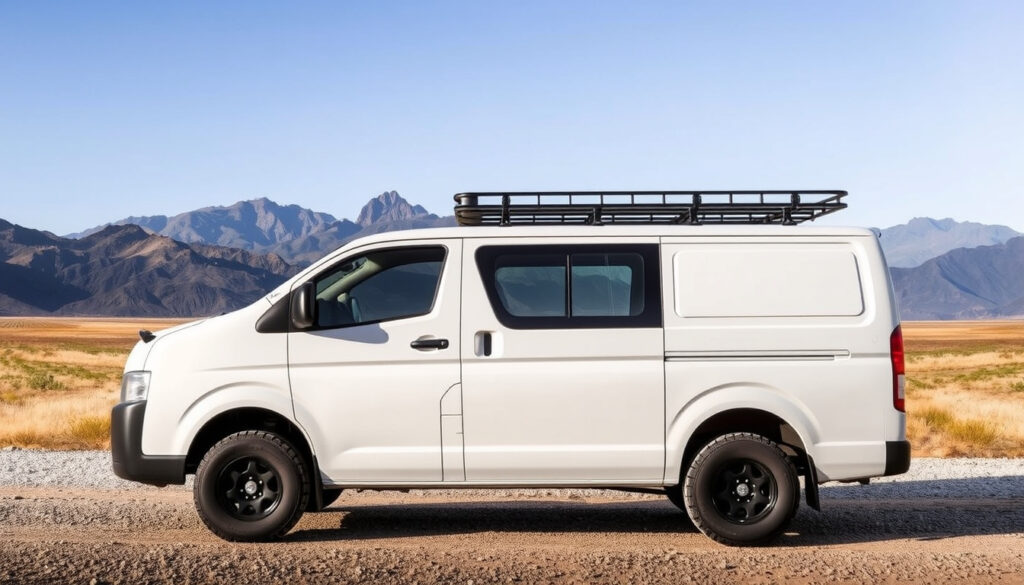
Toyota HiAce Buyer’s Guide: Prices, Reliability, 4×4
If you’ve priced a used van in Australia lately, one name keeps coming up: the Toyota HiAce, a model line in production since 1967 (Wikipedia’s HiAce history). The van’s durability is why a 20-year-old example can still command strong money — and why buyers get stuck choosing between diesel and petrol, old and new.
Years in production: since 1967 ·
Fuel economy (combined): 8.5 L/100km (2.8L diesel) ·
Tank capacity: 70 L ·
Typical lifespan: 300,000 km+ ·
Starting price (new, Australia): AUD $45,000
Quick snapshot
- Current Australian HiAce range: 2.8L turbo diesel (Toyota Australia’s HiAce brochure)
- 2012 recall on H200 diesel EGR pipes (Carify’s HiAce problem database)
- Diesel consumption: 7.4–8.1 L/100km combined (CarsGuide’s HiAce data)
- 2026 pricing: unpublished, trend points to small annual increases
- Factory 4×4 availability in Australia: uncertain beyond current RWD-only range
- Petrol fuel economy shifts with load and driving style
- Fifth generation 2004–2019: best used-value balance (WhichCar’s HiAce review)
- Sixth generation 2019+: major redesign with better safety and comfort (WhichCar’s HiAce review)
- Service cadence: every 10,000 km (WhichCar’s HiAce review)
- Official 2026 pricing announcements will reset the new-car benchmark (carsales.com.au listings)
- Used 4×4 supply stays limited to pre-2004 imports and aftermarket conversions (carsales.com.au listings)
- Diesel DPF care: regular highway runs keep regens healthy (carsales.com.au listings)
Ten key specifications, one pattern: the HiAce is a load-carrying workhorse, built around the payload and service-life figures Australian price guides track most closely (RedBook’s price guide).
| Specification | Value |
|---|---|
| First launched | 1967 |
| Current generation | 2019–present (sixth generation) |
| Engine | 2.8L 4-cylinder turbo diesel |
| Power | 130 kW |
| Torque | 450 Nm |
| Fuel economy (combined) | 8.5 L/100km |
| Tank capacity | 70 L |
| Seating capacity | 3 to 14 (depends on variant) |
| Cargo volume (LWB) | 6.2 m³ |
| Max payload | ~1000 kg |
What are the common problems with a HiAce?
Most HiAce problems are predictable: diesel emissions hardware, high-mileage wear, and a few electrical niggles. According to Carify’s HiAce problem database, Toyota recalled H200 diesel models in July 2012 because EGR pipes could fracture and let exhaust gases into the cabin. The same source describes the 2.7L petrol as simple and largely trouble-free, flags front crankshaft oil-seal leaks and cam-cover seepage at higher mileage, and recommends testing the clutch on a hill before buying. Owner reports gathered by AussiePulse from ProductReview.com.au add glovebox failure, rear parking-sensor failure, and intermittent headlights on newer examples — anecdotes the site itself notes are not widespread. Diesel HiAces that never see a highway can develop DPF problems; the engine section below explains the fix.
How long will a Toyota HiAce last?
- Typical lifespan: 300,000 km+ with regular maintenance; service every 10,000 km, with 3 years / 100,000 km warranty on new models (WhichCar’s HiAce review)
- Persistent white smoke may signal a blocked DPF; blue smoke under load suggests turbo or piston wear
That 10,000 km rhythm is the single best predictor of a healthy used HiAce. A 200,000 km van with an unbroken logbook is a safer buy than a 120,000 km example with gaps.
Pre-2004 HiAces are where rust most often hides. A floor-and-sill inspection is cheaper than structural repair — treat surface rust as a negotiation point, not a deal-closer.
Which year is the best for buying a used Toyota HiAce?
- 2005–2015: the reliability sweet spot at moderate prices
- 2019+: sixth generation, redesigned with better safety and comfort
- Pre-2004: the era to check hardest for rust and structural wear
The fifth generation (2004–2019) offers the best balance of price and durability; the 2019+ sixth generation is a genuine leap in safety and comfort. If you’re weighing a pre-2004 van, budget for an inspection — the hill-start clutch test is exactly the kind of check that exposes a worn example.
How much is a Toyota HiAce van in Australia?
New HiAce pricing in Australia starts near AUD $45,000 for a long-wheelbase cargo van and runs to roughly $60,000 for a Commuter; used prices span about $20,000 for 2005–2010 models to $50,000 for low-kilometre late models, according to RedBook’s price guide and carsales.com.au listings.
How much is a 2026 Toyota HiAce van?
- No official 2026 pricing has been announced
- Recent trend: small annual list-price increases
- Planning assumption: modest rises on the current $45,000–$60,000 spread
That makes waiting a gamble: the pattern in recent years is slow upward creep, not discounts. If you need a van in 2026, budget for a small increase over today’s list prices.
What this means: HiAce values hold because demand for reliable vans outruns supply. A used price that looks too good is usually hiding a service-history gap.
Is the Toyota HiAce better with a diesel or petrol engine?
The current Australian HiAce range settles half the debate: it is diesel-only, powered by a 2.8L turbo (Toyota Australia’s HiAce brochure). On the used market, though, the 2.7L petrol TRH models are still everywhere, and they behave very differently to run.
Which engine is considered the best for a Toyota HiAce?
- Overall best: the 2.8L turbo diesel — more torque, better economy, stronger resale
- Cheapest to maintain: the 2.7L petrol — fewer emissions parts, simpler design
- Tie-breaker: your driving pattern decides
The diesel’s 450 Nm of torque explains why it pulls loaded vans with ease. But it pays a complexity tax: Westside Auto’s diesel vs petrol analysis warns the DPF needs regular highway running to clear soot, while the petrol engine has no DPF at all — a genuine advantage in stop-and-go city work. Carify’s problem database describes the 2.7L petrol as simple and largely trouble-free.
What is the fuel economy of a Toyota HiAce per 100km?
- Diesel (2.8L, combined): 7.4–8.1 L/100km
- Petrol (2.7L, mixed): around 10.5 L/100km
- Class benchmark: Ford Transit diesel at 7.9 L/100km
CarsGuide’s HiAce data puts the diesel’s combined-cycle consumption at 7.4–8.1 L/100km — with Toyota’s own benchmark at 8.5 L/100km — and its theoretical range at roughly 860–940 km per tank. The petrol’s 10.5 L/100km figure is a mixed-use estimate; loaded city work pushes it higher.
How many litres is a Toyota HiAce full tank?
- Tank capacity: 70 L
- Diesel theoretical range: ~860–940 km
- Petrol on-paper range: around 660 km (70 L at 10.5 L/100km)
Seventy litres is generous for the class, and the diesel’s range advantage is one of the strongest reasons to choose it for regional routes.
Which van has the best fuel economy?
- HiAce diesel: competitive but not class-leading
- Ford Transit diesel: 7.9 L/100km on paper
- Real-world economy depends on load, route, and driver
Fuel bills rarely decide the HiAce purchase. What decides it is usage: highway kilometres favour the diesel, short urban trips favour a petrol’s simplicity.
Five differences, one pattern: diesel wins on energy and range, petrol wins on simplicity and maintenance ease.
| Attribute | 2.8L turbo diesel | 2.7L petrol |
|---|---|---|
| Fuel economy (combined) | 7.4–8.1 L/100km | ~10.5 L/100km mixed |
| DPF | Fitted — needs regular highway runs (Westside Auto) | Not fitted |
| Fuel-system maintenance (AustralianWatch’s HiAce guide) | Filter every 20,000 km | Timing chain check ~200,000 km |
| Engine character | High torque, strong for cargo | Simple, largely trouble-free |
| Availability | Standard in current AU range | Mainly older TRH models |
Diesel HiAce buyers who only do short city hops are asking for DPF trouble. Occasional longer highway drives aren’t optional — they are part of the maintenance schedule.
The trade-off: diesel buys torque, range, and resale; petrol buys cheap, simple maintenance. For most Australian buyers mixing highway and city, the diesel is the stronger all-rounder.
Which Toyota HiAce model is considered the best?
The best HiAce depends on the job: LWB for cargo, SLWB for longer loads, Commuter for passenger work, People Mover for maximum seating. The 2019+ sixth generation is a major redesign with better safety and comfort, while the fifth generation (2004–2019) offers the best used-value balance (Wikipedia’s HiAce history).
Toyota HiAce LWB vs SLWB vs Commuter vs People Mover
- LWB (cargo): 6.2 m³ load volume, 3 seats
- SLWB: extra length for larger loads
- Commuter: 12-seat bus layout
- People Mover: passenger seating up to 14 depending on variant
The mechanical package is shared across LWB and SLWB, so the real decision is length and storage. Commuter and People Mover shift the priority to seats and cabin access — which is why shuttle operators usually spec the diesel’s torque.
Six ownership specs, one pattern: the HiAce is engineered for long service life and simple maintenance.
| Specification | Detail |
|---|---|
| Transmission | 6-speed automatic |
| Drive type | Rear-wheel drive (Carbarn’s 4×4 analysis) |
| Max payload | ~1000 kg |
| Seating | 3 to 14 depending on variant |
| Diesel fuel filter | Change every 20,000 km (AustralianWatch’s HiAce guide) |
| Petrol timing chain | Inspect around 200,000 km (AustralianWatch’s HiAce guide) |
Why this matters: variant choice moves resale more than engine choice. Commuters hold value in shuttle corridors; cargo vans hold value wherever trades run.
Is there a Toyota HiAce 4×4 van available for sale in Australia?
The short answer for Australian buyers: there isn’t a factory one. The HiAce sold new through Australian Toyota dealers is rear-wheel drive only, so local buyers should not expect a factory 4×4 HiAce (Carbarn’s 4×4 analysis). Toyota does offer 4×4 HiAce variants in some Asian markets, but not through Australian dealers.
Toyota HiAce 4×4 models
- Current Australian generation: RWD only, no factory 4×4 option
- Pre-2004 4WD models: available used but increasingly rare
- Asian-market 4×4 HiAces: exist, but not sold by Toyota Australia
Because Toyota Australia doesn’t list a 4×4 HiAce, any example you see locally is an older import-style model or an aftermarket conversion. Both need careful checking before purchase.
Where to find Toyota HiAce 4×4 for sale
- carsales.com.au is the main used marketplace for 4×4 HiAce listings
- Specialist conversion shops build aftermarket 4×4 HiAces
- Check conversion engineering, wiring, and compliance before you pay
The conversion route works for a niche of buyers, but it changes the van’s warranty and resale story. Treat a converted 4×4 as a bespoke vehicle, not a factory Toyota.
Australian buyers who need genuine off-road capability should start with a different van. The HiAce’s 4×4 story is written by aftermarket shops, not Toyota dealers.
The trade-off: a factory-free 4×4 path means aftermarket engineering, warranty questions, and long-term resale uncertainty.
Toyota HiAce pros and cons at a glance
The strengths and weaknesses below reflect the manufacturer documents, review sources, and problem databases cited throughout this guide.
Upsides
- Durability: 300,000 km+ lifespans are common with proper servicing
- Strong resale demand across cargo, passenger, and camper buyers
- Diesel efficiency: 7.4–8.1 L/100km combined and ~860–940 km range
- Simple petrol alternative for city work, with no DPF to manage
Downsides
- DPF on diesel needs regular highway driving to clear soot
- No factory 4×4 from Toyota Australia
- Anecdotal quality niggles on newer models reported by owners (AussiePulse)
- High-mileage clutch and transmission wear needs checking
The imbalance is clear: HiAce problems are maintenance problems, not design failures. Buy the van with the logbook, and most of the downside list disappears.
What’s confirmed and what’s still unclear
Based on the sources gathered, here is the confirmed-versus-unclear picture for Australian buyers.
Confirmed facts
- HiAce has been in production since 1967 (Wikipedia’s HiAce history)
- Current Australian range is diesel-only, 2.8L turbo
- HiAce has a reputation for reliability and durability (WhichCar’s HiAce review)
- Diesel consumption: 7.4–8.1 L/100km combined (CarsGuide’s HiAce data)
- Australian-delivered HiAces are rear-wheel drive (RedBook’s price guide)
What’s unclear
- 2026 pricing: no official announcement; trend points to small annual increases
- Future factory 4×4 availability in Australia remains uncertain
- Petrol fuel economy varies widely with load, terrain, and driving conditions
- Newer-model niggles (glovebox, parking sensors, headlights) are anecdotal, not patterns
- Aftermarket 4×4 conversion quality and compliance vary by installer
- Exact resale values shift with market conditions and fitted accessories
The pattern: uncertainty concentrates where Toyota Australia stays quiet — future pricing and 4×4 plans — while the mechanical record is well documented and consistently positive.
What reviewers and dealers keep saying
Three perspectives, one theme: the HiAce is a workhorse with clear boundaries.
The Australian HiAce range is powered by a 2.8L turbo-diesel engine.
— Toyota Australia’s HiAce brochure
Diesel HiAce ownership depends on occasional longer highway drives to help the DPF clear soot.
— Westside Auto’s diesel vs petrol analysis
The HiAce sold new through Australian Toyota dealers is rear-wheel drive only, so local buyers should not expect a factory 4×4 HiAce from Toyota Australia.
— Carbarn’s 4×4 analysis
The implication: treat the HiAce as a tool with a known maintenance rhythm, and it rewards you in hundreds of thousands of kilometres.
What this means for Australian buyers
The HiAce’s real competition isn’t other vans — it’s the used example you pick. A diesel LWB with a complete 10,000 km service history is the safest money in the class, and its 7.4–8.1 L/100km economy plus 860–940 km range suits Australian distances. A 2.7L petrol TRH makes sense only if your week is genuinely city-bound; its simplicity is real, but its fuel bill grows with every loaded kilometre. For Australian trade buyers, the choice is clear: choose the diesel LWB for highway work and resale strength, or the petrol for the cheapest possible city-running costs — but in both cases, pay for an independent pre-purchase inspection, because the gap between a bargain and a rebuild is usually just service history.
risingrides.com.au, carexpert.com.au, gumtree.com.au, autopartswd.com
Frequently asked questions
Is the Toyota HiAce reliable for long-distance travel?
Yes, when serviced every 10,000 km. The diesel’s DPF prefers highway running, which makes long-distance work its natural habitat, and maintained examples routinely exceed 300,000 km.
What is the resale value of a Toyota HiAce?
Strong. Used prices run from about $20,000 for 2005–2010 models to roughly $50,000 for low-kilometre late models, with firm demand from trade, shuttle, and camper buyers.
Does the Toyota HiAce require premium fuel?
No. The current 2.8L turbo-diesel runs on standard diesel, and the older 2.7L petrol runs on standard unleaded.
Can a Toyota HiAce be converted into a camper?
Yes. The LWB’s 6.2 m³ cargo volume is one reason the HiAce is a popular camper base in Australia; payload of about 1000 kg and the 70 L fuel tank are the main planning numbers.
What is the towing capacity of a Toyota HiAce?
Toyota’s Australian materials do not publish one class-wide towing figure, so the correct number for your specific variant is on the vehicle’s compliance plate and owner’s handbook.
How much does it cost to service a Toyota HiAce?
Costs follow the 10,000 km service interval and the engine choice: diesels add DPF and fuel-filter considerations, while the 2.7L petrol is simpler and generally cheaper to maintain.
Is the Toyota HiAce a good first van for new drivers?
It can be, if the variant matches the job. The LWB is long and rear-wheel drive, so new drivers need to respect its size; the same service-history checks apply as with any used van.
More related posts
 Australian Drivers License Changes – 2026 Rules and Timelines
 Savannah Guthrie: Age, Husband, Kids, Net Worth, and More
 Alone Au tralia Sea on 2: Winner, Streaming & Ca t Guide
 Ursula von der Leyen: Biography, Religion, Nationality, Facts
 Google Veo 3: 4K AI Video Generator with Native Audio
 JPY to AUD Exchange Rate: Convert Yen to Australian Dollars
 My Brilliant Friend: Book, TV Series, Summary & Reviews
 Gryan Miers Injury Update: ACL Tear & Career Facts
