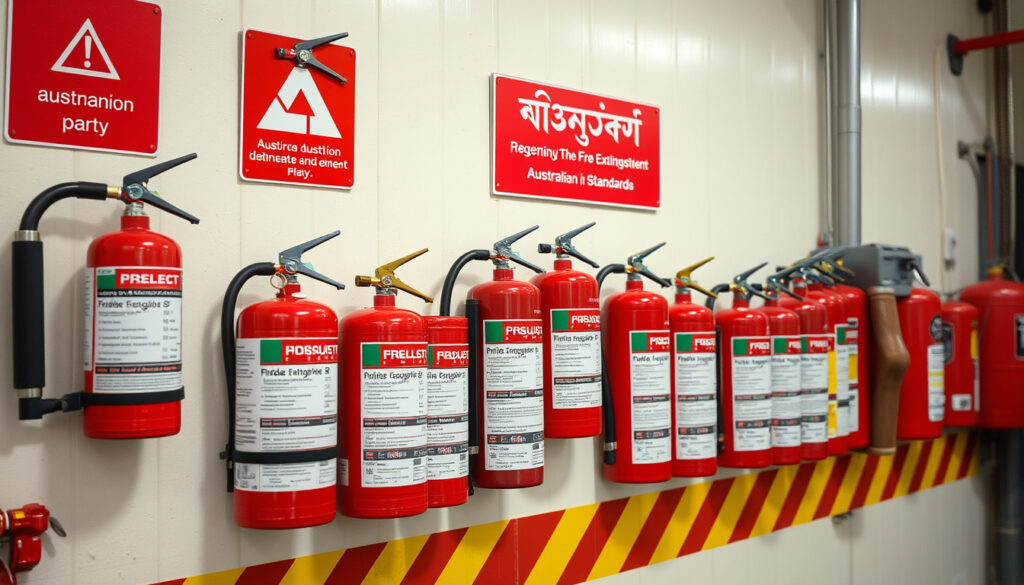
Fire Extinguisher Australia: Types, Sizes & Standards
Picking the right fire extinguisher for your Australian home isn’t just about grabbing any can—it requires matching the type, size, and placement to the risks you actually face. This guide covers the four main types, sizing for your home and car, and the clearance and maintenance rules you need to know.
Number of types in Australia: 4 (plus wet chemical) · Recommended home weight: 2 kg ABE dry chemical · Australian standard: AS 2444 · Service interval: Annual inspection by a qualified technician
Quick snapshot
- AS 2444 is the Australian standard that specifies criteria for selecting portable fire extinguishers and their location (Standards Australia Store).
- A 2 kg ABE dry chemical extinguisher is recommended for most Australian homes (Fire and Rescue NSW).
- Australian fire classes cover A, B, C, D, E, and F (Tasmanian Fire Service).
- Exact clearance requirements may vary by state or local regulation.
- Effectiveness of a 20‑year‑old extinguisher depends on its maintenance history.
- Whether a 1 kg unit is sufficient for all car types, including hybrid vehicles.
- The latest edition of AS 2444 dates from 2001; no newer Australian standard has been published since (Intertek Inform).
- Check local state rules for specific placement and clearance requirements (Fire and Rescue NSW).
- Replace any extinguisher that is more than 10 years old or has a damaged gauge. (Fire and Rescue NSW)
Here is a quick reference of essential fire extinguisher specifications:
| Category | Details |
|---|---|
| Types of fire extinguishers | Water, Foam, Dry Chemical Powder (DCP), Carbon Dioxide (CO₂) plus wet chemical |
| Typical home weight | 2 kg ABE dry chemical |
| Australian standard | AS 2444 |
| Service interval | Annual inspection; 5‑year pressure test |
| Fire classes defined in Australia | A (ordinary combustibles), B (flammable liquids), C (gases), D (metals), E (electrical), F (cooking oils) – Tasmanian Fire Service |
| Common sizes available | 1 kg, 1.5 kg, 2 kg, 2.5 kg, 4.5 kg, 9 kg – Ausfire Protection |
| Recommended mounting height | Handle between 1 m and 1.5 m above floor level – Queensland Fire Department |
| Clearance below extinguisher | At least 100 mm to allow visual inspection |
What are the four types of fire extinguishers?
What does each type cover (classes A, B, C, E, F)?
- Water – Class A fires (wood, paper, textiles). Red band.
- Foam – Class A and B (flammable liquids). Blue band.
- Dry Chemical Powder (DCP) – ABE – Classes A, B, C, and E (electrical). White band.
- Carbon Dioxide (CO₂) – Class B and electrical fires. Black band.
- Wet Chemical – Class F (cooking oils/fats). Yellow band (commercial kitchens).
Fire classes are defined by the Tasmanian Fire Service. For each class, Fire and Rescue NSW lists the suitable extinguishing media.
Which type is best for home?
For Australian homes, the most practical all‑rounder is a 2 kg ABE dry chemical extinguisher. It covers the most common household fires – wood, paper, flammable liquids, and electrical – and is widely available at retailers like Bunnings. A CO₂ extinguisher is a good alternative for kitchens and workshops where you want to avoid powder residue.
“A 2 kg ABE dry chemical extinguisher is recommended for most Australian homes.” – Fire and Rescue NSW
The implication: your choice of extinguisher type directly affects your ability to safely respond to common household fires.
How many fire extinguishers do I need in Australia?
What is the Australian standard for fire extinguishers?
AS 2444 – the Australian standard for portable fire extinguishers – guides selection, location, and distribution based on floor area and occupancy (Standards Australia Store). The standard also references maintenance under AS 1851. A general rule: at least one extinguisher per floor, with additional units in the garage and kitchen.
How much clearance is needed around a fire extinguisher in Australia?
“The extinguisher handle should be mounted between 1 m and 1.5 m above floor level, with a minimum of 100 mm clearance below to allow visual inspection.” – Queensland Fire Department
State variations may apply, so always check local regulations.
A poorly placed extinguisher is dangerous: if it’s too high, small adults or children can’t reach it; too low, it’s a tripping hazard. The 1 m to 1.5 m window balances accessibility and safety.
What this means: correct placement is as critical as having the right extinguisher.
What size fire extinguisher is best for residential use?
Is a 2 kg fire extinguisher enough for a home?
Yes – for living areas, a 2 kg ABE DCP is the standard recommendation (Fire and Rescue NSW). It delivers enough discharge time (8–10 seconds) for most room‑scale fires.
What type of fire extinguisher is best for a residential home?
Choose an ABE‑rated dry chemical extinguisher. It’s the only single type that covers the three most common residential fire classes: ordinary combustibles, flammable liquids, and electrical.
How do I determine what size fire extinguisher I need?
- Living areas: 2 kg ABE DCP.
- Garage/workshop: 3 kg or 4.5 kg ABE DCP for heavier fire load.
- Kitchen: 2 kg ABE DCP or a wet chemical unit for commercial kitchens.
- Car: 1 kg ABE DCP or CO₂.
The size you need depends on the potential fire load. Ausfire Protection lists common sizes from 0.75 kg up to 9 kg. A simple rule: bigger spaces and higher‑risk areas (workshop, garage) need larger extinguishers.
Four extinguisher types, one clear pattern: no single type is perfect for everything. The table below compares them at a glance.
| Type | Suitable classes | Pros | Cons | Common sizes (kg) |
|---|---|---|---|---|
| Water | A | Cheap, effective on wood/paper | Cannot be used on electrical or oil fires | 2, 4.5, 9 |
| Foam | A, B | Good on liquids, less mess than powder | Not for electrical fires | 2, 4.5, 9 |
| ABE DCP | A, B, C, E | ALL‑rounder, covers electrical | Powder residue corrosive to electronics | 1, 2, 2.5, 4.5, 9 |
| CO₂ | B, E | No residue, safe for electronics | Short discharge time, less effective outdoors | 2, 3.5, 5 |
The trade‑off: DCP covers the widest range, but CO₂ is better for sensitive equipment. For a typical home, DCP is the pragmatic pick.
ABE dry chemical extinguishers come in a range of capacities; the table below shows common ratings and recommended uses.
| Size (kg) | Typical rating | Best for |
|---|---|---|
| 0.75 | – | Small car, compact spaces |
| 1 | 1A 10B E | Car, small caravan |
| 1.5 | – | Medium home rooms, small workshop |
| 2 | 2A 20B E | Home living areas, kitchen |
| 2.5 | 2A 30B E | Garage, small workshop |
| 4.5 | 3A 40B E | Large garage, home workshop |
| 9 | 4A 60B E | Commercial, large sheds |
Why this matters: a 9 kg unit is overkill for a living room and heavy to handle. Stick with 2 kg for everyday rooms and scale up only where the fire load is higher.
Upsides of ABE DCP
- Covers the most fire classes (A, B, C, E).
- Affordable and widely available.
- Works well in home, garage, and car.
Downsides of ABE DCP
- Powder residue can damage electronics.
- Reduced visibility during discharge.
- Not recommended for Class F (cooking oil) fires.
Can a 20 year old fire extinguisher still be good?
Fire extinguisher expiry
Most portable extinguishers have a service life of 5 to 10 years, depending on type and conditions. A 20‑year‑old unit is far beyond that window, and its reliability is questionable. Check the pressure gauge: if the needle is not in the green zone, the unit cannot discharge effectively and should be replaced immediately.
When should you replace a fire extinguisher?
- After any discharge (even partial).
- If the gauge needle is out of the green zone.
- If tamper seal or safety pin is missing.
- If the body shows dents, corrosion, or leaking.
- At the end of its stated service life (check label).
Fire and Rescue NSW advises that extinguishers be inspected annually by a qualified technician. Units that fail inspection must be replaced – not recharged – if over 10 years old.
Is 1 kg fire extinguisher enough for a car?
What size fire extinguisher for car?
Yes, a 1 kg ABE DCP or 2 kg CO₂ extinguisher is generally enough for a standard passenger car. It’s small enough to mount under a seat or in the cabin without obstructing space. Ensure it’s easily accessible – never store it in the boot where you can’t reach it during an emergency.
Fire extinguisher car requirements Australia
While national law does not mandate a fire extinguisher in private cars, some states – such as New South Wales – require them for specific vehicles (e.g., taxis, buses). Check your state’s road authority. Retailers like Supercheap Auto and Bunnings stock car‑friendly models.
A 1 kg unit discharges in about 6 seconds – enough for an engine‑bay fire but not for a fully developed car fire. Hybrid and electric vehicles pose additional risks because of high‑voltage batteries; they may require a different agent.
The catch: a 1 kg unit offers quick response for engine fires but is not a substitute for a larger extinguisher in a major vehicle fire.
Concluded: Fresh eyes on fire safety
The choice for Australian homeowners is clear: equip your home with a 2 kg ABE dry chemical extinguisher, mount it within easy reach, inspect it annually, and replace it every 10 years. For your car, a compact 1 kg model provides peace of mind without sacrificing space. Staying ahead of these simple rules is not just about compliance – it’s about knowing you’ve done what you can before a flame ever touches your walls.
avadocuments.com, fireregulations.com.au, scribd.com, intertekinform.com, intertekinform.com, fire.tas.gov.au, kellssafetycentre.com.au
Frequently asked questions
What does the blue band on a fire extinguisher mean?
The blue band indicates a foam extinguisher, which is suitable for Class A and B fires (ordinary combustibles and flammable liquids).
Can I use a CO₂ extinguisher on a grease fire?
Yes, but carefully. CO₂ displaces oxygen, which can extinguish a small grease fire. However, the high pressure may splash burning oil. A fire blanket or wet chemical extinguisher is safer for kitchen oil fires.
Where should I store a fire extinguisher in my home?
Mount it in a visible, easily accessible location – e.g., near an exit in the hallway, in the kitchen (but not directly over the stove), and in the garage. Keep it away from potential fire sources and at the correct mounting height (1 m–1.5 m).
How do I dispose of an old fire extinguisher in Australia?
Contact your local council for scheduled household hazardous waste collections or drop‑off events. Some fire equipment suppliers also accept old units for recycling. Never puncture or burn an extinguisher.
Do fire extinguishers expire in Australia?
Yes. Most have a service life of 5–10 years from the date of manufacture. After that, they should be replaced, even if the gauge shows pressure.
What is the difference between ABE and BE extinguishers?
ABE extinguishers cover Classes A, B, C, and E – the broadest range for home and workplace. BE extinguishers cover only Classes B and E (flammable liquids and electrical) – they are not suitable for ordinary combustibles like wood or paper.
Can a fire extinguisher freeze?
Yes. Water‑based extinguishers (water, foam, wet chemical) can freeze if stored below 0 °C. DCP and CO₂ units are not affected by freezing, but always store in a frost‑free area if possible.
Is it legal to recharge a fire extinguisher yourself?
No. Australian standards require that extinguisher recharging be performed by a qualified technician using approved equipment. DIY recharging may void certification and prove dangerous.
Related reading
More related posts
 Tim Robinson: Career, Personal Life, and His Cult Comedy Series
 Jordan Peterson: Beliefs, Health, Politics & Status
 Breville Barista Touch Review: Pros, Cons & Comparisons
 Keith Haring: Life, Art, Death Cause & Legacy (Full Guide)
 Morgan Wallen: Biography, Controversies & Personal Life
 Peter Falconio Murder: Body Never Found, Killer Dies in Prison
 Train Wrecks: Definition, Famous Examples, Causes, and Prevention
