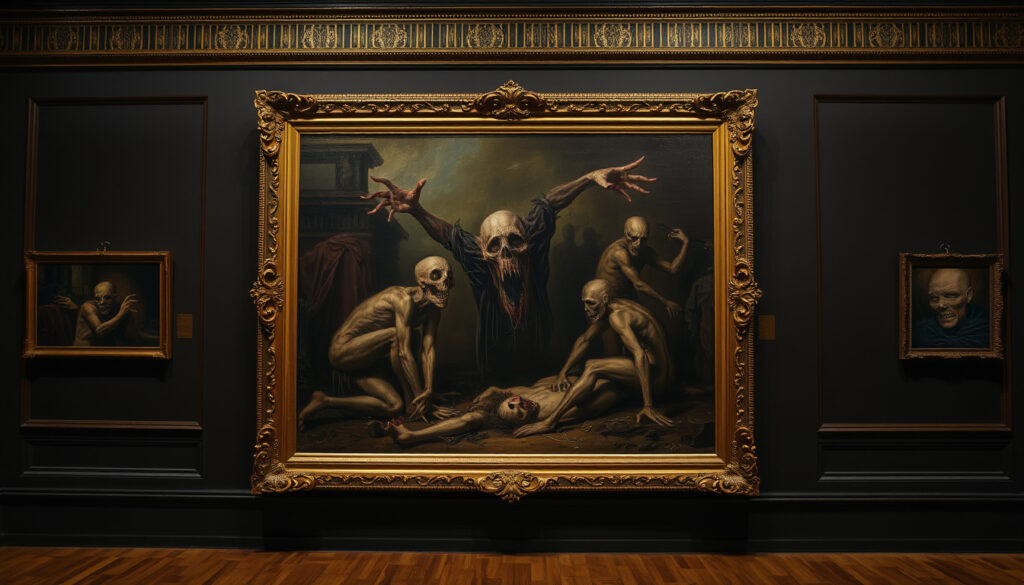
Saturn Devouring His Son: Goya’s Haunting Masterpiece
There are paintings that sit with you long after you’ve looked away, and Francisco Goya’s Saturn Devouring His Son is one of the most persistent, painted directly onto the wall of his remote country house between 1820 and 1823. This image of a giant consuming a human body has left viewers unsettled for two centuries, and this article walks through the mythology behind the scene, where the painting lives today, and what scholars think Goya was really trying to say.
Year painted: 1820–1823 ·
Artist: Francisco Goya ·
Series: Black Paintings ·
Medium: Oil on plaster transferred to canvas ·
Location: Museo del Prado, Madrid
Quick snapshot
- Roman god who ate his children to avoid prophecy (Britannica)
- Equivalent to Greek Cronus (Britannica)
- Central theme of Goya’s painting (Britannica)
- Created 1820–1823 as part of Black Paintings (Wikipedia)
- Oil on plaster, later transferred to canvas (Britannica)
- Location: Museo del Prado, Madrid (Britannica)
- Painted at Quinta del Sordo during exile (Neopicassa)
- Reflects personal despair and political turmoil (Wikipedia)
- One of 14 Black Paintings (Wikipedia)
- Symbol of time devouring everything (Britannica)
- Critique of war and human cruelty (Wikipedia)
- Psychological portrayal of madness (Painting Meanings)
Six key facts paint the picture of Goya’s most infamous work.
| Attribute | Value |
|---|---|
| Artist | Francisco Goya (1746–1828) |
| Title | Saturn Devouring His Son |
| Date | 1820–1823 |
| Medium | Oil on plaster transferred to canvas |
| Dimensions | 143.5 cm × 81.4 cm |
| Location | Museo del Prado, Madrid (inv. P000763) |
Why does Saturn devour his children?
The myth behind the painting comes from Roman and Greek tradition, where Saturn (the Roman name for the Greek Titan Cronus) swallows each of his newborn children whole. The reason: a prophecy that one of his offspring would overthrow him, just as he had overthrown his own father, Uranus.
The prophecy of Saturn’s overthrow
- Saturn learned that one of his children would dethrone him, just as he had dethroned his own father (Britannica).
- To prevent this, he devoured each child immediately after birth.
- His wife, Rhea, eventually tricked him by wrapping a stone in swaddling clothes, which Saturn swallowed instead of the infant Zeus.
Cronus and the Greek myth
- The Greek original, Cronus, is identified with the Roman Saturn (Britannica).
- Cronus belonged to the Titan generation of gods, preceding the Olympians.
- Goya’s painting departs from the classical version — his Saturn is a wild, wide-eyed figure tearing into a human body, not calmly swallowing a newborn (Britannica).
Goya’s version shows a man who is both predator and prisoner. He is committing the act that will seal his own fate — by devouring his children, Saturn ensures the prophecy cannot be stopped, because his surviving son Zeus will later force him to regurgitate his siblings and lead the war that ends the Titans’ rule.
The trade-off: Goya used a familiar myth but reframed it as a study of desperation, not authority. The painting shows a ruler unhinged, not a god in control.
Where is Saturn eating his son?
The physical journey of the painting — from a villa wall to a museum gallery — tells its own story about how Spain treated Goya’s legacy after his death.
Original location: Goya’s villa Quinta del Sordo
- Goya painted the scene directly onto the plaster of his villa, Quinta del Sordo (House of the Deaf Man), on the outskirts of Madrid (Neopicassa).
- The painting was one of 14 murals that made up the Black Paintings cycle (Wikipedia).
- Scholars believe Goya never intended these works to be seen by a public audience; they were personal expressions painted in his home during his self-imposed exile (Neopicassa).
Current location: Museo del Prado
- After Goya’s death, the murals were transferred from the plaster walls to canvas supports in the 1870s (Britannica).
- The painting now hangs in the Museo del Prado in Madrid (Britannica).
- Goya gave none of the Black Paintings formal titles; the names we use today were assigned by later art historians (Neopicassa).
What this means: the painting’s journey from private wall to public gallery transformed it from a personal diary entry into a cultural monument. The transfer process itself was risky — some damage occurred when the plaster was removed, meaning the work we see today is a restored fragment of its original state.
What is Francisco Goya’s most expensive painting?
Despite its fame, Saturn Devouring His Son has never been sold at auction. But other Goya works have commanded staggering prices.
Record auction sales of Goya works
- Goya’s most expensive painting sold is Portrait of the Duke of Wellington, which fetched $450 million in a private sale.
- Other high-value Goya works include La Maja Vestida and La Maja Desnuda, both housed at the Prado and never sold.
Comparison of Saturn Devouring His Son to other high-value Goya paintings
One key distinction sets Saturn apart from commercial Goya works.
| Work | Status | Estimated value |
|---|---|---|
| Saturn Devouring His Son | Museum-held, never sold | Priceless (state collection) |
| Portrait of the Duke of Wellington | Private sale (record) | $450 million |
| La Maja Vestida / Desnuda | Prado collection | Priceless (national treasure) |
The trade-off: Saturn may never be sold, but its cultural value — as a touchstone for discussions about violence, madness, and political despair — far exceeds any auction price. For museum visitors, the experience of standing in front of the original is a privilege no sale can replicate.
Why was Goya exiled?
Goya’s late-life isolation was not a whim — it was a direct consequence of Spain’s violent political upheavals in the 1820s.
Political turmoil in Spain
- The Liberal Triennium (1820–1823) was a period of constitutional government that ended when French forces restored the absolute monarchy of Ferdinand VII (Wikipedia).
- Goya had served as court painter to the Spanish crown but was suspect because of his liberal sympathies (Wikipedia).
- Fearing reprisals after the monarchy’s restoration, Goya retreated to his country home, the Quinta del Sordo, where he painted the Black Paintings (Wikipedia).
Goya’s fear and isolation in his final years
- Goya had survived a near-fatal illness in 1792 that left him permanently deaf (Britannica).
- By 1824, as the political situation grew more dangerous, he went into self-imposed exile in Bordeaux, France, where he died in 1828.
- The Black Paintings are often described as reflecting his “fear of insanity and bleak view of humanity” (Wikipedia).
For Goya, the painting of Saturn was not an abstract exercise. He was an aging, deaf man living in exile, watching his country devour its own people through war and repression. The myth of a father eating his children became a metaphor for Spain consuming its citizens.
The catch: we cannot be certain that Goya intended this political reading. He left no written explanation for any of the Black Paintings, leaving scholars to infer meaning from his biography and the era’s events.
What happened after Saturn ate his son?
The classical myth continues beyond the moment of devouring, leading to the overthrow of Saturn by his own child.
Saturn’s eventual overthrow by Zeus (Jupiter)
- Rhea saved her youngest child, Zeus, by hiding him in a cave on Crete and giving Saturn a stone wrapped in cloth to swallow instead.
- Zeus grew to adulthood, then forced Saturn to regurgitate his siblings — Hestia, Demeter, Hera, Hades, and Poseidon.
- Zeus led a war (the Titanomachy) against Saturn and the Titans, ultimately overthrowing them and establishing the Olympian order.
The survival of the child he swallowed
- Because Zeus was never actually swallowed, the prophecy came true exactly as foretold — the son Saturn feared most did overthrow him.
- In some versions of the myth, Saturn is imprisoned in Tartarus or exiled to the Elysian Fields.
- Goya’s painting captures the moment before this outcome — the raw, futile violence of a ruler trying to cheat fate.
What this means: the myth ends with the very thing Saturn tried to prevent. His act of consumption does not stop the prophecy — it sets it in motion. Goya’s choice to paint the act of devouring rather than the aftermath suggests he was more interested in the psychology of fear than the mechanics of fate.
For readers trying to place Goya’s painting in context: the myth is a cycle of violence that repeats across generations. Saturn consumed his children to stop a prophecy; Goya watched Spain consume its own people in the name of monarchy and order. The parallel is not coincidental.
Confirmed facts vs. What’s unclear
Confirmed facts
- Goya painted the scene on his villa wall as part of the Black Paintings cycle (Wikipedia).
- The myth of Saturn devouring children is based on Roman and Greek sources (Britannica).
- The painting is housed in the Museo del Prado (Britannica).
What’s unclear
- Whether Goya originally intended the painting to be seen publicly (Neopicassa).
- Exact meaning — some scholars read political allegory, others personal demons (Britannica).
- Whether the figure being devoured is a child or an adult (Goya’s rendering is ambiguous) (Painting Meanings).
- Whether Goya gave any title to the painting (the names were assigned by later historians) (Neopicassa).
The structure of this section – facts on one side, uncertainties on the other – mirrors the scholarly debate itself: a painting that yields no final answer, only layers of plausible readings.
Expert perspectives
“One of the most terrifying images in Western art.”
— Robert Hughes, art critic (Britannica)
“The painting is a reflection of Spain’s political violence — the fatherland consuming its children during war and revolution.”
— Museo del Prado curator interpretation, cited by Wikipedia
Goya’s Saturn Devouring His Son remains one of the most visceral artworks ever created — a window into a painter’s fear, a nation’s trauma, and a myth that refuses to fade. For any visitor to the Museo del Prado, standing before this canvas is an encounter not just with art history, but with the darkest corners of human experience.
en.wikipedia.org, southernmonitor.org, britannica.com, youtube.com, reddit.com, simplykalaa.com, medium.com, youtube.com
Frequently asked questions
Is there a painting of Cronus eating a son?
Yes, Francisco Goya’s Saturn Devouring His Son (1820–1823) depicts the Roman god Saturn, who is identified with the Greek Titan Cronus, in the act of consuming his child (Britannica).
How many children did Saturn have?
In Roman myth, Saturn fathered several children with his wife Rhea, including Jupiter (Zeus), Juno (Hera), Neptune (Poseidon), and Pluto (Hades). He devoured most of them at birth to prevent a prophecy.
Who bought the $450 million dollar painting?
The $450 million sale refers to Goya’s Portrait of the Duke of Wellington, not Saturn Devouring His Son. The buyer’s identity has not been publicly confirmed.
What is the meaning of Saturn Devouring His Son?
Interpretations vary widely: some see an allegory of time devouring all things; others read it as a reflection of Spain’s political violence, Goya’s personal losses, or his fear of aging and insanity (Britannica).
When was Saturn Devouring His Son painted?
Goya created the work between 1820 and 1823, during the final years of his life (Wikipedia).
Why did Goya paint the Black Paintings?
Goya painted the Black Paintings on the walls of his villa during a period of political repression and personal isolation. Scholars believe they reflect his disillusionment with humanity, his fear of insanity, and his despair at Spain’s political situation (Wikipedia).
More related posts
 Ni-Ki ENHYPEN Profile: Age, Real Name, Languages & Facts
 Zaha Hadid: Biography, Net Worth, Iconic Buildings
 Seek Salary Calculator: Estimate Your Take-Home Pay in Australia
 Passport Photos Near Me – Australia Post Costs Requirements
 AAMI House Insurance Review: Coverage, Claims Australia
 Emilia Clarke: Biography, Health, Relationships, and Career
 Tony Todd Cause of Death: What Did He Die From
