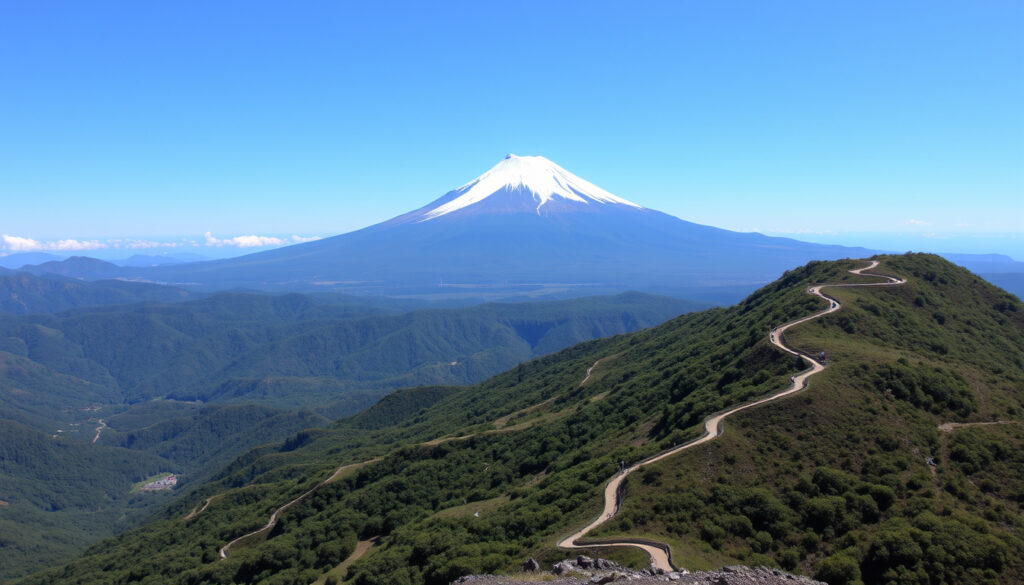
Mount Fuji: Climbing, Location, and Volcanic Activity
Few mountains capture the imagination quite like Mount Fuji. Rising 3,776 meters above the Japanese landscape, it’s both a beloved symbol of Japan and an active volcano that demands respect.
Height: 3,776 meters (12,389 ft) ·
Last eruption: 1707 (Hōei eruption) ·
Location: Honshu Island, Japan ·
First recorded ascent: 663 AD (by an unknown monk) ·
Climbing season: Early July to early September ·
UNESCO status: World Cultural Heritage Site (2013)
Quick snapshot
- Open season July–September (Japan National Tourism Organization)
- No permit required (JNTO)
- 4 main trails (Japan Guide)
- Altitude sickness risks apply (Mt. Fuji Climbing Safety Guide)
- Active stratovolcano (JNTO)
- Last erupted 1707 (Japan Guide)
- Monitoring level 1 (normal) (Japan Meteorological Agency)
- Height 3,776 m (JNTO)
- 100 km from Tokyo (Japan Guide)
- Shizuoka & Yamanashi prefectures (Mt. Fuji Climbing Safety Guide)
- Bus, train, car access (JNTO)
- 5th station starting point (Japan Guide)
- UNESCO World Cultural Heritage (2013) (UNESCO World Heritage Centre)
- Symbol of Japan (UNESCO)
- Associated with Sengen shrines (Japan Guide)
- Artistic inspiration (UNESCO World Heritage Centre)
Seven key specs define Mount Fuji — a pattern that reveals both its natural scale and its cultural weight.
| Elevation | 3,776 m (12,389 ft) (JNTO) |
| Prominence | 3,776 m (JNTO) |
| Location | Honshu, Japan (Mt. Fuji Climbing Safety Guide) |
| Type | Stratovolcano (active) (Japan Guide) |
| Last eruption | 1707 (Hōei) (Japan Guide) |
| First ascent | 663 AD (legendary) (Japan Guide) |
| Climbing season | July–September (JNTO) |
Can you legally climb Mount Fuji?
Climbing regulations and permits
- No special permit is required to climb Mount Fuji, according to the Japan National Tourism Organization (JNTO).
- During the official season (early July to early September), entry is permitted from 3:00 a.m. to 2:00 p.m. Access outside those hours is restricted to hikers with mountain hut reservations, per JNTO.
- A mandatory hiking fee of 4,000 yen per person is required (JNTO).
No permit doesn’t mean no rules. The 4,000-yen fee and time restrictions are designed to manage crowds and safety. For climbers who ignore the season, the risk isn’t just a fine — trails are unmaintained and huts closed.
Open climbing season
- The official climbing season runs early July to early September, with slight variations per trail (Japan Guide).
- Off-season climbing is strongly discouraged: trails are not maintained, mountain huts are closed, food is unavailable, and weather is unpredictable (Japan Guide).
Required gear and safety
- Essential gear includes warm clothing, rain gear, headlamp, and oxygen (optional but common) (Mt. Fuji Climbing Safety Guide).
- Altitude sickness is a real concern — ascending too quickly can cause headaches, nausea, and in severe cases, pulmonary edema (Safety Guide).
What this means: Climbing Mount Fuji is legally open to anyone, but the regulations effectively require planning and a fee. The trade-off is between flexibility and safety — tourists who arrive unprepared face real altitude risks and potential weather hazards.
Is Mt. Fuji still active?
Volcanic status and monitoring
Mount Fuji is classified as an active stratovolcano, monitored continuously by the Japan Meteorological Agency (JMA) on a scale of 1 to 5. The current alert level is Level 1 — normal, meaning no immediate eruption threat.
Last eruption details
- The last confirmed eruption was the Hōei eruption in 1707 (Japan Guide).
- That eruption was triggered by a large earthquake (the 1707 Hōei earthquake) and produced ash fall as far as present-day Tokyo (Japan Guide).
Current alert level
- Alert Level 1 means no unusual volcanic activity detected (JMA).
- Seismic and geodetic monitoring continues 24/7 (JMA).
“Mount Fuji remains an active volcano. We monitor it around the clock with seismometers and GPS. The current alert level is normal, but we cannot predict exactly when the next eruption will occur.”
— Japan Meteorological Agency volcano monitoring division
The pattern: Fuji is active but quiet. The 1707 eruption shows it can wake up after long dormancy. For climbers, the risk is low but not zero — JMA data is the best real-time indicator.
Where is Mount Fuji exactly located?
Geographic coordinates
Mount Fuji’s summit sits at 35°21′36″N 138°43′50″E, straddling the border of Shizuoka and Yamanashi prefectures on Honshu Island (Mt. Fuji Climbing Safety Guide).
Nearby cities and transport
- Approximately 100 km southwest of Tokyo (Japan Guide).
- The Yoshida Trail 5th Station is accessible by direct bus from Tokyo in about 2.5 hours during summer (JNTO).
- Trails on the Shizuoka side are most easily accessed via Shin-Fuji Station (JNTO).
How to get there from Tokyo
- Take a highway bus from Shinjuku Station to the 5th Station (summer only) (Japan Guide).
- Alternatively, take the Shinkansen to Mishima or Shin-Fuji, then local bus (JNTO).
The 100 km distance is close enough for day trips, but the journey time varies dramatically by season. Summer buses fill up weeks in advance — planning ahead is essential, especially for international visitors.
The implication: advance planning is essential for a smooth trip.
What’s so special about Mount Fuji?
Cultural significance
- Mount Fuji has been a pilgrimage site for centuries, associated with the ascetic practice of Shugendo (UNESCO).
- The summit is sacred in Shinto belief, with the Fujisan Hongū Sengen Taisha shrine at its base and summit (Japan Guide).
Natural beauty and symbolism
- Its near-perfect symmetrical cone is iconic, often depicted in ukiyo-e woodblock prints like Hokusai’s “Thirty-six Views of Mount Fuji” (UNESCO).
- The mountain is part of the Fuji-Hakone-Izu National Park, established in 1936 (Japan Guide).
UNESCO World Heritage status
- Designated a World Cultural Heritage site in 2013 under criteria (iii) and (vi) for its artistic and religious significance (UNESCO).
- The designation covers 25 component sites including the mountain itself, Sengen shrines, and pilgrimage routes (UNESCO).
“Mount Fuji is a cultural landscape of outstanding universal value. It has inspired artists and poets for centuries and continues to be a place of spiritual retreat.”
— UNESCO World Heritage Centre description
The implication: Fuji’s special status isn’t just about height — it’s the interplay of natural form, religious meaning, and artistic legacy that earned it UNESCO recognition.
Who owns Mount Fuji now?
Historical ownership
Originally, the entire mountain was under the control of the Fujisan Hongū Sengen Taisha shrine. After the Meiji Restoration (1868), ownership was transferred to the state.
Current legal status
- The area from the 8th station to the summit is privately owned by the Fujisan Hongū Sengen Taisha shrine (Japan Guide).
- A 2004 Supreme Court ruling confirmed the shrine’s ownership of the summit area (Japan Guide).
- The lower areas are part of national forest with mixed ownership (JNTO).
Sengen shrines and private holdings
- The shrine maintains several mountain huts and collects fees for the use of the summit area (Mt. Fuji Climbing Safety Guide).
- Climbing fees and conservation donations are often collected through the shrine’s system (Safety Guide).
“The summit of Mount Fuji has been sacred land belonging to our shrine for over a thousand years. The 2004 ruling simply restored what was ours.”
— Representative of Fujisan Hongū Sengen Taisha shrine
What this means: climbers are literally walking on private property from the upper portion. The shrine uses these funds for conservation and trail maintenance — a practical arrangement that blends religious tradition with modern tourism management.
Climbing trails compared
Four trails, one pattern: each offers a different balance of convenience, solitude, and physical demand.
| Trail | Starting elevation | Difficulty | Approx. ascent time |
|---|---|---|---|
| Yoshida Trail | 2,300 m (5th Station) | Moderate | 5–7 hours |
| Fujinomiya Trail | 2,400 m (5th Station) | Hard (steep) | 4–6 hours |
| Subashiri Trail | 2,000 m (5th Station) | Moderate | 5–7 hours |
| Gotemba Trail | 1,400 m (5th Station) | Very hard (long) | 7–10 hours |
Source data: JNTO Climbing Guide, Japan Guide. The trade-off: Yoshida offers comfort and facilities; Gotemba offers solitude but at a steep physical cost.
How to climb Mount Fuji: steps
First-time climbers: choose the Yoshida Trail, book a mountain hut in advance, and carry warm layers. The Fuji Mountain Guides recommend starting at 10 p.m. for a pre-dawn summit arrival.
- Plan your trip: Check the official season (July–September) and book bus tickets and mountain huts early (Safety Guide).
- Get to the 5th Station: Take a bus from Kawaguchiko Station (for Yoshida) or Shin-Fuji Station (for Shizuoka trails) (JNTO).
- Start climbing: Register at the trailhead, pay the hiking fee (4,000 yen), and begin a slow, steady ascent with breaks (JNTO).
- Stay at a mountain hut: Overnight huts are available at stations 7–8. Reserve ahead; they provide meals, shelter, and a 2–3 hour rest (Safety Guide).
- Reach the summit for sunrise: Leave the hut around 2 a.m. to catch the sunrise from the crater rim. Descend via the same trail to avoid loose volcanic rock on the way down.
Following these steps will maximize your chances of a safe and memorable climb.
Pros and cons of climbing Mount Fuji
Upsides
- Stunning sunrise from summit
- No special climbing skills required
- Well-maintained trails and huts
- Unique cultural experience
Downsides
- Altitude sickness is common
- Crowded during peak season
- Weather can deteriorate rapidly
- Off-season climbing is dangerous
Consider these points before deciding to climb.
Timeline of Mount Fuji
- ~100,000 years ago — Beginning of volcanic activity forming Mt. Fuji (Japan Guide)
- 663 AD — First recorded ascent by an unknown monk (Japan Guide)
- 1707 — Last confirmed eruption (Hōei eruption, caused by earthquake) (Japan Guide)
- 1936 — Fuji-Hakone-Izu National Park established (Japan Guide)
- 2004 — Supreme Court confirms private ownership of summit area by Fujisan Hongū Sengen Taisha shrine (Japan Guide)
- 2013 — UNESCO World Cultural Heritage designation (UNESCO)
The timeline underscores the mountain’s long history and the significance of recent events.
Confirmed facts vs. what’s unclear
Confirmed facts
- Mount Fuji is an active stratovolcano (Japan Guide)
- Last eruption occurred in 1707 (Japan Guide)
- Height is 3,776 meters (JNTO)
- Climbing season is July–September (JNTO)
- Summit area is privately owned by Fujisan Hongū Sengen Taisha shrine (Japan Guide)
- UNESCO World Cultural Heritage site since 2013 (UNESCO)
What’s unclear
- Exact date of next eruption cannot be predicted (JMA)
- Full extent of private vs. public land ownership details
- Whether oxygen levels are significantly lower at summit (debated among climbers)
- Number of climbers annually varies widely by source
- Effect of climate change on snow cover duration
- Accuracy of altitude sickness statistics for untrained climbers
These uncertainties highlight the need for further research.
Quotes from the experts
“Mount Fuji is not just a climb — it’s a pilgrimage. We recommend starting early, staying hydrated, and never climbing alone if you’re a first-timer.”
— Head guide, Fuji Mountain Guides
“The religious significance of Mount Fuji cannot be separated from its physical presence. The shrines are guardians of a sacred landscape.”
— Fujisan Hongū Sengen Taisha shrine representative
“[Fuji] is a masterpiece of natural form and human devotion. The art it has inspired is a testament to its universal appeal.”
— UNESCO World Heritage Centre description
These quotes reflect the diverse perspectives on Mount Fuji.
Summary: a mountain of trade-offs
Mount Fuji offers an accessible climb with profound cultural rewards, but it also carries real volcanic risk and requires serious preparation. For the international traveler planning a trip, the choice is clear: book early for the Yoshida Trail during the official season, respect the mountain’s active nature, and treat the summit’s private ownership as a reminder that you’re a guest on sacred ground — or risk a costly and potentially dangerous experience.
Related reading: Little Blue Lake: Depth, Temperature, Walk & Camping · Things to Do in Hobart: Top Guide & 3-Day Itinerary
youtube.com, en.wikipedia.org, explore-share.com, globetrottingpeanuts.com, mytokyoguide.com
Related coverage: a complete travel guide fördjupar bilden av Mt Fuji – Complete Travel Guide & Climbing Tips.
Frequently asked questions
How long does it take to climb Mount Fuji?
Most climbers take 5–7 hours up and 3–5 hours down, depending on the trail and pace. Overnight climbs with hut stays typically leave late evening and summit before dawn.
What is the best trail to climb Mount Fuji?
The Yoshida Trail is the most popular and accessible, with many facilities and a separate descent route. First-timers often prefer it.
Is Mount Fuji open year-round?
Only during the official season (early July to early September). Off-season climbing is strongly discouraged due to unmaintained trails, closed huts, and severe weather.
Can you see Mount Fuji from Tokyo?
Yes, on clear days Mount Fuji is visible from Tokyo, especially in winter and early morning. Distance is about 100 km.
How many people climb Mount Fuji each year?
Estimates range from 200,000 to 300,000 climbers annually. Official counts vary, but the Yoshida Trail alone sees over 100,000 per season.
What should I pack for climbing Mount Fuji?
Warm layers, rain jacket, headlamp, trekking poles, water, snacks, and optional oxygen canisters. Altitude sickness medication may be advisable.
Are there any dangerous animals on Mount Fuji?
No large predators. Bears are extremely rare at high elevations. The main dangers are altitude sickness, weather, and fatigue.
These answers cover the most common concerns for prospective climbers.
More related posts
 Mid Burst Fade: Styles, Tips & 2026 Trends for Guys
 Shark Tank: Richest Sharks, Top Products & Biggest Flops
 Gryan Miers Injury Update: ACL Tear & Career Facts
 Frances McDormand: 4 Oscars, Joel Coen, Net Worth
 Jon Heder: Career, Faith, and Life After Napoleon Dynamite
 Karisma Kapoor Single Status, Marriages & Custody Update
 Simone Ashley: Tamil Heritage, Bridgerton, and F1 Movie Cut
 Israel Folau: Where Is He Now, Career, Religion & Controversy
