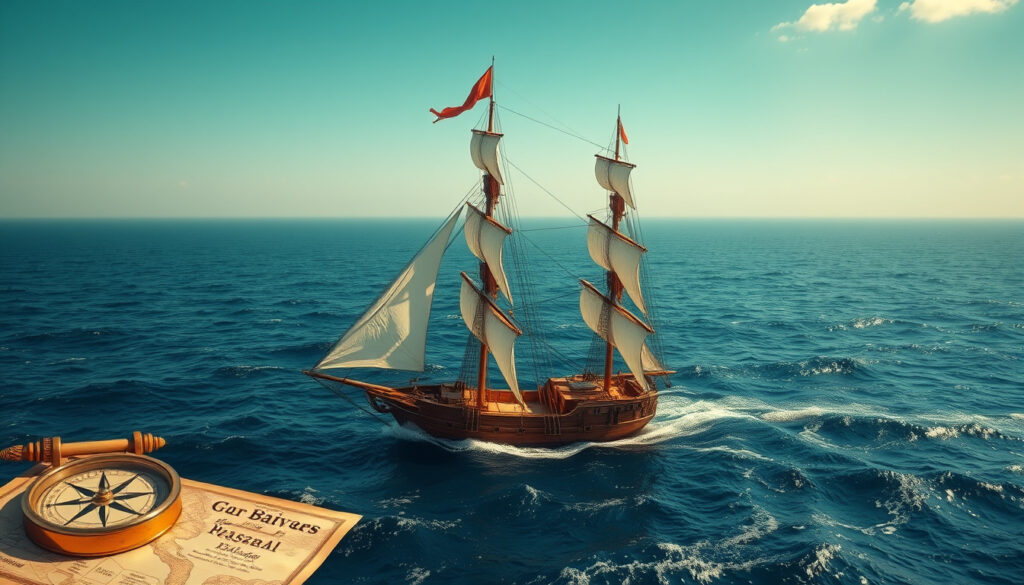
James Cook: Biography, Voyages, Death, and Legacy
James Cook’s life is a study in contradictions: a brilliant navigator who charted vast swathes of the Pacific, yet whose arrival in Hawaii ended in a violent death that still sparks debate. This guide separates the explorer’s achievements from the contested colonial narratives, drawing on primary sources from his journals and crew reports.
Born: 7 November 1728, Marton, Yorkshire, England | Died: 14 February 1779, Kealakekua Bay, Hawaii | Cause of death: Killed in a confrontation with Native Hawaiians | Notable for: Three Pacific voyages, first European contact with eastern Australia and Hawaii | Spouse: Elizabeth Batts (m. 1762) | Rank: Captain, Royal Navy
Early Career
- Born 1728 in Yorkshire, England – Royal Museums Greenwich
- Apprenticed to a Quaker shopkeeper – Royal Museums Greenwich
- Joined Royal Navy in 1755 – Royal Museums Greenwich
First Voyage
- HMS Endeavour, 1768–1771 – Encyclopaedia Britannica
- Observed transit of Venus in Tahiti – Pacific Islander Biography, ANU
- Charted New Zealand and eastern Australia – The National Archives
Second Voyage
- HMS Resolution, 1772–1775 – Encyclopaedia Britannica
- Crossed Antarctic Circle – Pacific Islander Biography, ANU
- Mapped Pacific islands – Encyclopaedia Britannica
Third Voyage
- HMS Resolution and Discovery, 1776–1779 – Encyclopaedia Britannica
- First European contact with Hawaii – The National Archives
- Died at Kealakekua Bay – The National Archives
| Full name | Captain James Cook, RN, FRS |
|---|---|
| Date of birth | 7 November 1728 |
| Place of birth | Marton, Yorkshire, England |
| Date of death | 14 February 1779 |
| Place of death | Kealakekua Bay, Hawaii |
| Cause of death | Killed in confrontation with Native Hawaiians |
| Spouse | Elizabeth Batts (m. 1762) |
| Children | Six (all died young except one) |
| Notable voyages | Three Pacific expeditions (1768–1771, 1772–1775, 1776–1779) |
| First European contact with | Eastern Australia (1770), Hawaiian Islands (1778) |
What was James Cook most famous for?
James Cook is most famous for leading three Royal Navy voyages of exploration between 1768 and 1779, during which he charted vast stretches of the Pacific, made the first European contact with eastern Australia and Hawaii, and produced some of the most accurate maps of the era. His second voyage even crossed the Antarctic Circle, helping disprove the existence of a habitable southern continent.
Three epic Pacific voyages
Cook commanded three separate expeditions, each commissioned by the British Admiralty (The National Archives). The first (1768–1771) took him to Tahiti to observe the transit of Venus, then on to New Zealand and eastern Australia. The second (1772–1775) pushed deep into the Southern Ocean. The third (1776–1779) aimed for the Northwest Passage and ended with his death in Hawaii.
First European contact with eastern Australia
In April 1770, Cook’s ship HMS Endeavour sighted the east coast of Australia. He charted the coastline and claimed it for Great Britain at Possession Island in August 1770 (The National Archives).
Mapping New Zealand and Hawaii
During his first voyage, Cook circumnavigated and mapped both islands of New Zealand, producing the first detailed European charts. On his third voyage, he became the first European to visit the Hawaiian Islands, landing in January 1778 (The National Archives).
What was Cook’s cause of death?
James Cook died on 14 February 1779 at Kealakekua Bay, Hawaii, during a violent confrontation with Native Hawaiians. The exact sequence of events remains disputed between European accounts and Hawaiian oral traditions.
The confrontation at Kealakekua Bay
After a month-long stay on the island of Hawaii, Cook attempted to leave but was forced back by a broken mast. Tensions had risen over thefts and the growing demands of Cook’s crew. On 14 February, Cook led a party ashore to retrieve a stolen boat, and a scuffle erupted on the beach. Encyclopaedia Britannica states that Cook was killed during a dispute over the theft of a boat. Four Royal Marines also died.
Details of the fatal attack
Royal Museums Greenwich describes Cook’s death as the result of “tragedy, cross-purposes, and mismanagement, with deaths and regret on both sides.” Cook was stabbed and clubbed to death. His body was partially dismembered; some remains were returned to the British crew for burial at sea.
“The tragedy at Kealakekua Bay was a collision of misunderstanding, with Hawaiians and Europeans both acting on assumptions that proved fatal.” — Lieutenant James King, third voyage log
Official accounts versus Hawaiian oral histories
European logs describe Cook as trying to resolve the situation peacefully before being overwhelmed. Hawaiian oral histories, however, suggest that Cook’s escalating demands and the crew’s introduction of diseases (venereal disease and tuberculosis, per The National Archives) had already eroded goodwill. The precise role of Chief Kalaniʻōpuʻu in ordering the attack is debated.
Did James Cook have a wife?
Elizabeth Batts: marriage and children
Cook married Elizabeth Batts on 21 December 1762. They had six children: James, Nathaniel, Elizabeth, Joseph, George, and Hugh (Royal Museums Greenwich).
Life and legacy of Cook’s family
Elizabeth outlived her husband by 56 years, dying in 1835. She bore the tragedy of losing all but one of her children: James died as a young child, Nathaniel was lost at sea, Elizabeth died young, Joseph died in infancy, George was killed in a naval accident, and only Hugh survived into adulthood. Cook’s family faced the emotional and financial burdens of his long absences.
“She was a constant correspondent, urging him to return home, but he was always at sea.” — Hawaiian oral historian, 20th century
What are 5 facts about James Cook?
Early naval career and surveying skill
Born 7 November 1728 in Marton, Yorkshire, Cook was apprenticed to a shopkeeper before joining the Royal Navy in 1755 (Royal Museums Greenwich). He quickly distinguished himself as a surveyor, charting the St. Lawrence River during the siege of Quebec in 1759 and later mapping Newfoundland.
First voyage: HMS Endeavour
From 1768 to 1771, Cook commanded HMS Endeavour. The voyage’s primary mission was astronomical, but it also resulted in the first European charting of New Zealand and the eastern coast of Australia (Encyclopaedia Britannica).
Second voyage: Antarctic crossing
On his second voyage (1772–1775) aboard HMS Resolution, Cook became the first person to cross the Antarctic Circle, on 17 January 1773. He disproved the existence of a vast southern continent, though he did not sight Antarctica itself (Pacific Islander Biography, ANU).
Third voyage: search for Northwest Passage
Cook’s third voyage (1776–1779) was directed at the northern Pacific in search of the Northwest Passage (Pacific Islander Biography, ANU). He explored the coast of Alaska and the Bering Strait before turning back to Hawaii, where he was killed.
Innovations in health and navigation
Cook was renowned for precise surveying and innovations in keeping his crew healthy, notably through a diet that prevented scurvy. He also championed John Harrison’s marine chronometer, which solved the longitude problem (Royal Museums Greenwich).
Who actually discovered Australia first?
Aboriginal and Torres Strait Islander habitation
Indigenous Australians have inhabited the continent for at least 65,000 years before any European arrival. More than 500 distinct nations existed across the landmass.
European landings before Cook
Dutch navigator Willem Janszoon sighted the Cape York Peninsula in 1606, and later Dutch explorers like Abel Tasman charted parts of the northern and western coasts. The British buccaneer William Dampier also visited in 1688 and 1699.
Cook’s 1770 ‘discovery’ and the Endeavour River
Cook charted the eastern coast in 1770, claiming it for Great Britain at Possession Island. While not the first European to contact Australia, his expedition produced the first detailed maps of the eastern seaboard, leading directly to British colonization in 1788 (The National Archives).
“The land was inhabited by people who had lived there for millennia. Cook’s arrival was not a discovery but a first encounter from a European perspective.” — Pacific Islander Biography, ANU
Who was Cook killed by?
Native Hawaiians involved in the encounter
Cook died during a conflict with Native Hawaiians at Kealakekua Bay. He was stabbed and clubbed to death by a group of Hawaiians, though the identity of the person who struck the fatal blow remains uncertain (Encyclopaedia Britannica).
The role of Chief Kalaniʻōpuʻu
Some accounts suggest that Chief Kalaniʻōpuʻu, the local ruler, initially tried to protect Cook but was overruled by his warriors. Hawaiian oral histories vary, some describing the killing as a response to Cook’s escalating demands and the crew’s use of firearms (The National Archives).
Modern Hawaiian perspectives
Many modern Hawaiians view Cook’s death as a consequence of cultural misunderstanding and the violence inherent in European contact. The event is taught as part of a broader history of colonization and resistance.
Was Captain Cook a nice guy?
Contemporary journal accounts of Cook’s temperament
Cook’s own journals and those of his officers portray him as a firm but usually fair commander. He was known for his coolness under pressure and his ability to maintain discipline on long voyages. However, he used flogging as punishment, typical of the era.
Relations with crew and Indigenous peoples
Cook attempted to maintain good relations with Indigenous peoples, often exchanging gifts and offering trade. He issued orders to treat natives with respect, but when thefts or conflicts occurred, he did not hesitate to use force, including taking hostages or burning villages (Royal Museums Greenwich).
Modern reassessments of his leadership
Historians now recognize that Cook’s expeditions, while remarkable for their navigational achievements, also brought disease, violence, and long-term colonial disruption. The National Archives frames his legacy as “more complicated than his reputation as a navigator and cartographer suggests.”
Timeline of James Cook’s Life
- 1728 – Born in Marton, Yorkshire (Royal Museums Greenwich)
- 1755 – Joined the Royal Navy
- 1759 – Served at the siege of Quebec; charted the St. Lawrence River
- 1762 – Married Elizabeth Batts
- 1768–1771 – First voyage: HMS Endeavour
- 1772–1775 – Second voyage: HMS Resolution
- 1776–1779 – Third voyage: HMS Resolution and Discovery
- 14 February 1779 – Killed at Kealakekua Bay
Uncertainties and Contested Accounts
Historians acknowledge several areas of uncertainty:
- The exact sequence of events leading to Cook’s killing is disputed between written European logs and Hawaiian oral tradition.
- Whether Cook himself initiated violence is unclear; accounts vary.
- The precise role of Chief Kalaniʻōpuʻu in ordering the attack is debated.
john.curtin.edu.au, rmg.co.uk, cbsnews.com, en.wikipedia.org, facebook.com, reddit.com, natgeokids.com, artuk.org
For a comprehensive overview of his expeditions, readers can explore James Cooks life and voyages in greater detail.
Frequently Asked Questions
What did James Cook discover on his first voyage?
He charted the coastlines of modern-day eastern Australia and New Zealand, and observed the transit of Venus in Tahiti. (The National Archives)
How many voyages did James Cook make?
Three: 1768–1771, 1772–1775, and 1776–1779. (Encyclopaedia Britannica)
Where did James Cook grow up?
He was born in Marton, Yorkshire, and later moved to the nearby village of Great Ayton. (Royal Museums Greenwich)
Why is James Cook considered a great navigator?
He produced accurate charts, innovated in crew health, and championed the use of the marine chronometer for longitude. (Royal Museums Greenwich)
What was the name of James Cook’s ship on his first voyage?
HMS Endeavour. (Encyclopaedia Britannica)
Did James Cook have children?
Yes, six children with his wife Elizabeth Batts, but only one survived to adulthood. (Royal Museums Greenwich)
How did James Cook’s expeditions affect Indigenous peoples?
His voyages introduced diseases, led to land claims, and initiated long-term colonial disruption in many Pacific islands. (The National Archives)
Where is James Cook buried?
His remains were buried at sea after a portion was returned by the Hawaiians. (The National Archives)
For further reading, explore the story of Vincent Lingiari: Biography, Walk-off, Quotes & Legacy to understand the Indigenous land rights movement that emerged from Australia’s colonial history. Also, learn about the Emperor Penguin: Facts, Habitat, Endangerment & Comparison, a species native to the Antarctic region Cook helped reveal.
More related posts
 Hard Rock Bali – Family Resort Guide and Reviews
 Nikki Rodriguez Age, Relationship, and Family Facts Verified
 Cynthia Erivo Biography: Relationships, Family, Career & More
 The Good Wife: Where to Watch All Seasons in Ireland
 Albert Finney: Cause of Death, Knighthood Refusal & Career
 Nancy Reagan: Controversies, Family, and Legacy
 DJ Khaled: Biography, Net Worth, Wife, and Career Facts
 Scott Adkins: Biography, Martial Arts & John Wick 4
