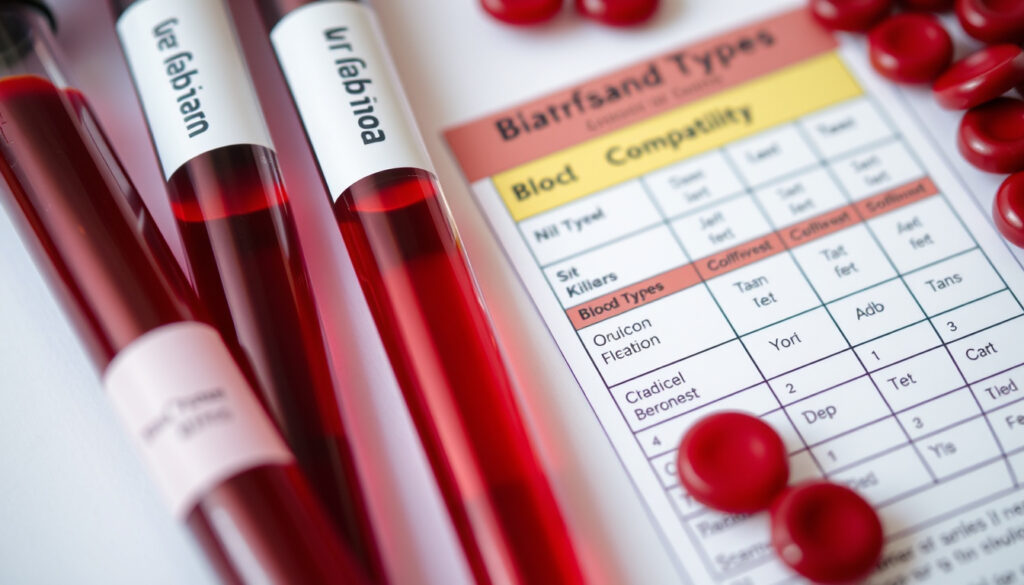
Blood Types: Rarity, Compatibility, and Key Questions Answered
If you’ve ever donated blood, you’ve probably been asked your blood type — and maybe you didn’t know it. O positive is the most common type worldwide at about 37%, but in Ireland it reaches 47%; AB negative is the rarest, at under 1%, according to the Irish Blood Transfusion Service.
Most common blood type worldwide: O positive (~37%) ·
Rarest blood type worldwide: AB negative (<1%) ·
Universal red blood cell donor: O negative (7% of population) ·
Most common type in Ireland: O positive (47%) ·
Rarest type in Ireland: AB negative (1%)
Quick snapshot
- Four main groups: A, B, AB, and O (Irish Blood Transfusion Service)
- Based on presence of A and B antigens on red blood cells (Irish Blood Transfusion Service) (Irish Blood Transfusion Service)
- Group O has no A or B antigens (Irish Blood Transfusion Service) (Irish Blood Transfusion Service)
- Rh-positive (+) means the Rh antigen is present (Irish Blood Transfusion Service) (Modern Ireland study)
- Rh-negative (-) means the Rh antigen is absent (Irish Blood Transfusion Service) (Modern Ireland study)
- Rh-negative is less common globally (Modern Ireland study)
- O positive is most common (~37%) (Irish Blood Transfusion Service)
- AB negative is rarest (<1%) (Irish Blood Transfusion Service)
- Rarity varies by ethnicity and region (Modern Ireland study)
- O negative is universal red cell donor (BloodBanker)
- AB positive is universal plasma donor (Blood Analysis)
- Matching Rh factor is critical for transfusions (BloodBook)
Eight blood types, one pattern: the interplay of ABO antigens and the Rh factor defines who can donate to whom. Here’s a quick reference.
| Fact | Value |
|---|---|
| Number of main blood types | 8 |
| Four ABO groups | A, B, AB, O |
| Universal donor (red cells) | O negative (BloodBanker) |
| Universal recipient (red cells) | AB positive (BloodBook) |
| Rarest major blood type | AB negative (<1%) (Irish Blood Transfusion Service) |
| Most common major blood type | O positive (~37%) (Irish Blood Transfusion Service) |
| Rh-negative frequency in Caucasians | ~15% (Modern Ireland study) |
| Blood type can change? (medical exception) | Only in rare cases like stem cell transplants |
Which is the rarest blood type?
AB negative is the rarest of the eight major blood types, occurring in less than 1% of the population worldwide, according to the Irish Blood Transfusion Service. The rarity stems from the combination of the AB blood group and the absence of the Rh antigen — both traits are recessive and less common.
What are the 3 rarest blood types?
- AB negative — less than 1% globally (Irish Blood Transfusion Service)
- AB positive — about 3% of the population (Modern Ireland study)
- B negative — roughly 2% of the population (Modern Ireland study)
The pattern: the rarest types share a common thread — either the AB combination or the Rh-negative factor, both of which are genetically recessive.
Is O+ a rare blood group?
No. O positive is the most common blood type worldwide, accounting for about 37% of the population, and in Ireland it reaches 47% (Irish Blood Transfusion Service). It is far from rare.
The same scarcity logic applies across all eight types: the less common the antigen combination, the smaller the pool of compatible donors.
What are the 3 most common blood types?
The three most common blood types globally are O positive, A positive, and B positive. O positive leads at roughly 37%, followed by A positive at around 27%, and B positive at about 12% in many populations, according to Irish Blood Transfusion Service data. These three types together cover more than three-quarters of the world’s population.
In Ireland, the distribution is even more skewed: the Modern Ireland study reports O positive at 45.55%, A positive at 24.31%, and B positive at 9.78%.
O positive donors are the backbone of the blood supply, but the abundance means their blood is less urgently needed in rare-type emergencies.
The practical consequence: routine blood drives depend on O positive donors, but emergencies depend on having O negative units already on the shelves.
Why is O-negative blood so rare?
O negative blood is rare because the Rh-negative trait is recessive and less common. About 7% of the population has O negative, according to the Irish Blood Transfusion Service. The absence of A, B, and Rh antigens makes it the universal red cell donor — it can be given to anyone in an emergency when the recipient’s blood type is unknown.
In Ireland, the Modern Ireland study found O negative in 9.40% of the population, slightly higher than the global average.
Why can’t O+ donate to everyone?
O positive blood carries the Rh antigen. If a patient with Rh-negative blood receives Rh-positive blood, their immune system may attack the foreign Rh antigen, causing a transfusion reaction, explains BloodBook. That’s why O negative, which lacks the Rh antigen, is the only universal red cell donor.
For transfusion services, the takeaway is that Rh matching is not optional — a mismatch can turn a life-saving transfusion into a life-threatening one.
What blood type do most Irish have?
The most common blood type in Ireland is O positive, found in 47% of the population, according to the Irish Blood Transfusion Service. The rarest is AB negative, at 1%.
Regional variation exists: the Irish Blood Transfusion Service notes that people in the West of Ireland are predominantly group O, while counties with Viking, Anglo-Norman, and English settlement history have a higher concentration of group A. The Modern Ireland study confirms these patterns, showing O positive at 45.55%, and Rh-negative frequency at 17.74%.
Ireland’s higher-than-average O positive prevalence means blood banks rarely face shortages of that type, but they constantly need O negative donations for emergencies.
What this means for the blood supply: O positive is the local backbone, while O negative remains the strategic reserve for trauma and emergencies.
Which blood type is usually the healthiest?
There is no single “healthiest” blood type. Associations between blood type and disease risk are statistical and not definitive. Some studies suggest type O individuals have a lower risk of blood clots and heart disease, but may have a higher risk of certain infections like H. pylori, according to research cited by BloodBook.
What blood type rarely gets sick?
No blood type is immune to illness. The idea that one type is “healthiest” is a common myth. The evidence shows weak, inconsistent associations, not protective effects, as noted by Blood Analysis.
What blood type usually lives longer?
Research on longevity and blood type is inconclusive. No consistent evidence supports that one type lives longer than another. The Modern Ireland study does not address longevity, and broader population studies have not replicated any longevity advantage.
The practical takeaway is simple: donate based on what your blood service needs, not on blood-type health theories.
Eight blood types, one pattern: compatibility is all about antigens. Here’s a comparison of the eight major types.
| Blood Type | Antigens | Can donate red cells to | Can receive red cells from |
|---|---|---|---|
| O negative | None | All types (universal donor) | O negative only |
| O positive | Rh | O+, A+, B+, AB+ | O+, O- |
| A negative | A | A-, A+, AB-, AB+ | A-, O- |
| A positive | A, Rh | A+, AB+ | A+, A-, O+, O- |
| B negative | B | B-, B+, AB-, AB+ | B-, O- |
| B positive | B, Rh | B+, AB+ | B+, B-, O+, O- |
| AB negative | A, B | AB-, AB+ | AB-, A-, B-, O- |
| AB positive | A, B, Rh | AB+ only | All types (universal recipient) |
Compatibility data from BloodBook and BloodBanker.
For hospitals, the scarcity of O negative blood means that trauma centers must keep it carefully rationed — it’s the only type that can be given to any patient in a life-or-death situation.
Confirmed facts
- There are eight main blood types defined by the ABO and Rh systems (Irish Blood Transfusion Service)
- O-negative blood is the universal donor for red blood cells (BloodBanker)
- AB-positive blood is the universal recipient for red blood cells (BloodBook)
- Blood type is inherited through two alleles from each parent (Irish Blood Transfusion Service)
What’s unclear
- Whether a particular blood type is “healthiest” remains debated; current evidence shows weak associations
- Claims about blood type affecting longevity lack robust replication
- The exact blood type of historical figures (e.g., Jesus) is unknown and based on speculation
- Whether H. pylori risk or other infection links are causal, rather than statistical, is not yet established
“The most common blood group in Ireland is O positive, at 47% of the population.”
— Irish Blood Transfusion Service
“O negative is able to donate red cells to all major ABO/Rh categories, making it the universal donor in emergencies.”
— BloodBanker compatibility guide
For Irish blood donors, the implication is clear: O positive donors are the most numerous, but O negative donors are the most critical for emergency supplies. Knowing your blood type isn’t just a fun fact — it’s a piece of information that could save a life, including your own.
publicsofttools.com, poplix.uk, giveblood.ie, bloodbanker.com, periodtools.com, nature.com, en.wikipedia.org, tools.alexandrai.org
Frequently asked questions
What was Jesus’ blood type?
There is no reliable evidence. Blood type is inherited, and no biological samples from Jesus exist. Speculation is not based on science.
Can a person change their blood type?
In rare cases, such as after a stem cell transplant, a patient’s blood type may change to match the donor’s. Otherwise, blood type is fixed for life.
Can a child have a different blood type than both parents?
Yes. Blood type is inherited via two alleles (one from each parent). A child can have a type different from both parents if the parents carry recessive alleles.
How is blood type inherited?
Each parent contributes one allele (A, B, or O). The combination determines the child’s ABO type. The Rh factor is inherited separately as a dominant or recessive trait.
Can blood type affect pregnancy?
Yes, if an Rh-negative mother carries an Rh-positive baby, her immune system may produce antibodies that can affect subsequent pregnancies. This is managed with Rh immunoglobulin.
Why are there eight main blood types?
Four ABO groups (A, B, AB, O) combined with two Rh possibilities (positive or negative) gives 8 total types. Each has a unique combination of antigens.
For patients and donors, the pattern to remember is simple: ABO plus Rh determines every compatibility answer.
More related posts
 Bay of I land Travel Guide: Worth Vi iting? Be t Town
 Things to Do in Hobart: Top Guide & 3-Day Itinerary
 Ollie Wines: Brownlow, Heart Condition & Personal Life
 Roald Dahl Books: Best Titles, Order, and Age Guide
 Dolce and Gabbana The One – Scent Notes Longevity Reviews
 Aileen Wuornos: Verified Facts, Timeline, and Unanswered Questions
 Byeon Woo-Seok Relationship Status: Is He Dating Now
