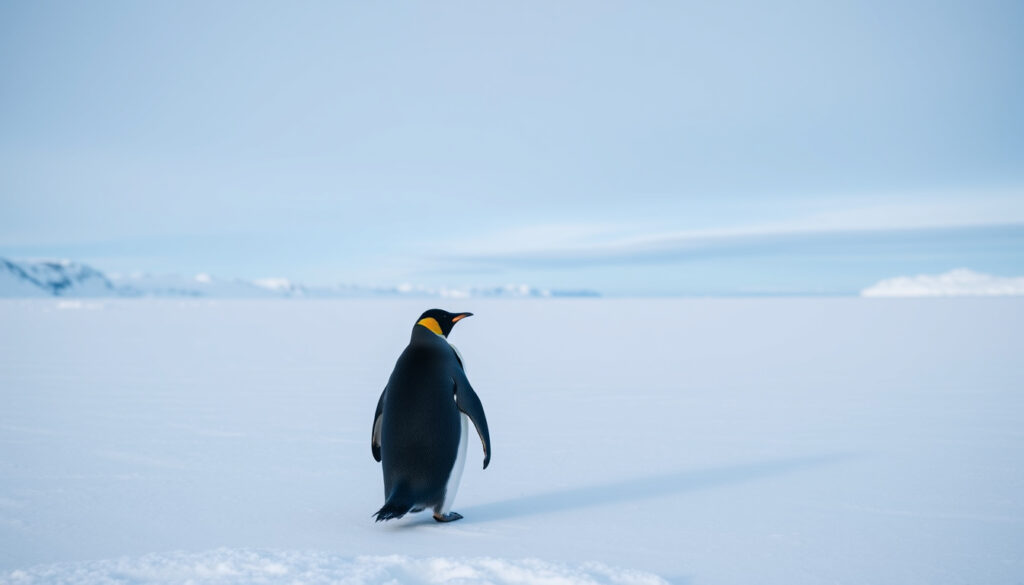
Emperor Penguin: Facts, Habitat, Endangerment & Comparison
Few sights in the natural world rival a thousand emperor penguins huddled together in the pitch‑black Antarctic winter. These flightless birds are not just the largest penguin species—they are the only animals that breed during the most hostile season on Earth.
Scientific name: Aptenodytes forsteri ·
Height: Up to 125 cm (4.1 ft) ·
Weight: 22–45 kg (49–99 lb) ·
Population: ~650,000 individuals ·
Conservation status: Endangered (IUCN 2022) ·
Habitat: Antarctic sea ice and coastal waters
Quick snapshot
- Largest penguin species (height up to 125 cm, weight 22–45 kg) Australian Antarctic Program (government agency)
- Breeds exclusively on Antarctic sea ice British Antarctic Survey (UK polar research institute)
- IUCN listed as Endangered in 2022 PBS NewsHour (U.S. public‑broadcast news)
- Male incubates single egg on feet for two months during winter Australian Antarctic Program
- Exact total population — satellite counts have margins of error British Antarctic Survey
- How quickly colonies can relocate to stable ice as sea ice declines Science (AAAS journal)
- Long‑term survival if sea ice losses exceed thresholds IUCN Red List assessment (pre‑publication PDF)
- 1844: First formally described by George Robert Gray Australian Antarctic Program
- 2012: Satellite surveys reveal many new colonies U.S. Federal Register (ESA proposal)
- 2022: IUCN reclassifies from Near Threatened to Endangered PBS NewsHour
- 2025: Breeding failures linked to record low sea ice British Antarctic Survey
- Ongoing satellite monitoring to track colony shifts British Antarctic Survey
- U.S. Endangered Species Act listing decision expected Federal Register
- International pressure for emissions cuts to slow sea ice loss WWF UK (global conservation NGO)
| Scientific name | Aptenodytes forsteri |
|---|---|
| Height | Up to 125 cm (4.1 ft) |
| Weight | 22–45 kg (49–99 lb) |
| Wingspan | 76–89 cm |
| Lifespan | 15–20 years in the wild |
| Population | ~650,000 individuals (2022 estimate) |
| Conservation status | Endangered (IUCN, 2022) |
| Habitat | Antarctic sea ice and coastal waters |
| Diet | Fish, krill, squid |
| Predators | Leopard seals, orcas, skuas (chicks) |
What is special about emperor penguins?
Physical characteristics: size, weight, and plumage
- Emperor penguins are the tallest and heaviest of all penguin species. Adults reach up to 125 cm (4.1 ft) and weigh between 22 and 45 kg Australian Antarctic Program (government agency).
- Their plumage includes a dense double layer of feathers and a distinctive yellow‑orange ear patch that fades into the white chest WWF UK.
Breeding cycle and winter survival
- They are the only animals that breed during the Antarctic winter (May–June) Australian Antarctic Program.
- Males incubate a single egg on their feet for two months, fasting for up to 115 days while females forage at sea Australian Antarctic Program.
- To survive temperatures as low as −60 °C, they form tightly packed huddles that rotate so each bird gets a turn in the warm centre Australian Antarctic Program.
Diet and hunting techniques
- Their diet consists primarily of fish (especially Antarctic silverfish), krill, and squid Australian Antarctic Program.
- They are exceptional divers, reaching depths of up to 500 m and holding their breath for as long as 20 minutes WWF UK.
The implication: every adaptation—from dense feathers to huddle rotation—turns the emperor penguin into a machine built for the coldest place on Earth.
The very trait that makes emperor penguins unique—breeding on winter sea ice—is now their biggest vulnerability. As sea ice forms later and breaks up earlier, the window for raising chicks shrinks, and entire colonies risk collapse.
Which penguin is bigger, king or emperor?
Two species dominate the popular imagination, but one stands head and shoulders above the other. Here is a side‑by‑side comparison.
| Trait | Emperor penguin | King penguin |
|---|---|---|
| Maximum height | 125 cm (4.1 ft) | 95 cm (3.1 ft) |
| Weight range | 22–45 kg | 13–18 kg |
| Ear patch colour | Yellow‑orange fading to white | Bright orange, more vibrant |
| Breeding habitat | Antarctic sea ice | Sub‑Antarctic islands, ice‑free ground |
| Breeding season | Winter (May–June) | Spring–summer (November–February) |
| Range | Antarctic coastline | Sub‑Antarctic islands (South Georgia, Falklands) |
Height and weight comparison
- Emperor penguins are roughly 30 cm taller and more than twice as heavy as king penguins Australian Antarctic Program.
- The emperor’s larger size helps it retain heat in the extreme cold, while the king’s smaller size suits its milder sub‑Antarctic home.
Differences in plumage and coloration
- King penguins display bright orange ear patches and a vivid orange‑yellow upper chest—more striking than the emperor’s paler, graduated yellow Australian Antarctic Program.
- Both species have a black back and white belly, but the king has a sleeker, more elongated look.
Geographic range and habitat differences
- Emperor penguins are confined to the Antarctic continent and rely entirely on sea ice for breeding British Antarctic Survey.
- King penguins inhabit sub‑Antarctic islands north of the Antarctic Circle, breeding on beaches or bare rock Australian Antarctic Program.
The pattern: the emperor is consistently larger and adapted to a more extreme environment.
Why are emperor penguins going extinct?
Climate change and sea ice loss
- The primary driver is the rapid loss of Antarctic sea ice. Emperor penguins need stable fast ice for at least eight months of the year to breed and moult British Antarctic Survey (UK polar research institute).
- Record low sea‑ice extents in 2023 and 2024 have caused widespread breeding failures; one colony off the Antarctic Peninsula has already disappeared WWF UK (global conservation NGO).
Population declines and IUCN status
- The IUCN reclassified the emperor penguin from Near Threatened to Endangered in 2022 PBS NewsHour (U.S. public‑broadcast news).
- A 2025 British Antarctic Survey study found a 22% decline across a key Antarctic sector—representing about 30% of the total population—from 2009 to 2024 PBS NewsHour.
- As of 2020, there were 61 known breeding colonies out of 66 total, according to the U.S. Federal Register U.S. Federal Register (ESA proposal document).
Conservation efforts and future outlook
- In 2022, the U.S. Fish and Wildlife Service proposed listing the species as threatened under the Endangered Species Act U.S. Federal Register.
- Protection under the Antarctic Treaty offers limited direct safeguards, but scientists agree that reducing global greenhouse gas emissions is the only long‑term solution Science (AAAS journal).
- Projections suggest that if emissions continue unchecked, emperor penguin populations could decline by 98% by 2100 Science.
What this means: the next decade will determine whether the species can adapt by moving to more stable ice or whether large‑scale collapse becomes inevitable.
The next decade will be critical. If sea‑ice losses accelerate, the 2025–2030 breeding seasons could determine whether the species can adapt by moving to more stable ice or whether large‑scale collapse becomes inevitable.
Are emperor penguins friendly?
Temperament and behavior toward humans
- Emperor penguins are not aggressive toward humans. In the wild, they are curious and have been known to approach researchers, but they remain wild animals Australian Antarctic Program.
- Huddling behaviour is a purely social survival mechanism—they rely on each other for warmth and often vocalise to maintain contact Australian Antarctic Program.
Social interactions within colonies
- Colonies can number more than 20,000 pairs, and individuals recognise each other through a mix of calls and visual cues Australian Antarctic Program.
- Homosexual behaviour has been observed in many penguin species, including emperors, though studies specific to emperors are less extensive Australian Antarctic Program.
Homosexual behavior and aggression among penguins
- Same‑sex pairings and courtship are documented in at least 20 penguin species. In emperors, such behaviour has been noted but not thoroughly researched.
- The most aggressive penguin species is the chinstrap penguin (Pygoscelis antarcticus), which is known for vigorous pecking and territorial fights—a contrast to the emperor’s generally calm disposition Australian Antarctic Program.
The catch: emperor penguins are social but not aggressive; the title of most aggressive penguin belongs to the chinstrap.
Can a polar bear ever meet a penguin?
Geographic distribution of polar bears and penguins
- Polar bears (Ursus maritimus) live only in the Arctic, centred on the North Pole. Penguins are found exclusively in the Southern Hemisphere, with the majority breeding in Antarctica and sub‑Antarctic islands Australian Antarctic Program.
- No species of penguin inhabits the Arctic; the great auk, a similar but unrelated bird, was the Northern Hemisphere’s penguin‑like species and went extinct in 1844.
Why they are polar opposites
- The two animals are literally polar opposites: polar bears occupy the top of the Arctic food chain, while emperor penguins inhabit the Antarctic sea‑ice zone. Thousands of miles of ocean separate them Australian Antarctic Program.
- The phrase “polar opposite” is a literal description of their ranges.
Myths and common misconceptions
- The myth that polar bears and penguins share the same habitat is one of the most persistent geographic errors. It likely arose from early polar explorers’ narratives that conflated both poles.
- In captivity, a few zoos have housed both species in separate enclosures, but they have never met in the wild—and with accelerating climate change, the emperor penguin’s habitat is at far greater risk than the polar bear’s.
The implication: these two iconic polar animals will never share the same ice.
Six traits that set emperor and king penguins apart, one pattern: the emperor is consistently larger and adapted to a more extreme environment.
| Attribute | Emperor penguin | King penguin |
|---|---|---|
| Height | Up to 125 cm | Up to 95 cm |
| Weight | 22–45 kg | 13–18 kg |
| Breeding habitat | Antarctic sea ice | Sub‑Antarctic islands |
| Breeding season | Winter (May–June) | Spring–summer |
| Ear patch colour | Yellow‑orange (fading) | Bright orange |
| Incubation period | ~65 days by male | ~55 days, shared |
Twelve specifications that define the emperor penguin’s biology, one theme: every adaptation is tuned for survival in the coldest place on Earth.
| Scientific classification | Animalia → Chordata → Aves → Sphenisciformes → Spheniscidae → Aptenodytes forsteri |
|---|---|
| Height | 100–125 cm |
| Weight | 22–45 kg |
| Wingspan | 76–89 cm |
| Feather density | About 100 feathers per cm² (double layer) |
| Blubber thickness | Up to 3 cm |
| Diving depth | Up to 500 m |
| Dive duration | Up to 20 min |
| Swimming speed | 6–9 km/h (cruising), up to 19 km/h (burst) |
| Lifespan | 15–20 years |
| Population estimate | ~650,000 individuals |
| IUCN status | Endangered (2022) |
Timeline of emperor penguin research and conservation
- 1844 – First formally described by British zoologist George Robert Gray Australian Antarctic Program.
- 1901–1904 – First detailed observations recorded during the Discovery Expedition.
- 1960s–1980s – Early population estimates and identification of major colonies.
- 2012 – Satellite surveys reveal many new colonies, improving count accuracy U.S. Federal Register.
- 2021 – U.S. Fish and Wildlife Service proposes listing under the Endangered Species Act U.S. Federal Register.
- 2022 – IUCN reclassifies from Near Threatened to Endangered PBS NewsHour.
- 2025 – British Antarctic Survey report reveals 22% decline in key region; breeding failures linked to record low sea ice British Antarctic Survey.
The pattern is clear: each decade brings new evidence of how rapidly the emperor penguin’s world is shrinking. The pace of scientific discovery now races against the pace of climate change.
What we know and what remains uncertain
Confirmed facts
- Emperor penguins are the largest penguin species.
- They breed exclusively on Antarctic sea ice.
- Climate change reduces sea ice extent and duration, harming breeding success.
- The population is declining, leading to the IUCN Endangered status (2022).
- Male incubation of a single egg on the feet for two months is unique among birds.
What’s unclear
- Exact total population size—satellite counts carry margins of error.
- How quickly colonies can relocate to stable ice as the climate warms.
- Long‑term survival thresholds if sea ice losses accelerate beyond current projections.
Expert perspectives
“If sea ice continues to decline at current rates, emperor penguins could face a 98% loss of colonies by 2100.”
— Dr. Stephanie Jenouvrier, seabird ecologist, Woods Hole Oceanographic Institution Science (AAAS journal)
“We have discovered colonies in places we never expected, but many are now at risk.”
— Dr. Michelle LaRue, penguin researcher, University of Canterbury British Antarctic Survey
“The emperor penguin’s fate is tied directly to our actions on climate.”
— BirdLife International WWF UK (global conservation NGO)
Emperor penguins have spent millennia evolving to survive the coldest, darkest winter on the planet. Now, in a matter of decades, that evolutionary advantage has become a liability: the sea ice they need is vanishing faster than scientists predicted. For the global community, the choice is straightforward—cut emissions and preserve the ice, or watch the world’s most remarkable penguin become a casualty of our warming planet.
en.wikipedia.org, facebook.com, instagram.com, facebook.com, nature.com
For a more comprehensive look at their size and conservation efforts, check out this detailed emperor penguin guide from Southern Watch.
Frequently asked questions
How long do emperor penguins live?
Emperor penguins live 15–20 years in the wild. The longest recorded lifespan for a captive individual is over 30 years Australian Antarctic Program.
Do emperor penguins have any predators?
Leopard seals and orcas hunt adults at sea. Skuas and giant petrels prey on eggs and chicks Australian Antarctic Program.
How do emperor penguins keep warm in the Antarctic winter?
They use a dense double layer of feathers, a thick layer of blubber, and huddling behaviour. Huddles can contain thousands of birds that rotate to share thermal
More related posts
 Rupert Everett: Partner, Madonna Friendship, Colin Firth Feud
 George R.R. Martin: Writing, Net Worth, and FAQs
 Magento Service Companies by aelftech.com – Top Agencies Compared
 Wide Bay TV Guide: Free-to-Air Listings & Fixes
 Savoury Mince Recipe: Easy Classic with Beef & Veggies
 Irrfan Khan: Cause of Death, Last Words, Religion & Biography
 Jensen Huang: Age, Net Worth, Wife, and Nvidia Success Story
 Patrick Carrigan: Biography, Salary Stats & Facts
