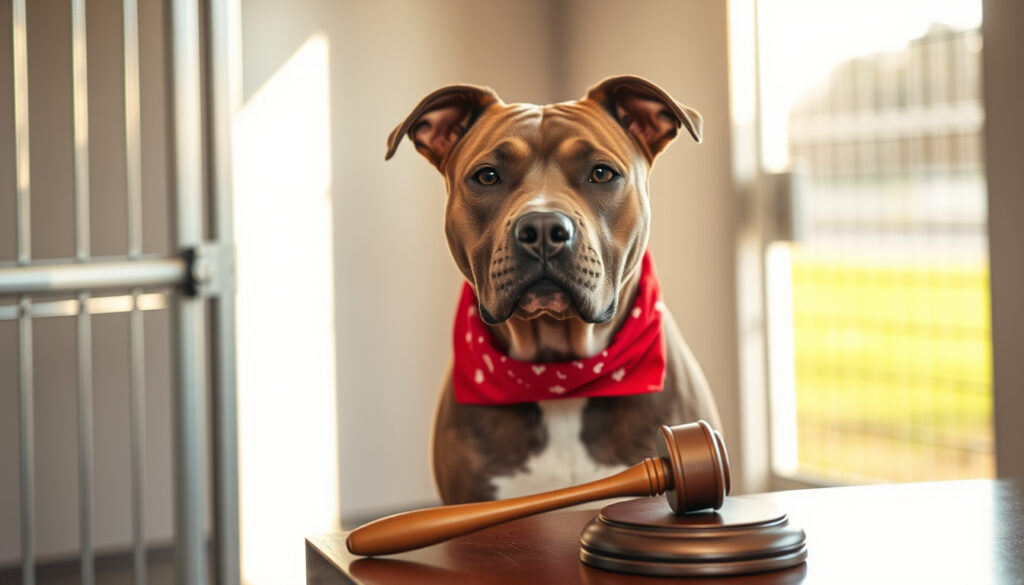
Pit Bull Guide: Temperament, Legal Status & Rescue Facts
Few dog labels carry as much baggage as the phrase “pit bull” — a name that shows up in attack headlines, viral cuddle videos, and legal codes that decide whether a family can keep its pet. The term isn’t a single breed, which is the first surprise most people run into.
Bite Force: 235–250 PSI (estimated) ·
ATTS Temperament Pass Rate: 86.6% ·
Countries with Bans: 12+ (incl. Australia, UK) ·
Rescue Spotlight: Junie the Pit Bull rescue (2025) ·
Top Registry: American Staffordshire Terrier (AKC/UKC)
Quick snapshot
- Pit bull-type dogs pass ATTS temperament testing at a higher rate than Golden Retrievers, according to Best Friends Animal Society (national animal welfare nonprofit).
- The ATTS test measures responses to stability, shyness, aggressiveness, friendliness, protectiveness, and self-preservation in a staged walk-through setting (DogsBite.org (dog-bite data tracker)).
- ATTS-style tests simulate a casual neighborhood walk with strangers, noises, and unexpected encounters — not a real-world bite-risk trial (PolitiFact (fact-checking newsroom)).
- The exact share of dogs that qualify as “pit bull type” in the general population is unknown. (PolitiFact (fact-checking newsroom))
- 1991: UK bans the breed under the Dangerous Dogs Act (cited by Pit Bull Rescue Central BSL statement).
- 2022: Ricky, a Pit Bull mix, becomes the first dog to pass a US Secret Service bomb-detection olfactory test. ((cited by Pit Bull Rescue Central BSL statement))
- 2025: Junie, a neglected Pit Bull, becomes a national rescue story. ((cited by Pit Bull Rescue Central BSL statement))
- Rescue groups keep pushing temperament screening over breed bans.
- Owners in restricted areas face continued legal and insurance uncertainty.
Six rows, one pattern: the “pit bull” label covers a wide range of shapes and sizes, which is the first reason breed-wide statistics deserve a second look.
| Attribute | Value |
|---|---|
| Height | 17–21 inches at shoulder |
| Weight | 30–65 lbs (varies by type: APBT, Am Staff, Staff) |
| Lifespan | 12–16 years |
| Temperament (UKC standard) | Friendly, Confident, Clownish |
| Bite force | 235–250 PSI (estimated) |
| Breed status | Umbrella term, not a single registered breed |
Are Pit Bulls Legal in Australia?
Australia is one of more than a dozen countries that restrict or ban pit bull-type dogs, and the UK followed a similar path with its 1991 Dangerous Dogs Act. Enforcement rests on a shaky foundation: no genetic test can determine a specific dog breed, so the “pit bull” label in a legal setting depends on visual identification. Pit Bull Rescue Central (rescue and policy group) supports reasonable dangerous-dog laws over breed bans for exactly that reason (Pit Bull Rescue Central (BSL policy statement)).
What Is the Typical Pit Bull Price?
Rescue adoption: $50–$350 · Breeder puppy: $500–$2,000 · Budget for: skin allergies, hip dysplasia
Adoption is the cheaper route and the one rescue advocates recommend, because it comes with behavioral screening built in. Breeder prices vary with lineage and health testing, but no price tag predicts temperament. What costs more over time is the dog’s health: skin allergies and hip dysplasia are the conditions owners budget for.
What Happened to the Neglected Pit Bull Junie?
A dog’s fate can turn on the label it’s given. Junie’s story drew national attention to pit bulls in 2025; most neglected dogs never get a headline.
Junie, a neglected Pit Bull, became a national rescue story in 2025. For shelters, her recovery demonstrated something they see daily: the breed’s worst outcomes usually trace back to how the dog was kept, not to the dog’s DNA. The case became a touchstone for advocates pushing adoption over assumptions.
The pattern: political energy goes to banning the label, while the rescue world focuses on the individual dog in front of it.
The implication: legal bans rely on visual identification, not genetic proof, making the label’s application inconsistent.
Is a Pit Bull a Good Family Dog?
The most-cited answer comes from the American Temperament Test Society, whose standardized walk-through measures stability, shyness, aggressiveness, friendliness, protectiveness, and self-preservation. Pit bull-type dogs pass at a higher rate than Golden Retrievers — the breed the public treats as the safe default — and Best Friends Animal Society (national animal welfare nonprofit) adds the qualifier that matters: aggression is not a breed characteristic or a personality trait specific to any one breed. By the time PolitiFact reviewed the claim in 2011, the ATTS had tested nearly 31,000 dogs (PolitiFact (fact-checking newsroom)).
Are Pit Bulls Safe Around Children?
- ATTS pass rate: 86.6% for pit bull-type dogs
- Golden Retriever comparison: pit bull-type dogs score higher on the same test
- UKC breed standard: friendly, confident, clownish
The safety answer is conditional, and the condition is management. Rescue protocols treat human aggression and known bite histories as disqualifying, which means a well-screened pit bull in a family home is not the same animal as a neglected one in a backyard.
Do Pit Bulls Like to Cuddle?
“Friendly” is the first word in the UKC temperament standard. The cuddle drive isn’t a myth — it’s the trait the breed standard actually asks for.
Owners describe a breed group that prefers being close: leaning, lap-sitting, and following people from room to room. The flip side is that a dog bred for human closeness needs human time; a pit bull left alone all day is a bored dog, and a bored dog of any breed finds trouble.
The pattern: the public conversation focuses on what the dog could do; the data focuses on what the dog is actually like under supervised, socialized conditions.
What this means: responsible ownership, not breed label, determines whether a pit bull thrives as a family companion.
Do Pit Bulls Pick One Person?
The idea that a pit bull bonds to a single owner makes good copy and bad dog psychology. These are people-oriented dogs — “friendly” is the first word of the UKC standard — and what owners experience as “picking me” is usually the dog attaching to the primary caregiver.
What Type of Person Owns a Pit Bull?
Stereotype: tough, inexperienced owners · Reality: no single profile · Common thread: the dog’s behavior matches the effort invested
The cultural image is an owner drawn by the tough reputation; the rescue world sees the full range, from first-time adopters to seasoned trainers. The difference shows up in outcomes, not in the dog’s DNA. Junie’s 2025 rescue story shows what can happen in the careless group, while the temperament data above comes from dogs raised with structure.
Are Pit Bulls Loyal to a Single Owner?
- Human-directed aggression: rare in well-bred, well-socialized dogs
- Dog-directed selectivity: common enough that rescues screen for animal compatibility before placement
Loyalty to one person is usually a preference for the primary caregiver, not the exclusion of everyone else. What rescuers actually watch for is the opposite pattern: a dog that ignores people but fixates on other animals. That is why adoption screening includes compatibility with other pets — same-household aggression is a management issue, not a bonding feature.
The implication: “picks one person” is how an untrained dog forms a narrow attachment; “family dog” is how a socialized one behaves.
How Common Are Pit Bull Attacks?
The honest answer is that no one has a reliable count. Fatal-bite statistics are built on visual breed identification, and as the legal section noted, no genetic test can confirm a “pit bull.” The most rigorous data we have describes the circumstances, not the breed: a peer-reviewed study cited by Best Friends Animal Society (national animal welfare nonprofit) found that nearly 85% of dog-bite fatalities involved unneutered dogs.
How Many People Were Killed by Pit Bulls Last Year?
- No reliable annual count exists; breed labels in fatality reports are visual guesses.
- No genetic test can verify a dog’s breed after the fact (as stated by Pit Bull Rescue Central (BSL policy statement)).
Any number you see attributed to “pit bulls” comes from someone looking at a photo or a police report and deciding what the dog was. Pit Bull Rescue Central is blunt about why that matters: there is no genetic test to determine a specific dog breed, so the numbers carry an identification problem the headlines never mention.
How Serious Is a Pit Bull Bite?
Estimated bite force: 235–250 PSI · Fatal-bite profile: ~85% unneutered dogs · Key variable: management, not breed
The often-quoted 235–250 PSI figure is an estimate, not a lab measurement, and bite force varies with jaw size and the individual dog. The more instructive number is the one above: the dogs in fatal-bite cases were overwhelmingly unneutered — a marker of poor ownership, not a genetic trait.
Breed bans respond to the rare worst case, while the data points at the common risk factor: unmanaged, unneutered dogs of any breed.
The pattern: the most reliable data points to owner behavior, not breed identity, as the primary risk factor.
What Are the Top 3 Aggressive Dog Breeds?
Search “most aggressive dog breeds” and the usual suspects appear: pit bulls, Rottweilers, German Shepherds. The ranking feels authoritative, but it is a media artifact. The American Temperament Test Society measures dogs under standardized conditions — stability, shyness, friendliness, self-preservation — and the pit bull-type dogs in that dataset outperform the breed at the top of “most gentle dog” lists. A ranking that ignores that data is not a ranking; it is a headline.
Can Two Pit Bulls Defeat a Lion?
The lion question is fight-ring folklore, not a behavioral benchmark. No temperament test measures “lion-fighting ability,” and the myth survives on viral videos, not documented outcomes (DogsBite.org (dog-bite data tracker)).
The fantasy version of the pit bull as an unstoppable fighter is the same image that built the fighting rings — and the same image that drives breed bans. The documented reality is a dog group that scores “friendly” on standardized tests when it has been raised and socialized, and fails predictable temperament markers when it has been abused, tethered, or neglected.
What Is a Basset Hound Pit Bull Mix Like?
- A “Basset Hound Pit Bull mix” is a designer label, not a registered breed.
- No genetic test can verify the exact mix or predict the dog’s behavior.
Shelters label mixes by appearance, but behavior follows the individual dog, not the breed names in the paperwork. The same rule governs every dog in the debate: temperament screening and history matter more than the mix on the tag.
The trade-off: the “top aggressive breeds” list gives the public a simple enemy, but the data says the real variable is how the dog was raised — which is a lot harder to put on a listicle.
Pit Bull vs the “Aggressive Breed” Reputation
Three rows, one contrast: the breed with the “dangerous” reputation out-tests the classic family dog on the same standardized walk.
| Breed or label | Media reputation | ATTS temperament result | Legal exposure |
|---|---|---|---|
| Pit bull-type | Headline shorthand for danger | Pass rate higher than Golden Retrievers | Banned or restricted in 12+ countries; UK since 1991 |
| Golden Retriever | The “safe family dog” | Baseline on the same test | Rarely targeted by breed-specific laws |
| The “aggressive breed” label | Used to justify bans | Not a scientific classification | No evidence BSL reduces overall fatalities |
The pattern: reputations are assigned by media cycles; temperament results are assigned by standardized tests. The two rarely agree.
Pit Bull Specs: From Bite Force to Temperament Tests
Ten rows, one theme: the observable facts about pit bull-type dogs — size, lifespan, test performance, and screening behavior — are more stable than the public reputation.
| Spec | Detail |
|---|---|
| Breed group | Terrier types: American Pit Bull Terrier, American Staffordshire Terrier, Staffordshire Bull Terrier |
| Registry recognition | American Staffordshire Terrier: AKC and UKC |
| Height | 17–21 inches at shoulder |
| Weight | 30–65 lbs, varies by type |
| Lifespan | 12–16 years |
| Temperament (UKC standard) | Friendly, Confident, Clownish |
| ATTS performance | 86.6% pass rate for pit bull-type dogs |
| Adoption screening | Tests social behavior, resource guarding, toy/play/prey drive, animal compatibility |
| Genetic identification | No test can confirm a “pit bull” label |
| Adoption cost | $50–$350 via rescue; $500–$2,000 via breeder |
Why this matters: the spec sheet describes a medium-size, athletic, people-oriented dog group — the gap between that and the “killer” reputation is where the policy confusion lives.
Pros and Cons of Owning a Pit Bull
The trade-off is real: strong temperament-test results on one side, heavy legal and insurance friction on the other.
Upsides
- Outperforms Golden Retrievers on standardized ATTS temperament testing
- UKC standard: friendly, confident, clownish
- Rescue screening protocols match dogs to the right homes
- Advocates push behavior-based laws over blanket bans
Downsides
- Banned or restricted in 12+ countries plus local US ordinances
- No genetic test proves a dog is “not a pit bull,” so enforcement can be arbitrary
- High energy and a powerful bite demand committed training and supervision
- Fatal-bite data clusters around unneutered, poorly managed dogs
The pattern: most “cons” are external — laws, insurance, stigma — while the “pros” are about the dog’s actual tested behavior. Owners take on both.
How to Adopt or Rescue a Pit Bull Safely
Five steps, one goal: let screening and local law, not labels, decide which dog enters your home.
- Start with a rescue that runs a full temperament evaluation before placement. Pit Bull Rescue Central (rescue and screening network) says shelters should test for social behavior, resource guarding, toy/play/prey drive, and compatibility with other animals.
- Ask about red flags before you meet the dog. According to the same guidelines, dogs with human aggression, known bite histories, or extreme shyness should not be placed for adoption.
- Check your local laws before you commit. Breed-specific restrictions vary widely by US city and county, and more than a dozen countries have national or regional bans.
- Budget beyond the adoption fee: rescue adoptions run $50–$350, breeder puppies $500–$2,000, and vet costs for skin allergies and hip dysplasia add up over the dog’s 12–16 year lifespan.
- Commit to management: daily exercise, early socialization, and supervised introductions. The common thread in fatal-bite data is unneutered, abused, or tethered dogs — conditions responsible ownership prevents.
The pattern: every screening rule exists because behavior is individual. The label alone never tells you which dog you are getting.
Pit Bull History: A Timeline
Seven moments, one arc: a farm dog turned fighter, then a scapegoat, and now a working dog again.
- — Breed group developed in England for bull baiting and farm work.
- — A Pit Bull named Buddy becomes one of the first shelter rescues, fueling breed admiration.
- — Organized fighting rings push the breed into negative headlines.
- — The UK bans the breed under the Dangerous Dogs Act.
- — The Michael Vick dog-fighting case exposes the breed’s suffering and sparks rescue reforms.
- — Ricky, a Pit Bull mix, becomes the first dog to pass a US Secret Service bomb-detection olfactory test.
- — Junie, a neglected Pit Bull, becomes a national rescue story.
The pattern: the breed’s reputation flipped with human decisions — from family dog to fighting dog to legal target — while the dogs themselves stayed the same.
What’s Confirmed vs What’s Still Unclear
The distinction matters for policy: confirmed facts can support behavioral laws; unclear facts cannot support breed bans — yet the bans are built on the unclear column.
Confirmed
- “Pit bull” is not a single breed — it is an umbrella term for several terrier types (Pit Bull Rescue Central (BSL policy statement)).
- The breed group was historically bred for blood sports and also kept as family dogs.
- Breed-specific legislation has not been shown to reduce overall dog-bite fatalities (Best Friends Animal Society (national animal welfare nonprofit)).
- Rescue groups exclude dogs with human aggression or known bite histories from adoption placement.
Still unclear
- Exact annual fatality counts by breed: disputed, because breed identification is visual.
- Whether any breed has an inherent “aggression baseline”: unknown — environment plays a major role.
- The actual percentage of dogs in the population that qualify as “pit bull type”: unknown.
The bottom line for policymakers: the confirmed column supports strict dangerous-dog laws and better ownership enforcement; the unclear column is where breed bans are left without evidence.
Voices From the Field
Three voices, one through-line: the closer people get to actual pit bulls, the more the reputation and the animal diverge.
On an even playing field, a pit bull is no more dangerous than a collie.
Salliann Comstock, chief tester, American Temperament Test Society — via PolitiFact (fact-checking newsroom)
Aggression is not a breed characteristic or personality trait specific to any one breed.
Best Friends Animal Society (national animal welfare nonprofit)
“Pit bull” is not, in fact, a single breed of dog.
Pit Bull Rescue Central (rescue and policy group)
What these voices share: the pit bull’s reputation is a story people tell about dogs — the temperament data and the screening protocols are what actually protect families.
The Bottom Line
The weight of the evidence puts the pit bull in an uncomfortable middle: a powerful, people-oriented dog group that performs well on standardized temperament tests, and a label that has been demonized by media cycles and exploited by bad owners. The verified data — higher ATTS pass rates than Golden Retrievers, aggression that tracks with environment rather than breed, and fatal-bite cases dominated by unneutered and neglected dogs — points away from the “dangerous breed” story. For a family considering a pit bull, the decision is clear: choose a temperament-tested rescue dog, obey local breed laws, and commit to training and management — because the dog you raise, not the label it carries, determines the outcome.
usserviceanimalregistrar.org, pethelpful.com, diamondpet.com, reflector.uindy.edu, bestfriends.org, pbrc.net, bestfriends.org, reddit.com, reddit.com
Frequently Asked Questions
Do pit bulls have locking jaws?
No. The “locking jaw” claim is a myth with no anatomical basis — no dog breed has a jaw-locking mechanism (DogsBite.org (dog-bite data tracker)).
Are pit bulls banned in most US states?
There is no single national US rule. Breed-specific legislation in the United States is a patchwork of city and county laws, and restrictions vary widely from place to place — which is why the legality question always comes down to your local address.
What is the difference between a pit bull and a Staffordshire Terrier?
“Pit bull” is the umbrella term; the Staffordshire Bull Terrier and the American Staffordshire Terrier are two distinct breeds that sit under it, alongside the American Pit Bull Terrier.
How much exercise does a pit bull need daily?
Needs vary by individual dog, but high-energy dogs left without exercise and positive interaction are exactly the ones that develop behavioral problems. Consistent daily activity and training are the non-negotiables.
Are pit bulls good apartment dogs?
They can adapt well if their exercise needs are met and the building allows them. Landlord and insurance restrictions on the breed are common, so the housing check comes before the adoption paperwork.
What is a red nose pit bull?
A “red nose pit bull” is a color-description label for pit bull-type lines with reddish-brown noses and coats. It is not a separate breed and carries no special behavioral meaning.
How do I train a pit bull puppy?
Start with the same foundation any powerful dog needs: early socialization, positive interaction, and clear rules. Rescue groups screen for resource guarding and toy/prey drive so training can target real behaviors instead of breed stereotypes.
Related reading
- Swae Lee: Biography, Net Worth & Common Myths Debunked
- Mama Cass: Death, Daughter, and Debunking the Sandwich Myth
These articles share a focus on debunking myths, connecting the pit bull discussion to broader misinformation correction.
More related posts
 Eric Bana Biography: Ethnicity, Languages, Career & More
 Dylan Alcott: Disability, Paralympic Gold & Advocacy
 Luke Kidgell: Australian Comedian Biography and Tour 2026
 Ruth Bader Ginsburg: Life, Legacy, Quotes, Cause of Death
 Greek Gods: Olympians, Primordials, and Dark Powers
 Tony Soprano Character Psychology: The Sad Clown
 Cheryl Hines: Biography, Career, and Marriage to RFK Jr.
 Tim David: Biography, Personal Life, IPL Career, Suspension
