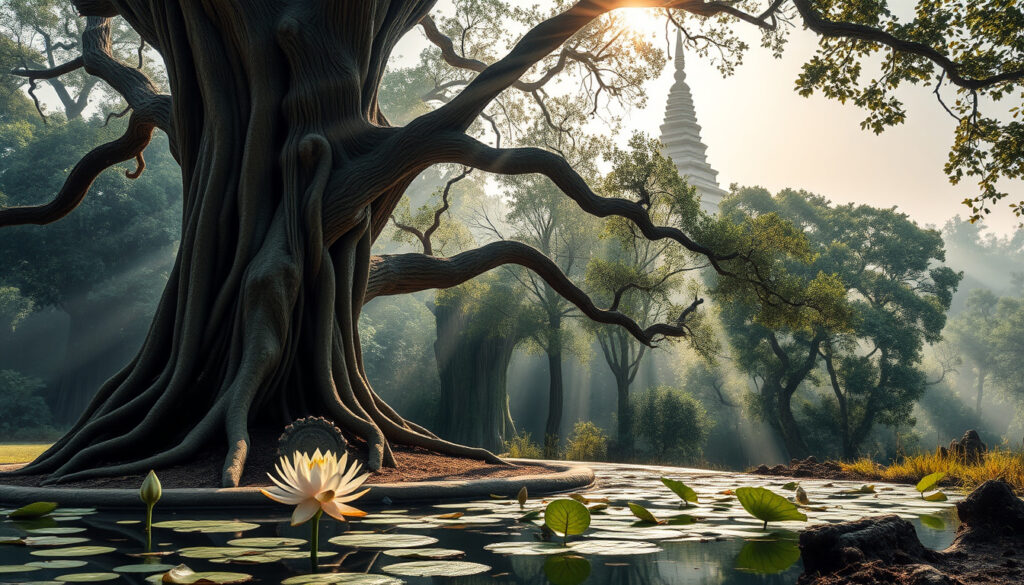
Gautama Buddha: Life, Teachings, and History vs Legend
Few names from the ancient world travel as far as the Buddha’s, yet the man behind the title is often buried under layers of miracle stories and later legend. Scholars accept that a real person named Siddhartha Gautama founded Buddhism in northern India during the 5th century BCE, but caution that much of his traditional biography resists verification — so by the end, you’ll know which parts are history and which are tradition.
Birth name: Siddhartha Gautama · Birthplace: Lumbini, present-day Nepal · Title: Buddha, meaning ‘Awakened One’ · Traditional lifespan: c. 563–483 BCE · Role: Founder of Buddhism
Quick snapshot
- The historical Buddha is identified as Siddhartha Gautama, founder of Buddhism (Stanford Encyclopedia of Philosophy (academic reference)).
- Scholars accept his existence, while noting that biography details are layered with tradition (Encyclopaedia Britannica (reference work)).
- Traditional birthplace: Lumbini, in present-day Nepal (Encyclopaedia Britannica (reference work)).
- Exact birth and death dates remain uncertain (Encyclopaedia Britannica (reference work)).
- The famous encounters with old age, illness, and death have uncertain historicity (Britannica Kids (educational encyclopedia)).
- Many details in traditional biographies cannot be established confidently as historical (Encyclopaedia Britannica (reference work)).
- Traditional death: age 80 at Kushinagar, in present-day India (Encyclopaedia Britannica (reference work)).
- Traditional teaching period: about 45 years after awakening (Stanford Encyclopedia of Philosophy (academic reference)).
- Scholarly consensus points to a 5th-century BCE window, with exact dates debated (Encyclopaedia Britannica (reference work)).
- Read “c. 563–483 BCE” as a traditional range, not a settled historical record (Encyclopaedia Britannica (reference work)).
- The last-meal debate, “sukara-maddava”, remains open (Encyclopaedia Britannica (reference work)).
- Check whether family claims come from early texts or later hagiography (Encyclopaedia Britannica (reference work)).
Gautama Buddha at a glance
Nine facts, one pattern: the core identifiers are stable, while the personal details carry the label “traditional” for a reason.
| Attribute | Detail | Source |
|---|---|---|
| Name | Siddhartha Gautama | Stanford Encyclopedia of Philosophy (academic reference) |
| Title | Buddha (‘Awakened One’) | Encyclopaedia Britannica (reference work) |
| Birthplace | Lumbini, present-day Nepal | Encyclopaedia Britannica (reference work) |
| Parents | King Suddhodana and Queen Maya (traditional) | Encyclopaedia Britannica (reference work) |
| Wife | Yasodhara (traditional) | Encyclopaedia Britannica (reference work) |
| Son | Rahula (traditional) | Encyclopaedia Britannica (reference work) |
| Enlightenment site | Bodh Gaya, present-day India | Encyclopaedia Britannica (reference work) |
| Death site | Kushinagar, present-day India | Encyclopaedia Britannica (reference work) |
| Core teachings | Four Noble Truths and the Eightfold Path | Encyclopaedia Britannica (reference work) |
The pattern: what the tradition remembers about his family and early life is consistent enough to pass down for centuries, but the word “traditional” is doing real work in that table — those are the claims the historical record can’t independently confirm.
What is Gautama Buddha famous for?
Gautama Buddha is famous as the founder of Buddhism. The tradition that grew from his life traces his awakening to Bodh Gaya, where he is said to have sat beneath the Bodhi tree, and his first teaching to Sarnath, near Varanasi (Encyclopaedia Britannica (reference work)). His core teachings — the Four Noble Truths and the Eightfold Path — became the backbone of the tradition.
What does the title ‘Buddha’ mean?
- ‘Buddha’ is a title meaning ‘Awakened One’, not a personal name.
- The title describes someone who has reached awakening and understood the nature of suffering.
- In most Buddhist traditions, Gautama is treated as an awakened teacher, not a creator deity.
The title points to the event that defines him: the awakening traditionally placed at Bodh Gaya. The Stanford Encyclopedia of Philosophy (academic reference) identifies the historical figure behind the title as Siddhartha Gautama and regards him as the founder of Buddhism. Later traditions expanded that identity with elaborate biography, but the core claim — an awakened teacher — is what made his name carry across cultures.
What are the Four Noble Truths?
- First: life as ordinarily experienced involves suffering or dissatisfaction.
- Second: that suffering has a cause — craving.
- Third: suffering can end.
- Fourth: the Eightfold Path is the way to end it.
The Four Noble Truths are traditionally described as the content of his first sermon at Sarnath (Encyclopaedia Britannica (reference work)). Traditional accounts add that his first audience was five former ascetic companions, who became his first disciples after hearing the sermon (Encyclopaedia Britannica (reference work)). Read as a system, the Four Noble Truths function like a medical diagnosis: identify the disease, name the cause, confirm that health is possible, and prescribe the treatment.
The Four Noble Truths reframe the Buddha’s project: he is offering a diagnosis and a treatment plan for human suffering, not a metaphysical system to be believed on authority.
The pattern: the Buddha’s fame rests less on a title than on a claim — that suffering has a cause and a path out — which is why his teaching outlived his historical moment.
Are Buddha and Gautama Buddha the same?
In most English-language writing, yes: ‘Buddha’ and ‘Gautama Buddha’ refer to the same person, Siddhartha Gautama. The confusion comes from the word ‘Buddha’ itself, which is a title rather than a name — and from later Buddhist texts, which describe other buddhas beyond the historical founder.
Why is he called Siddhartha Gautama?
- Siddhartha is his given name in traditional biographies.
- Gautama (Pali: Gotama) is his clan name.
- Traditional accounts place him in the Shakya clan, which is why he is also called Shakyamuni, ‘the sage of the Shakyas’.
The Stanford Encyclopedia of Philosophy (academic reference) identifies the historical Buddha as Siddhartha Gautama and notes his traditional association with the Shakya clan. Traditional biographies describe Gautama as having lived in luxury before renouncing worldly life (Encyclopaedia Britannica (reference work)), and they say he left home to seek an answer to suffering (Encyclopaedia Britannica (reference work)). The traditional birthplace, Lumbini in present-day Nepal, anchors this clan identity (Encyclopaedia Britannica (reference work)).
Is Buddha a name or a title?
- ‘Buddha’ means ‘Awakened One’ — it describes a state, not a surname.
- Buddhist texts speak of other buddhas, past and future; Gautama is the central figure for this tradition.
- When English speakers say ‘the Buddha’, they almost always mean Siddhartha Gautama.
Because the title applies to a category, some traditions envision a lineage of awakened teachers. But the historical Buddha referred to in most encyclopedic and academic sources is Gautama, the founder of Buddhism (Stanford Encyclopedia of Philosophy (academic reference)).
When a source says ‘Buddha’ without qualification, it usually means Gautama — but the word itself signals an achievement, not a birth certificate.
Was Buddha Chinese or Indian?
The most accurate short answer: neither, in today’s national terms. The Buddha lived in the northern Indian subcontinent, in a region that sits roughly on the present-day India–Nepal border (Encyclopaedia Britannica (reference work)).
Where was Gautama Buddha born?
- Traditional birthplace: Lumbini, in present-day Nepal.
- The site is marked by an Ashokan pillar, which is why tradition and archaeology converge there.
- Modern national borders did not exist in his era, so ‘Nepali’ and ‘Indian’ are modern labels applied to an ancient landscape.
Traditional accounts place the birth at Lumbini, now in Nepal (Encyclopaedia Britannica (reference work)). The site’s importance is reinforced by the Ashokan pillar that still marks it, a detail the traditional record preserves. The Buddha then spent his teaching career in the eastern Gangetic plain, an area that falls inside present-day India (Encyclopaedia Britannica (reference work)).
Did Buddhism start in India?
- His awakening is traditionally placed at Bodh Gaya, in present-day India.
- His first sermon is traditionally placed at Sarnath, near Varanasi, also in India.
- Buddhism reached China and East Asia centuries after his death.
The key sites of his life story are split across the modern border: birth in Nepal, awakening and teaching in India. The answer to ‘was he Chinese?’ is clearly no — Buddhism arrived in China only centuries later, carried by missionaries and texts along the Silk Road. Calling him simply ‘Indian’ works as shorthand for the broader civilization he belonged to, but it quietly erases the Nepali birthplace that both tradition and the archaeological record point to.
‘Indian’ and ‘Nepali’ are modern passports applied to a man who lived two and a half millennia before either country existed.
The trade-off: geography is the one part of his biography where tradition and scholarship mostly agree — which makes the modern labeling debate say more about our borders than about his life.
When was Gautama Buddha born and died?
There is no single agreed date. Traditional sources commonly give c. 563–483 BCE, while many historians place his death in the 5th century BCE, with some estimates stretching into the 4th century BCE (Encyclopaedia Britannica (reference work)).
What are the traditional dates of the Buddha’s life?
Traditional birth: c. 563 BCE · Traditional awakening: c. 528 BCE · Traditional death: c. 483 BCE
The conventional chronology runs: birth in Lumbini, renunciation of palace life, awakening at Bodh Gaya, about 45 years of teaching, and death at Kushinagar at the age of 80 (Stanford Encyclopedia of Philosophy (academic reference); Encyclopaedia Britannica (reference work)). Traditional accounts add that Gautama practiced severe asceticism for approximately six years before adopting a middle way (Encyclopaedia Britannica (reference work)). These dates come from later Buddhist chronicles and are repeated in textbooks as a convention, not as a verified record.
Why do historians disagree on the dates?
- The earliest Buddhist texts do not include a clear historical chronology.
- The traditional numbers depend on later chronicles, especially Sri Lankan ones.
- Scholarly estimates for his death range across the 5th and possibly the 4th century BCE.
Encyclopaedia Britannica (reference work) is direct about the problem: the Buddha’s historical existence is accepted by scholars, but many details in traditional biographies cannot be established confidently as historical. That applies to the dates as much as to the miracles. The traditional range c. 563–483 BCE is best read as a conventional timeline that Buddhist cultures use to structure their own history, not as a precise birth certificate.
Whenever a source gives exact Buddha dates without a ‘traditional’ or ‘c.’ qualifier, it is smoothing over a debate that specialists keep open.
The implication: the dates are a historical question mark, and the question mark matters because so much of Buddhist chronology — from the calendar to commemorative holidays — is built on a timeline that scholarship can only approximate.
What did Buddha say before he died?
The Mahaparinibbana Sutta, a long discourse in the Pali Canon, is the traditional source for the Buddha’s last days. It describes his final meal, his illness, his instructions to his disciples, and his death at Kushinagar (Encyclopaedia Britannica (reference work)).
What were the Buddha’s final words?
The famous final line is an instruction about impermanence, not a sentimental farewell — a reminder that his teaching pointed past himself.
A common translation of his final address is: “All conditioned things are subject to decay; strive with diligence.” The sentence frames his death as a teaching moment: because everything is impermanent, diligence is the only sensible response. The same sutta records that he died peacefully, and traditional accounts describe his death not as an ordinary biological ending but as parinirvana, the final release (Encyclopaedia Britannica (reference work)).
How did the Buddha approach death?
- Traditional accounts place his death at Kusinara, usually identified with Kushinagar in present-day India.
- The same accounts say his body was cremated and his relics distributed and placed in stupas.
- His death is remembered as parinirvana — the completion of his awakening, not a tragedy.
Traditional accounts say he died at age 80 (Encyclopaedia Britannica (reference work)). The setting is consistent across sources: Kushinagar, a final meal, a gathering of disciples, and a death treated with the same clarity the Buddha taught. Later accounts describe the cremation and the distribution of relics to rival clans and kings, a practice that turned his physical remains into objects of devotion (Britannica Kids (educational encyclopedia)).
Why did Buddha eat pork?
The question comes from a famous detail in the Mahaparinibbana Sutta: the Buddha’s last meal was offered by a smith named Cunda, and the Pali term describing the meal is still debated. Whether it was actually pork is an open translation question, not a settled fact.
What was the Buddha’s last meal?
- According to the Mahaparinibbana Sutta, the meal was offered by Cunda the smith.
- The Pali term is ‘sukara-maddava’.
- The sutta links the meal to his subsequent illness and death.
Traditional accounts describe the meal as the immediate prelude to his death: after eating, he fell ill and died at Kushinagar, at the age of 80 (Encyclopaedia Britannica (reference work)). That sequence has made the meal a point of intense curiosity — if his last meal killed him, what was it?
Is the translation of the last meal disputed?
- ‘Sukara-maddava’ has been translated as soft pork, boar’s delight, mushroom, and truffle.
- Literal readings point to pig; vegetarian readings point to plant foods or fungi.
- No translation has won universal acceptance.
The range of translations — soft pork, boar’s delight, mushroom, truffle — shows how much weight one word is carrying (Encyclopaedia Britannica (reference work)). The debate matters beyond the menu: a single untranslatable term has been used to argue everything from the Buddha’s cause of death to whether Buddhists are bound to vegetarianism.
If the meal was pork, the Buddha ate it as a guest, without a dietary rule against it; if it was a plant food, the vegetarian reading gains a proof-text. The text itself refuses to settle the question.
Did Buddha say anything about homosexuality?
The honest answer is that the early texts do not contain a clear, direct statement about homosexuality as a category. What they do contain are ethical precepts and monastic rules about sexual conduct, composed in a social world very different from ours.
Do early Buddhist texts address same-sex relationships?
- The Pali Canon and early suttas do not give a clear direct statement about homosexuality.
- The third precept prohibits sexual misconduct, not all same-sex conduct.
- Monastic rules list specific offenses, but the category ‘homosexuality’ is modern, not a term the early texts use.
Because the category itself is modern, applying the early rules to present-day questions requires interpretation. The third precept’s wording — avoid sexual misconduct — leaves room for very different readings: a conservative reading restricts sexual expression to narrow norms; a modern reading emphasizes consent, honesty, and non-harm as the real content of the precept (Encyclopaedia Britannica (reference work)).
How do different Buddhist traditions interpret these teachings?
The same precept that conservative traditions read narrowly is read expansively by modern teachers who put compassion and context first.
Interpretations vary by tradition and by modern context (Encyclopaedia Britannica (reference work)). Some Buddhist communities welcome same-sex relationships as consistent with the tradition’s core ethics; others hold to older cultural norms and read the precepts strictly. Both sides can cite the texts, because the texts do not settle the question directly. In that sense, the Buddhist record on homosexuality is less a ruling than an unfinished conversation.
The pattern: when a question is modern, the early sources offer principles, not verdicts — and the gap between principle and verdict is where Buddhist ethics are still being negotiated today.
Traditional account vs historical record: a quick comparison
Four aspects, one pattern: the distance between the devotional biography and the historical record grows wider the closer you look.
| Aspect | Traditional account | Historical/scholarly view |
|---|---|---|
| Birthplace | Lumbini, now in Nepal (Encyclopaedia Britannica (reference work)) | Lumbini is the traditional site and remains the reference point for his birthplace (Encyclopaedia Britannica (reference work)) |
| Life dates | c. 563–483 BCE (traditional) (Encyclopaedia Britannica (reference work)) | Exact dates uncertain; a 5th-century window is favored (Encyclopaedia Britannica (reference work)) |
| Biographical detail | Palace luxury, four encounters, renunciation (Encyclopaedia Britannica (reference work)) | Details cannot be confidently established as historical (Encyclopaedia Britannica (reference work)) |
| Death | Age 80, parinirvana at Kushinagar (Encyclopaedia Britannica (reference work)) | The age and setting are traditional; the chronology is debated (Encyclopaedia Britannica (reference work)) |
The implication: reading the Buddha’s life means holding two timelines at once — the one the tradition remembers and the one historians can defend.
Timeline: the Buddha’s traditional chronology
The dates below are the traditional chronology preserved by later Buddhist sources. The final entry gives the scholarly alternative that most historians currently work with.
- — Birth in Lumbini, now Nepal (Encyclopaedia Britannica (reference work))
- — Siddhartha leaves the palace (Encyclopaedia Britannica (reference work))
- — Awakening under the Bodhi tree at Bodh Gaya (Encyclopaedia Britannica (reference work))
- — Teaching in eastern India and establishing the monastic order (Stanford Encyclopedia of Philosophy (academic reference))
- — Death in Kushinagar (Encyclopaedia Britannica (reference work))
- — Alternative dating for the Buddha’s life and death (Encyclopaedia Britannica (reference work))
The pattern: the traditional dates form a clean narrative arc — birth, departure, awakening, teaching, death — while the scholarly entry is a range, not a story. That difference is the whole historiographical debate in miniature.
Separating confirmed facts from unclear tradition
The research on the Buddha is not equally confident about everything. Some facts are stable; others are traditional claims that scholarship cannot verify. The balance matters: with a figure this old, the honest move is to say which is which.
Confirmed facts
- Buddhist texts and tradition identify Gautama Buddha as the founder of Buddhism (Stanford Encyclopedia of Philosophy (academic reference)).
- Lumbini is traditionally recognized as his birthplace and is marked by an Ashokan pillar (Encyclopaedia Britannica (reference work)).
- Traditional sources name his parents as Suddhodana and Maya, his wife as Yasodhara, and his son as Rahula (Encyclopaedia Britannica (reference work)).
- The Mahaparinibbana Sutta records his final exhortations before death (Encyclopaedia Britannica (reference work)).
What’s unclear
- Exact birth and death dates vary by source (Encyclopaedia Britannica (reference work)).
- Many details in traditional biographies cannot be established confidently as historical (Encyclopaedia Britannica (reference work)).
- The four encounters with old age, illness, and death are central to the biography but historically uncertain (Britannica Kids (educational encyclopedia)).
- The contents of the Buddha’s last meal are disputed, including whether it was pork or a plant food (Encyclopaedia Britannica (reference work)).
- Later hagiography, not early texts, supplies many details about his marriage and bloodline (Encyclopaedia Britannica (reference work)).
Why this matters: the confirmed list is mostly about what the tradition itself says and where it says it. The unclear list is where historical claims get made too quickly, and where a phrase like ‘traditionally said’ should be doing more work.
Quotes: the Buddha and the record
Two kinds of voices meet in this section: the Buddha as the tradition remembers him, and the modern scholarly record that assesses what can be known.
“All conditioned things are subject to decay; strive with diligence.”
— Gautama Buddha, final words as recorded in the Mahaparinibbana Sutta (Encyclopaedia Britannica (reference work))
“The Buddha’s historical existence is accepted by scholars, but many details in traditional biographies cannot be established confidently as historical.”
— Encyclopaedia Britannica, biography of the Buddha (Encyclopaedia Britannica (reference work))
“In his first sermon at Sarnath, the Buddha set the wheel of dharma in motion with the Four Noble Truths.”
— Traditional account of the first sermon (Encyclopaedia Britannica (reference work))
The contrast: the first voice speaks in absolutes about impermanence; the second speaks in probabilities about history. Reading them together is the whole exercise of studying the Buddha.
Why the distinction still matters
Two and a half millennia of devotion have produced a radiant biography: a prince who renounced luxury, met old age and death, and woke under a tree. The historical record is more modest — a teacher of the 5th century BCE whose teachings were carried orally and written down centuries later. Both portraits are real; they are just different kinds of truth. For students and curious readers, the choice is clear: value the traditional account as a window into the tradition’s self-understanding, and use the scholarly account as the check on what can be asserted as fact — or risk retelling hagiography as history.
Frequently asked questions
Did Gautam Buddha marry his cousin?
According to traditional biographies, yes. Siddhartha Gautama married Yasodhara, who is described in later tradition as his cousin. Early texts say little about the marriage; the family story is expanded in later hagiography (Encyclopaedia Britannica (reference work)).
Is Buddha’s bloodline still alive?
There is no verified continuous biological lineage from the Buddha to the present. Traditional accounts place him in the Shakya clan (Stanford Encyclopedia of Philosophy (academic reference)), and name his son Rahula, but Rahula is traditionally said to have joined the monastic order rather than continuing a royal line. Later family details come from hagiography, not from historical record (Encyclopaedia Britannica (reference work)).
Who’s older, Buddha or Jesus?
The Buddha, by several centuries. Traditional dates place his death in the 5th century BCE (Encyclopaedia Britannica (reference work)), while Jesus of Nazareth lived in the 1st century CE. The Buddha lived many centuries before Jesus.
Did Buddha and Jesus meet?
No. The Buddha died centuries before Jesus was born, so the two never met.
Do Muslims believe in Buddha?
In short, mainstream Islamic theology does not recognize the Buddha as a prophet. The Quran names prophets from the Abrahamic tradition, and the Buddha is not among them. Some Muslim writers over the centuries have drawn parallels between his teachings and Islamic values, but that is an interpretive view, not Islamic doctrine.
Related reading
- Saint Patrick: Biography, Facts, Legends & Day Origins — another religious figure whose biography mixes fact and legend.
- Helen of Sparta: The Truth Behind the Name and Her Fate — a historical figure re-examined against myth.
More related posts
 Renée Zellweger: Children, Marriage, Hiatus & Face Rumors
 Anton Yelchin: Death, Cause, Relationships & Last Movie
 Nintendo Switch 1 – Specs, Battery and Buying Guide
 Bluey’s World Brisbane: Worth It? Tickets, Dates and Age Guide
 Michael Polansky: Biography, Age, Net Worth, and Lady Gaga
 Nala Ray: Why She Left OnlyFans for Christian Ministry
 Kaya Scodelario: Biography, Movies, and Life Updates
 Damon Salvatore: Age, Death & Actor Ian Somerhalder
